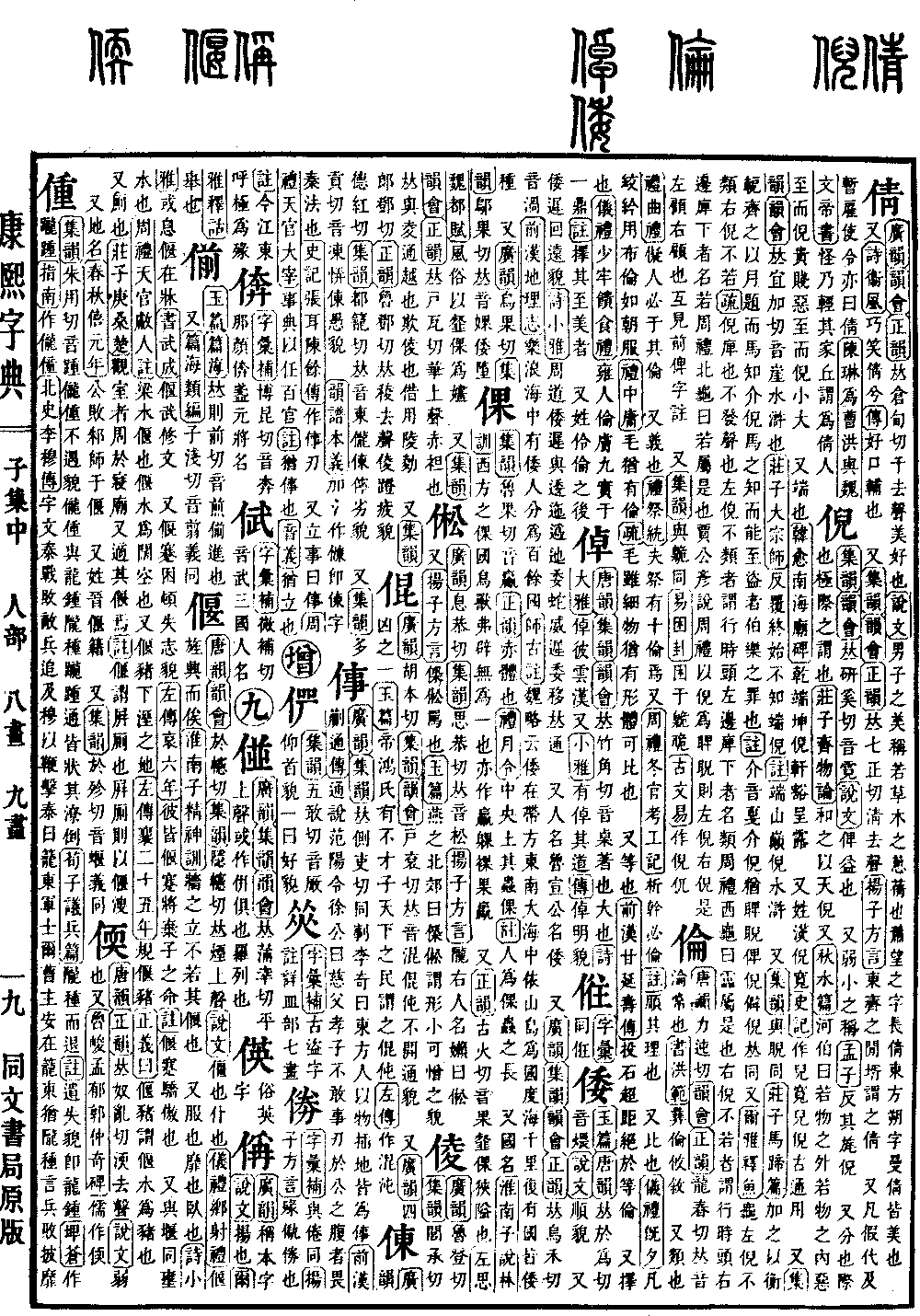
Zi Collection, Middle Volume
Radical: Person (rén)
偃
Kangxi strokes: 11
Page 109, Entry 22
Pronounced yǎn (rising tone).
Shuowen Jiezi (Explanation of Writing): To fall over, to fall prostrate.
Book of Etiquette and Ceremonial (Yili): Lowering the banners then rising to wait.
Huainanzi: It is better for a wall that is upright to fall down.
Also carries the meaning of submitting, lodging, or lying down.
Book of Odes (Shijing): There are those resting and lying on beds.
Book of Documents (Shangshu): Cease military preparations and cultivate civil virtues.
Also appears as "yanjian," referring to the appearance of being distressed or frustrated.
Zuo Zhuan (Zuo Commentary): Those people are arrogant and will discard your orders.
Commentary: Yanjian refers to arrogance.
Also synonymous with "yan," referring to a dam that obstructs water.
Rites of Zhou (Zhouli): A bridge is a dam, obstructing water to form a narrow pass.
Also refers to "yanzhu," meaning low-lying, damp ground.
Zuo Zhuan: Planning for low-lying, damp land.
Corrected Commentary: Yanzhu refers to a pool for water storage.
Also refers to a toilet.
Zhuangzi: The visitor walked around the sleeping quarters and went to the toilet there.
Commentary: Yan refers to a toilet. A toilet is used for urination and defecation.
Also a place name.
Spring and Autumn Annals (Chunqiu): The Duke defeated the army of the State of Zhu at Yan.
Also a surname. There was a Yan Ji in the State of Jin.
Also pronounced tiǎn (rising tone). The meaning remains the same.
Textual research: In the Rites of Zhou, Heaven Offices, commentary, it says "Liang, water yan also, yan water to form a narrow pass." Corrected "broad pass" to "narrow pass" according to the original text.