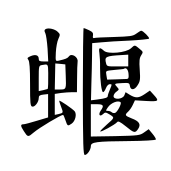
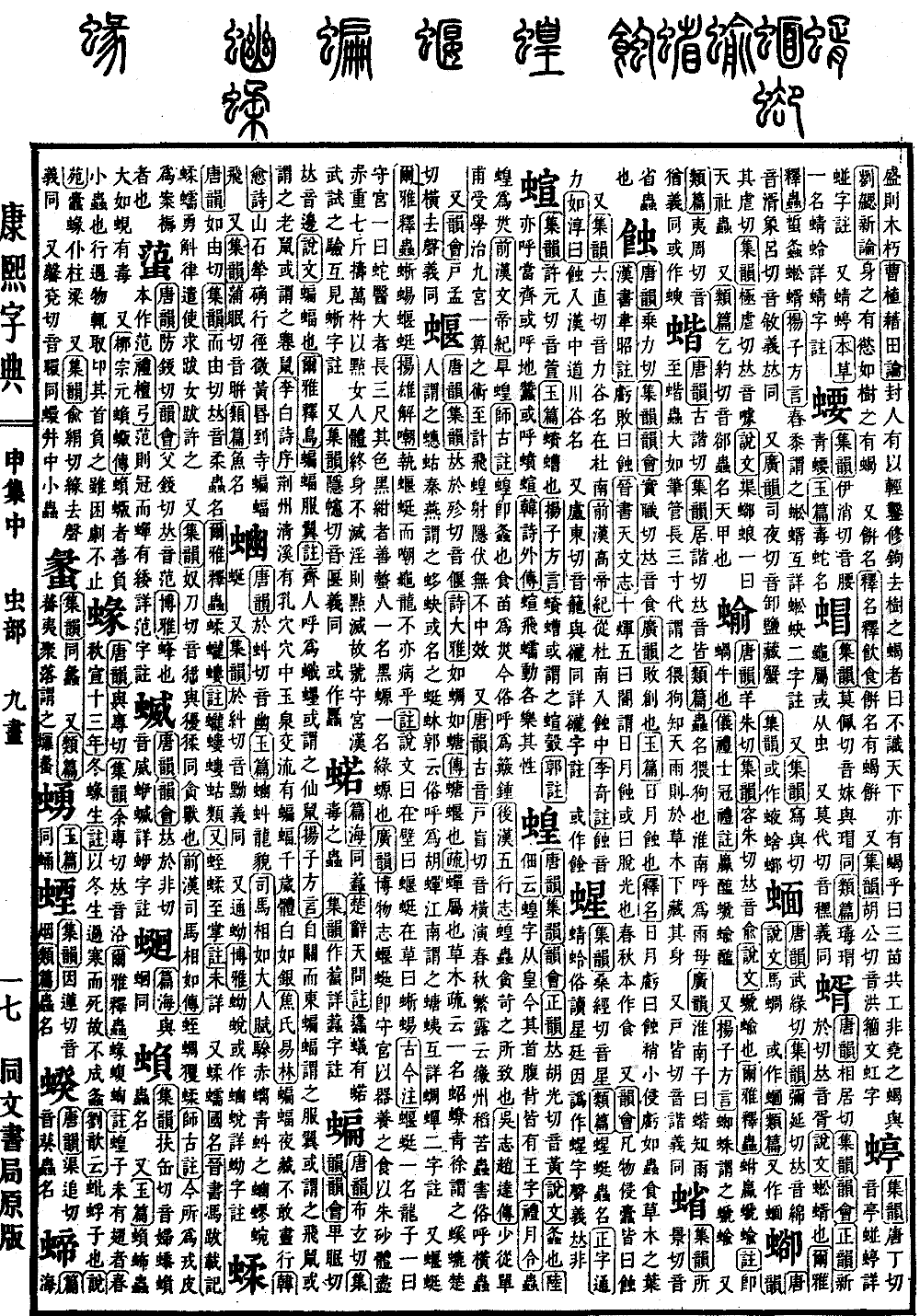
Shen Collection, Middle Volume. Radical: Insect (chóng). Kangxi stroke count: 15. Page 1089, Entry 14.
Pronounced yan (rising tone), same as the pronunciation of yan (rising tone).
Book of Odes (Shijing), Greater Odes (Daya): "Like the cicada, like the tang." The commentary explains: "Tang" is the "yan." The sub-commentary explains: This indicates a type of cicada. The Commentary on Grasses and Trees (Caomu Shu) states: It is also called the tiaoliao. In the regions of Qingzhou and Xuzhou it is called the xiluo; in the region of Chu it is called the huigu; in the regions of Qin and Yan it is called the sheju; it is also called the tingqiu. Guo Pu states: Commonly known as the huchan; in the Jiangnan region it is called the tangyi. For detailed content, please refer to the annotations for the characters tiao and chan.
Also "yanting."
Literary Expositor (Erya), Interpretation of Fishes (Shiyu) records: The lizard is the yanting.
Yang Xiong, Ridicule Explained (Jiechao) states: "To hold a yanting while mocking turtles and dragons, is that not problematic?"
Commentary: The Explaining Graphs and Analyzing Characters (Shuowen Jiezi) states: Those found on walls are called yanting, and those found in grasses are called lizards. The Record of Ancient and Modern Matters (Gujin Zhu) states: The yanting is also called the longzi, also called the shougong, also called the sheyi. Larger ones can grow to three feet in length; the variety with a blackish-red color is the most prone to stinging. It is also called the heiyuan, and also the luyuan.
Expanded Rhymes (Guangyun) cites the Record of Observations of Natural Phenomena (Bowuzhi) stating: The yanting is the shougong. It is kept in a vessel and fed cinnabar until its entire body turns red, weighing up to seven jin. After being pounded ten thousand times, the substance is applied to a woman's body and will never fade for the rest of her life. If the woman engages in illicit sexual relations, it disappears, hence it is called "shougong" (guardian of the palace). Emperor Wu of Han tested this and it was effective. For detailed content, please refer to the annotations for the character xi.
Also, as pronounced in Collected Rhymes: Pronounced yin (rising tone), same as the pronunciation of yan (rising tone). The meaning is the same. Sometimes also written in a variant form (zhuàn).
Verification: Literary Expositor (Erya), Interpretation of Insects (Shichong) states: "Lizard, yanting." This has been carefully revised according to the original text by changing Interpretation of Insects to Interpretation of Fishes.