Yin Collection, Lower Volume
Radical: Broad (guǎng)
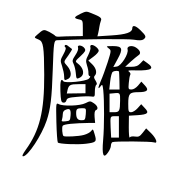
Yong
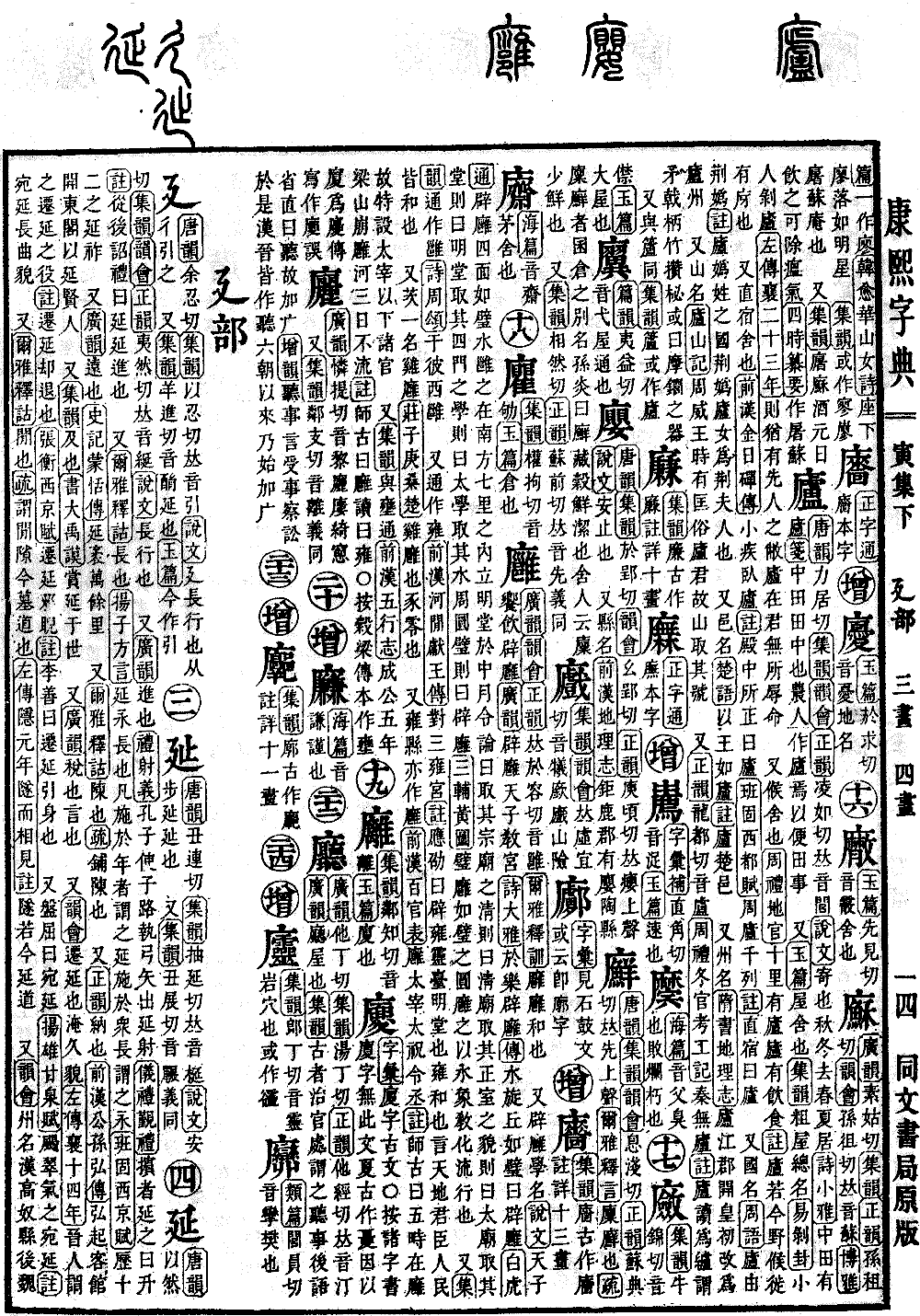
Kangxi strokes: 21
Page 352, Entry 19
Pronounced yong.
Erya: Explanation of Teachings (Erya): Yong yong means harmony. Also, Biyong is the name of a school.
Shuowen Jiezi (Shuowen): A place where the Son of Heaven feasts and drinks at Biyong.
Guangyun (Guangyun): Biyong is the teaching palace of the Son of Heaven.
Book of Odes (Shijing), Greater Odes: In the music of Biyong.
Commentary: Water circling a mound like a jade disk is called Biyong.
White Tiger Hall Discussions (Baihu Tong): Biyong is shaped like a jade disk on all four sides, surrounded by water; it is located within seven miles of the south, with the Hall of Enlightenment (mingtang) established in the center. The Monthly Ordinances (Yueling) discussions state: when referring to the purity of the ancestral temple, it is called the Pure Temple. When referring to the appearance of the main hall, it is called the Great Temple. When referring to the hall itself, it is called the Hall of Enlightenment. When referring to the schools at the four gates, it is called the Great School. When referring to the water circling like a round jade disk, it is called Biyong.
Sanfu Huangtu (Sanfu Huangtu): Biyong is round like a jade disk, surrounded by water, symbolizing the spread of education and transformation.
Also, Jiyun (Jiyun): Commonly written as yong.
Book of Odes (Shijing), Odes of Zhou: At that western yong.
Also commonly written as yong.
Book of Han (Hanshu), Biography of Prince Xian of Hejian: Regarding the three yong palaces.
Commentary: Ying Shao says Biyong, Lingtai, and the Hall of Enlightenment. Yong means harmony; it means that heaven, earth, ruler, ministers, and the people are all in harmony.
Also, ci (a type of herb) is also called jiyong.
Zhuangzi: The Gengsangchu chapter: Jiyong is a type of herb, shiling is another.
Also, Yong County. Also written as yong.
Book of Han (Hanshu), Table of Officials: Yong, the Grand Butcher and Grand Invoker, with their assistants and clerks.
Commentary: Yan Shigu says the five altars are located in Yong, so special officials such as the Grand Butcher and others were established.
Also, Jiyun (Jiyun): Interchangeable with yong (to obstruct).
Book of Han (Hanshu), Treatise on the Five Elements: In the fifth year of Duke Cheng, Mount Liang collapsed, obstructing (yong) the river for three days without flowing.
Commentary: Yan Shigu says yong is read as yong. Note: In the Guliang Commentary to the Spring and Autumn Annals (Guliang Zhuan), it is originally written as yong (to obstruct).