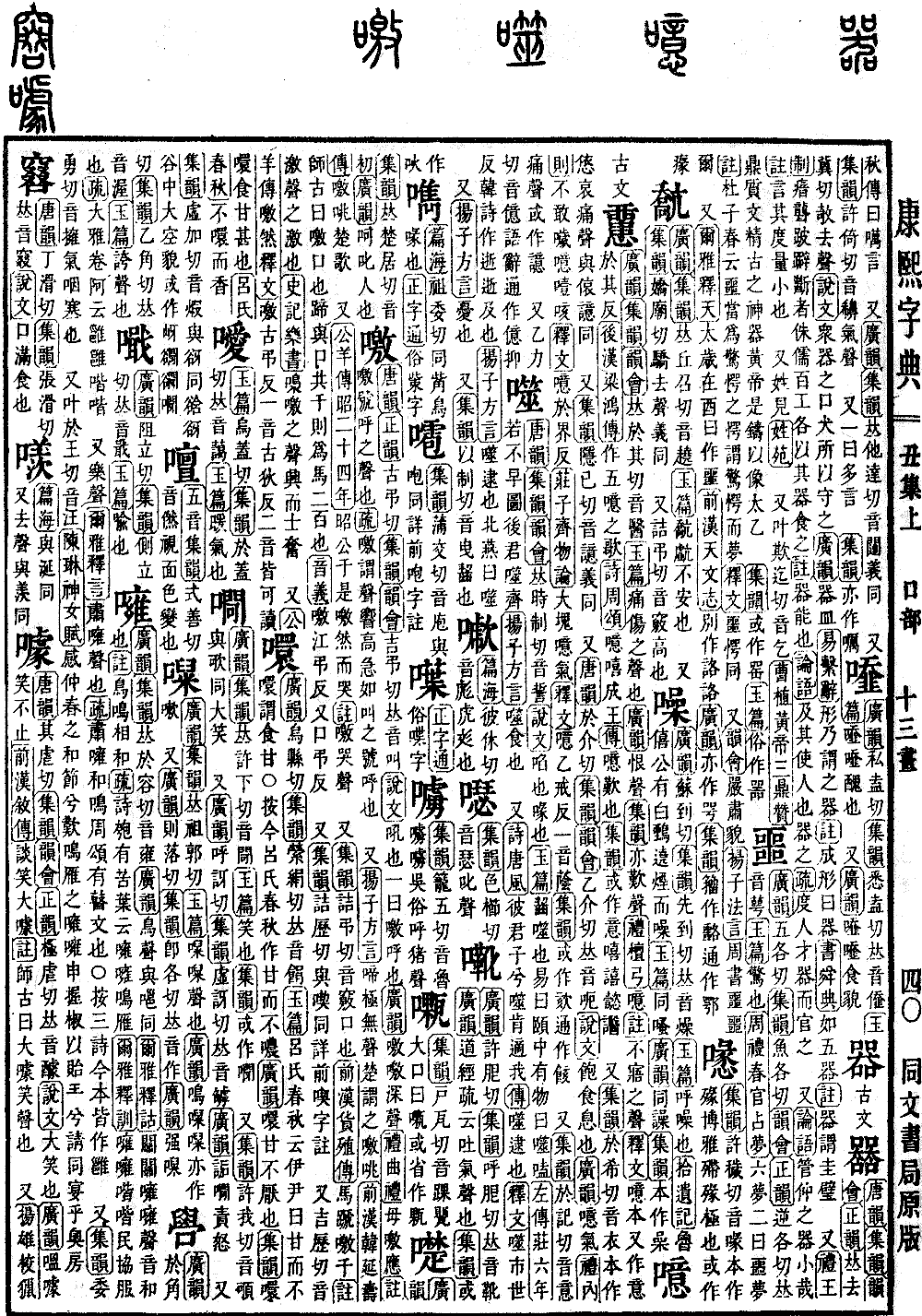
Chou Collection, Upper Volume
Radical: Mouth (kǒu)
16 strokes
Page 210, Entry 28
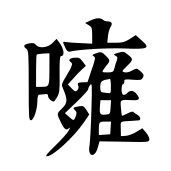
According to the Broad Rhymes of Guangyun (Guangyun) and the Compilation of Rhymes (Jiyun), it is pronounced yong.
According to the Broad Rhymes of Guangyun (Guangyun), it refers to the sound of birds calling. It is identical to the character for birdsong (yong).
In the Erya (Erya) chapter on explaining ancient terms, the phrase guan guan yong yong refers to harmonious sounds.
The commentary notes this refers to the birds calling and responding to one another.
The sub-commentary notes that the Classic of Poetry (Shijing) in the section on the Gourd has bitter leaves says: The wild geese call yong yong.
In the Erya (Erya) chapter on explaining instructional terms, yong yong jie jie refers to the people living in harmony and obedience.
The sub-commentary notes that the Greater Odes of the Kingdom (Daya) in the chapter on the Curving Slope says: The sounds are yong yong and jie jie.
It also refers to the sound of music.
In the Erya (Erya) chapter on explaining words, su yong refers to sound.
The sub-commentary notes that su yong harmonious singing appears in the Odes of Zhou (Zhousong) in the chapter on the blind musicians.
Note: The current versions of these three poems all use the variant character yong.
Also, according to the Compilation of Rhymes (Jiyun), it is pronounced yong. It refers to the breath being choked or blocked.
Also pronounced wang as a rhyme.
In the Rhapsody on the Goddess (Shennü Fu) by Lin, it is written: Sensing the harmonious season of mid-spring, I sigh at the yong yong sound of the calling wild geese. Holding pepper in my hand to offer, I request a banquet in the inner chamber.