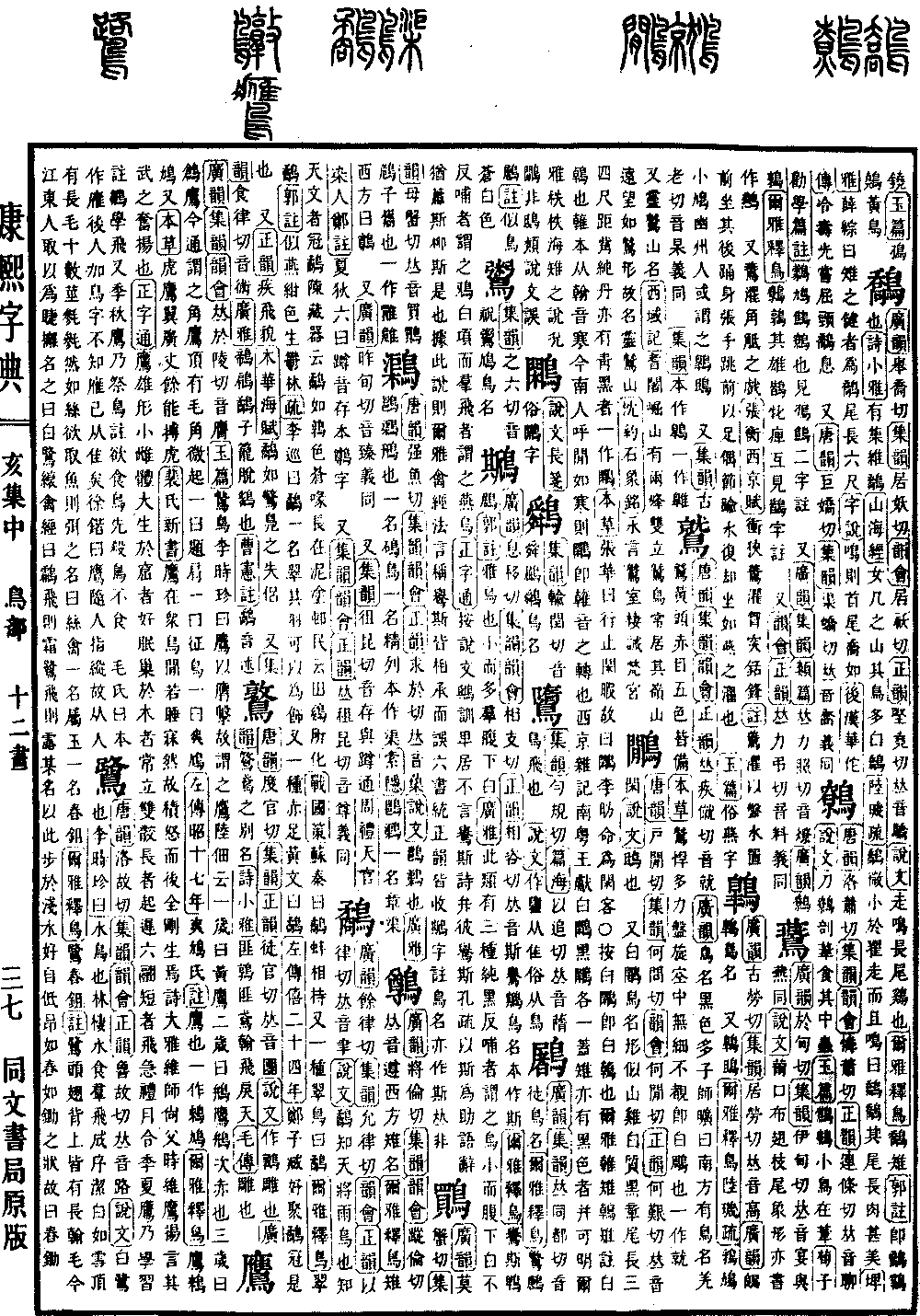
Hai Collection, Middle Volume
Radical: Bird (niǎo)
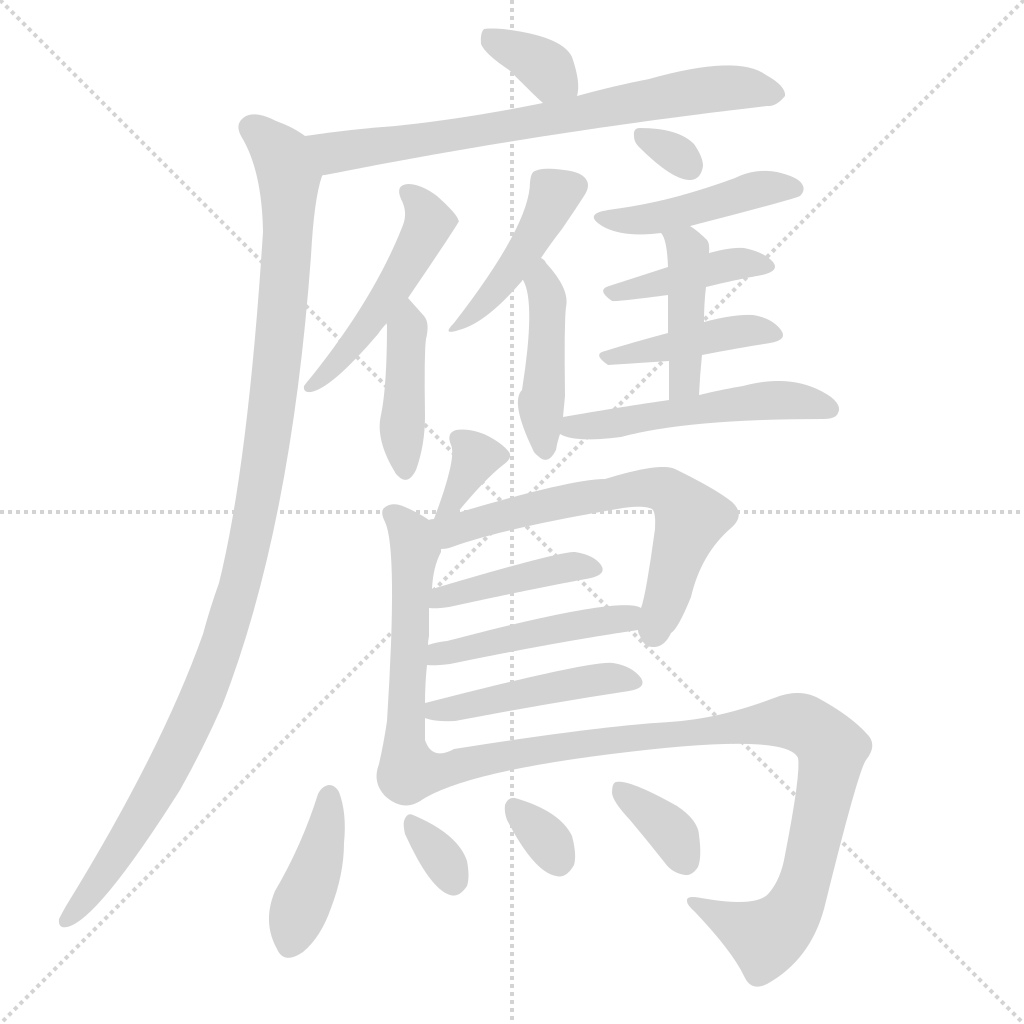
Eagle; Kangxi strokes: 23; Page 1501, Entry 18
Guangyun (Broad Rhymes), Jiyun (Combined Rhymes), Yunhui (Collection of Rhymes): Pronounced yīng.
Yupian (Jade Chapters): A bird of prey. Li Shizhen says: The eagle strikes with its breast, which is why it is called ying (eagle). Lu Dian says: A one-year-old is called a yellow eagle, a two-year-old is called a tia eagle; tia means approaching red. A three-year-old is called a cang eagle; nowadays they are generally called horned eagles, as they have slightly protruding tufts of hair on their heads. One type is called the shoulder-staring bird, one is called the expedition bird, and one is called the shuangjiu.
Zuo Zhuan (Chronicle of Zuo), 17th Year of Duke Zhao: The shuangjiu clan. Note: This refers to the eagle, also written as the ljiu.
Erya (Approaching Elegance), Interpretation of Birds: The eagle is the ljiu.
Also, Bencao (Compendium of Materia Medica): The tiger eagle has a wingspan of over ten feet and can fight and kill tigers.
Pei Shi Xin Shu (Master Pei’s New Book): Among all birds, the eagle appears as if it is sleeping, which allows it to store up its rage and unleash its full ferocity.
Book of Odes (Shijing), Greater Odes: He is the Great Master Shangfu, a force as the eagle soars. This describes the rising and flourishing of his martial prowess.
Zhengzitong (Correction of Character Mastery): The male eagle is smaller than the female. Those born in caves like to sleep; those that nest in trees often stand. Those with long shanks rise slowly; those with short primary feathers fly swiftly.
Book of Rites (Liji), Monthly Ordinances: In the last month of summer, the eagle begins to learn to fly. Note: This refers to the young bird learning to fly. It also records that in the last month of autumn, the eagle kills birds as an offering. Note: When it desires to eat, it kills the bird first without immediately consuming it.
Master Mao says: Originally written as the character for eagle, later generations added the bird radical, not realizing it was already derived from the bird (zhui) character. Xu Kai says: The eagle can follow the commands of a person, which is why the character is formed with the component for person.