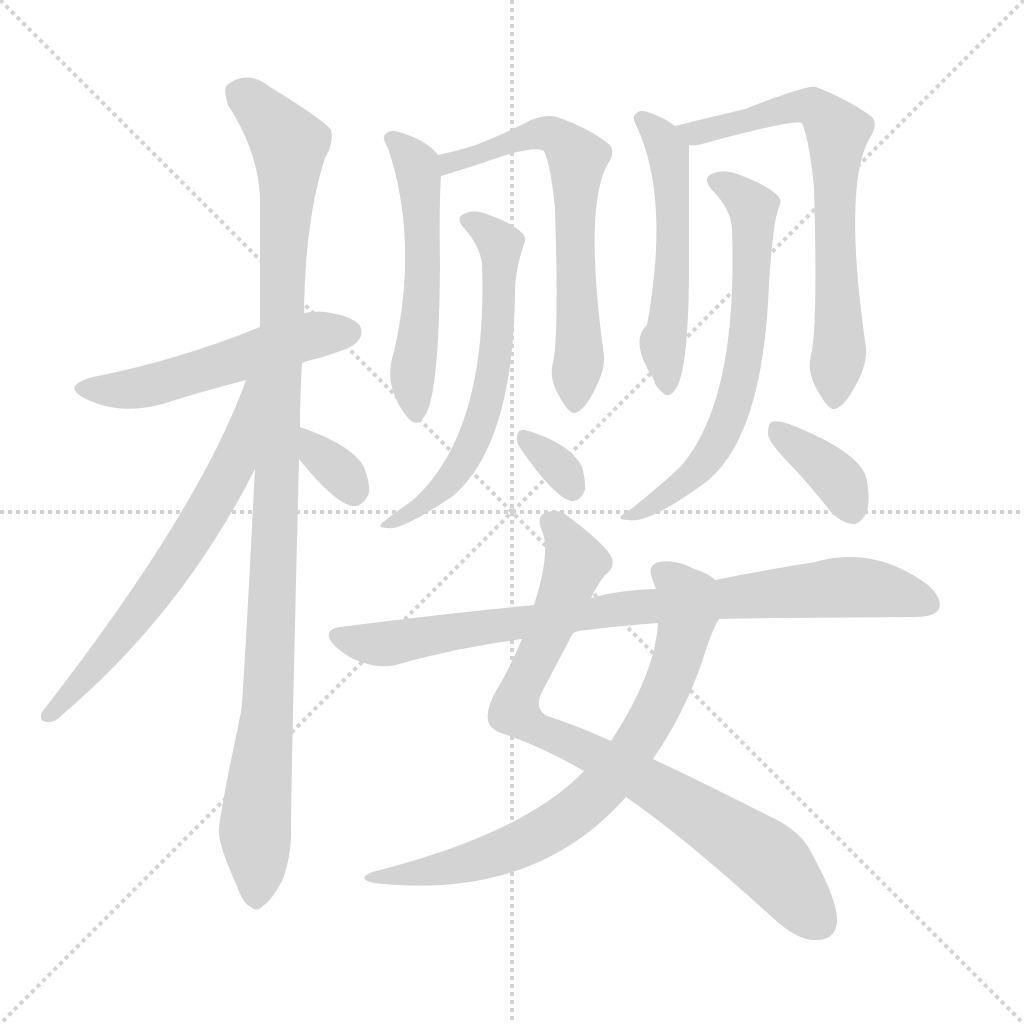
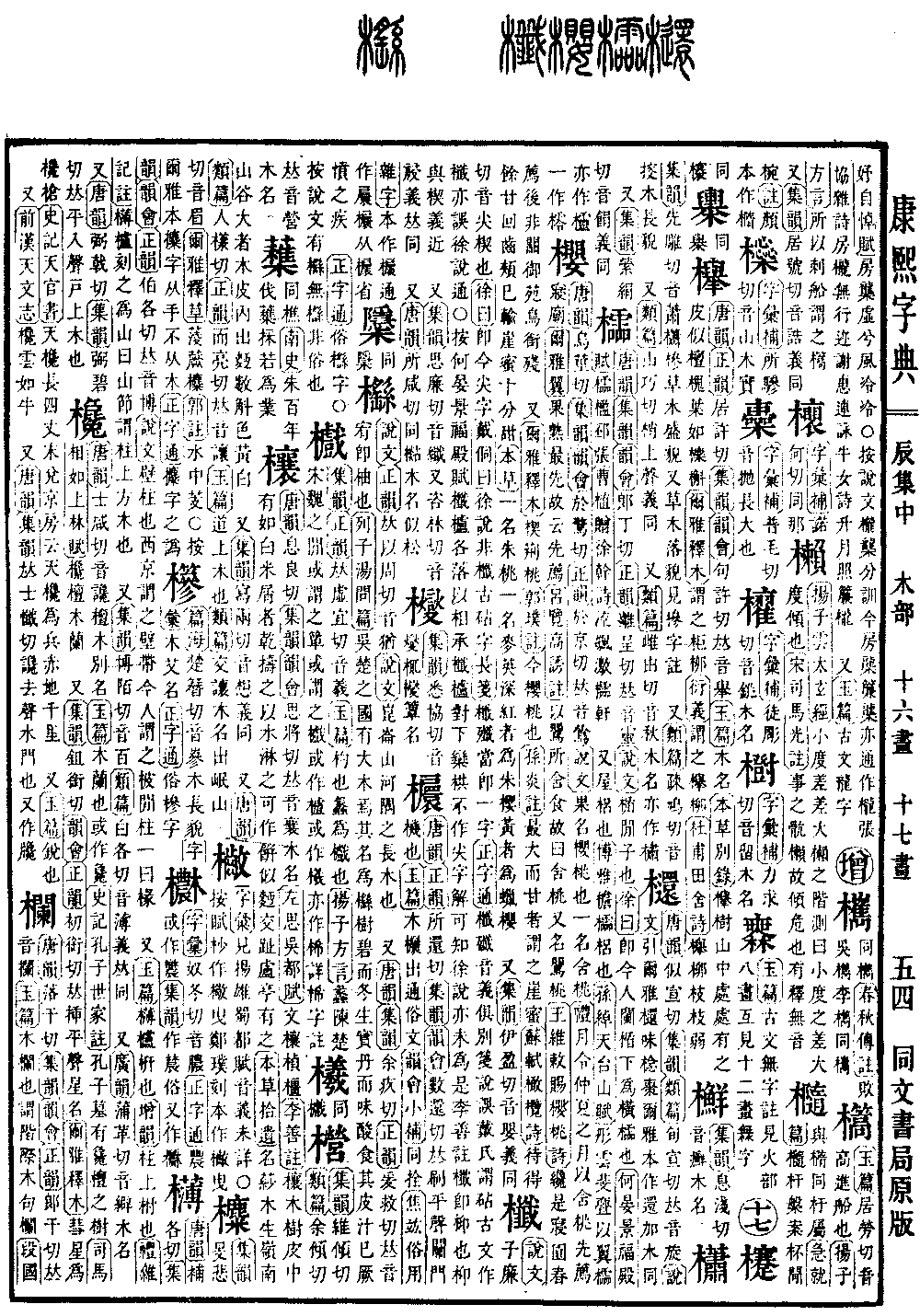
Chen Collection, Middle Volume. Radical: Tree (mù). Kangxi stroke count: 21. Page 562, Entry 01.
Pronounced ying.
According to the Explaining Graphs and Analyzing Characters (Shuowen Jiezi), it is the name of a fruit, the cherry. Another name for it is hantao.
According to the Book of Rites (Liji), in the month of midsummer, one offers hantao as the first seasonal sacrifice to the ancestral temples. According to the Erya Yi, this fruit ripens earliest, which is why it is said to be offered first. The commentary by Gao You on the Lu's Springs and Autumns (Lüshi Chunqiu) states that because orioles contain them in their beaks to eat, they are called hantao. It is also known as yingtao. A poem by Wang Wei titled Poem on Imperial Gifted Cherries says: Just after it is offered in the spring at the imperial ancestral temple, it is not merely leftovers left by birds in the imperial garden.
Also, according to the Erya (Er Ya), in the section explaining trees, the xie is the jingtao. Guo Pu comments that this is the current cherry. Sun Yan comments that the largest and sweetest variety is called yamit. Su Shi in his poem on olives writes: By the time the lingering sweetness returns to the teeth and cheeks, it has already lost to the yamit in sweetness by ten parts.
According to the Compendium of Materia Medica (Bencao), it is also called zhutao and maiying. The deep red variety is called zhuying, and the yellow variety is called laying.
Pronounced ying. The meaning is the same.
Textual research: In the Book of Rites (Liji), in the month of midsummer, it should read as offering hantao first in the ancestral temples. We have carefully added the character xiu according to the original text.