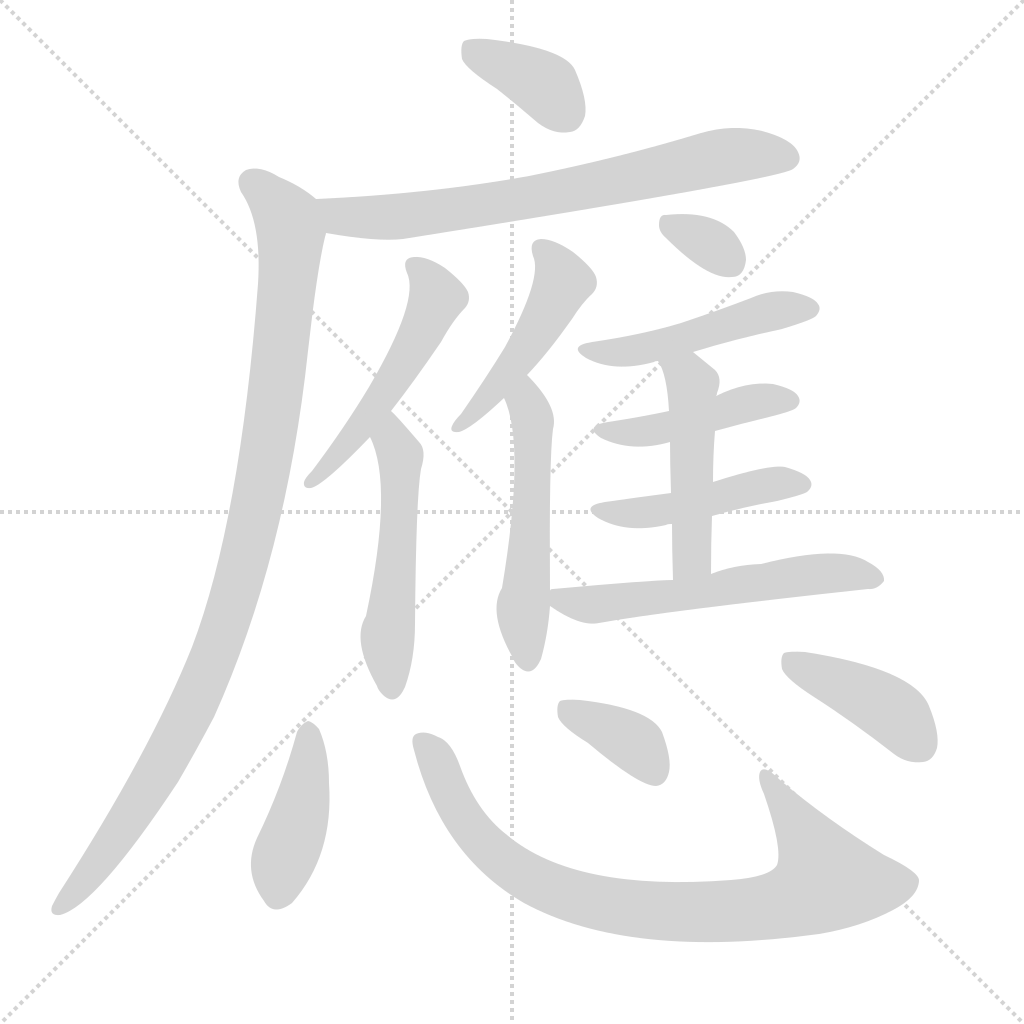
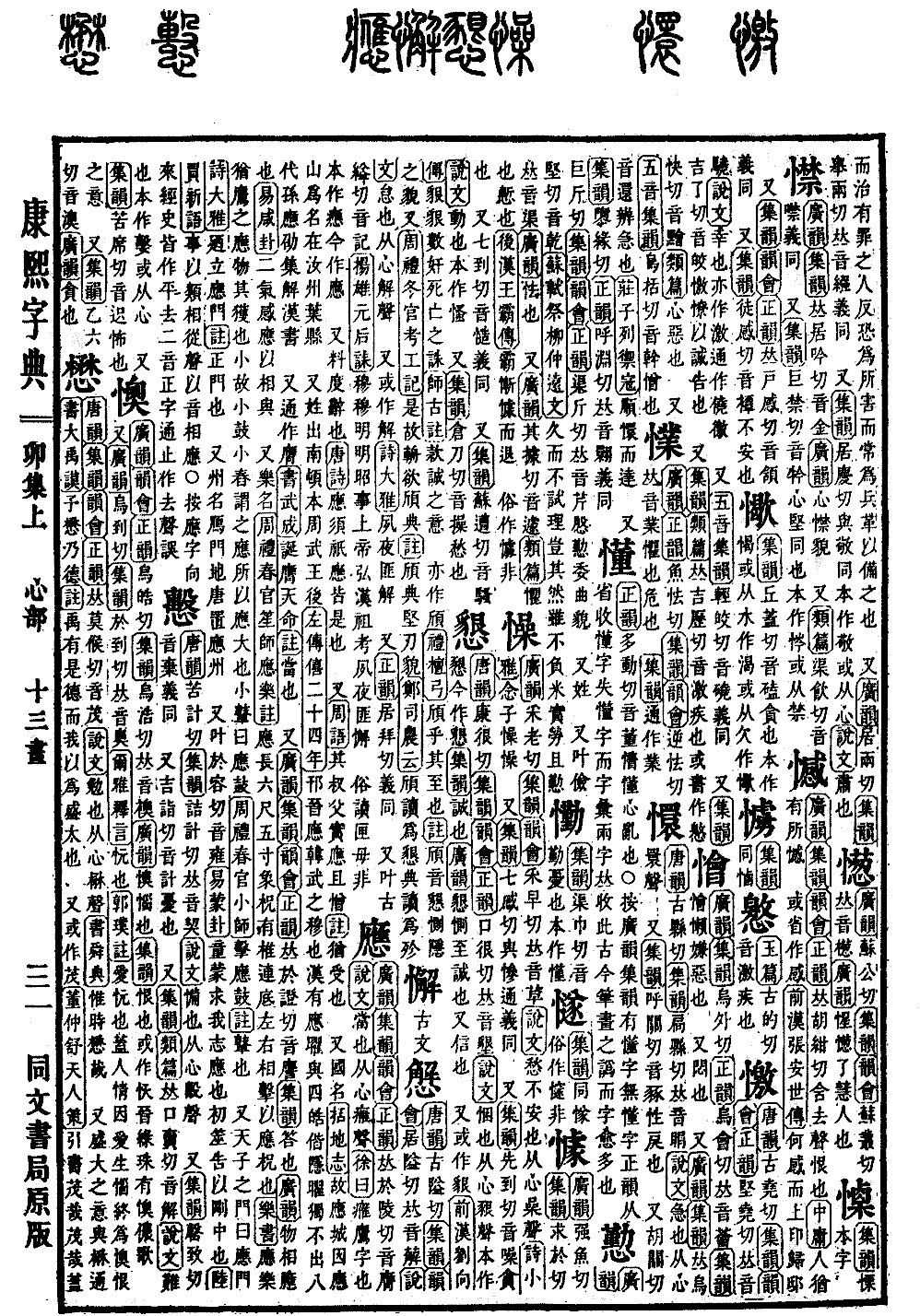
Mao Collection, Upper Volume
Radical: Heart (xīn)
Kangxi Strokes: 17
Page 405, Entry 21
Broad Rhymes (Guangyun), Collected Rhymes (Jiyun), Rhyme Meetings (Yunhui), and Orthodox Rhymes (Zhengyun) define this as ying (level tone).
Explaining Graphs and Analyzing Characters (Shuowen Jiezi): To be fitting. Derived from the heart radical, with a phonetic indicator.
Xu states: This is the character for hawk. Originally written as a different form, now written as ying. Also used as a particle for estimation or anticipation.
Tang Poetry: Used in phrases such as must, or only expected to be, both examples of this usage.
Discourses of the States (Zhouyu): His uncle truly accepted it and hated it.
Commentary: This means to receive.
Also a state name.
Records of Geography (Kuodizhi): The former city of Ying, named after Mount Ying, is located in Ye County of Ruzhou.
Also a surname. Originating from Nandun, originally descendants of King Wu of Zhou.
Zuo Tradition (Zuo Zhuan): The states of Han, Jin, Ying, and Han were the descendants of King Wu. During the Han Dynasty, there was Ying Yao, who lived in seclusion with the Four White-Haired Sages; Yao alone did not emerge. His eighth-generation descendant was Ying Shao, who compiled the Collected Explanations of the Book of Han (Hanshu).
Also used interchangeably with ying (chest/to bear).
Book of Documents (Shujing): Truly accepting the mandate of Heaven.
Commentary: This means to be fitting.
Also from Broad Rhymes (Guangyun), Collected Rhymes (Jiyun), Rhyme Meetings (Yunhui), and Orthodox Rhymes (Zhengyun), pronounced ying (departing tone).
Collected Rhymes (Jiyun): To respond.
Broad Rhymes (Guangyun): Things responding to one another.
Book of Changes (Yijing): The two qi (vital energy) sense and respond to each other to unite.
Also the name of an instrument.
Rites of Zhou (Zhouli): The ying instrument is six feet five inches long, resembling a zhu (wooden percussion instrument). It has a pestle connected to the bottom, which is struck from left to right to respond to the zhu.
Book of Music (Yueshu): The ying music is like a hawk responding to prey; its capture is small, thus small drums and small mortars are called ying, as they serve to respond to the large. A small drum is called an ying drum.
Rites of Zhou (Zhouli): Striking the ying drum.
Commentary: This refers to a small drum.
Also, the gate of the Son of Heaven is called the ying gate.
Book of Odes (Shijing): Then the ying gate was established.
Commentary: This is the main gate.
Also a prefecture name. Located in the Yanmen region, established as Ying Prefecture during the Tang Dynasty.
Also rhymes with rong (level tone), pronounced yong (level tone).
Book of Changes (Yijing): The ignorant youth seeks me, as his will is responding. The first divination provides the answer, because it is firm and centered.
New Discourses (Xinyu) by Lu Jia: Affairs follow one another by category, and sounds respond to one another by tone.
Note: Regarding the character ying, throughout historical classics, it has always been used with both level and departing tones. The Orthodox Character Mastery (Zhengzitong) restricts it only to the departing tone, which is an error.