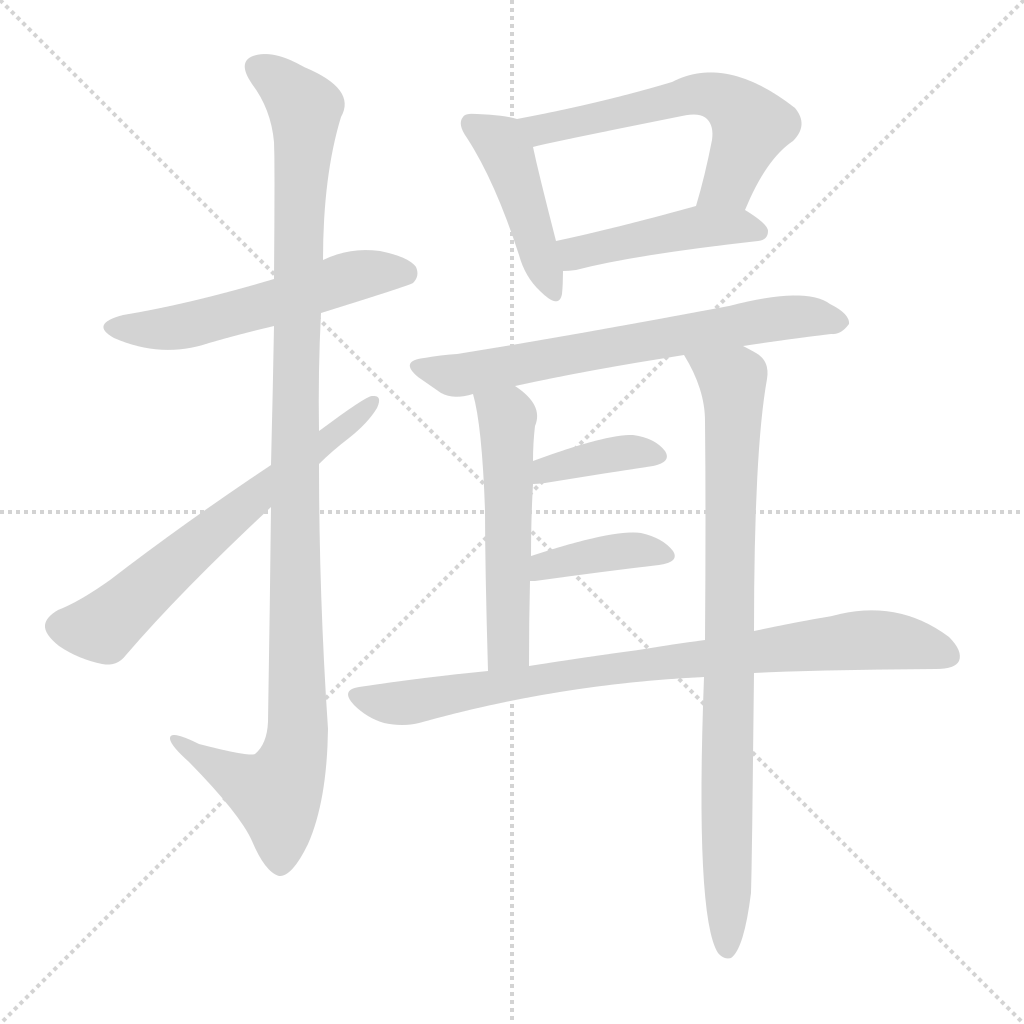
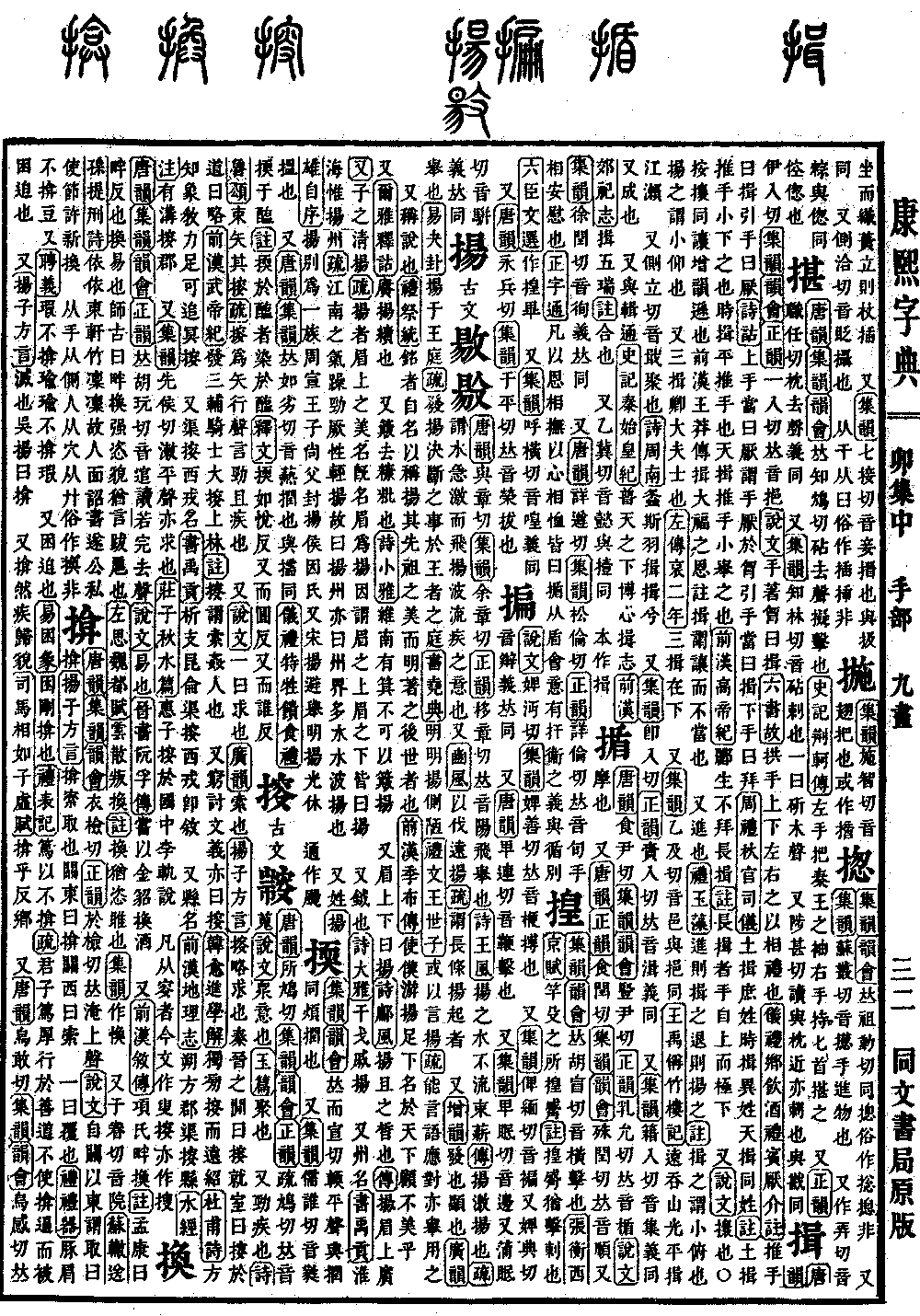
Mao Collection, Middle Volume
Radical: Hand (shǒu)
Kangxi stroke count: 13
Page 442, Entry 04
Pronounced yi (falling tone).
According to the Shuowen Jiezi, to place the hands against the chest is called yi.
According to the Liushu Gu, it is the act of bowing with hands clasped, moving them up, down, left, or right to perform a rite.
According to the commentary on the Guest and Assistant of Honor in the Book of Etiquette and Ceremonial (Yili), extending the hands is called yi, and drawing the hands back is called yan.
According to the Shigugu, to hold the hands up at the chest is called yan, meaning the hands are pressed against the chest; to draw the hands forward is called yi; and to lower the hands is called bai.
According to the Rites of Zhou (Zhouli), Office of the Autumn, Minister of Rites, for various surnames one performs a earth-bow (tuyi), meaning the hands are pushed forward and lowered slightly; for different surnames one performs a timely-bow (shiyi), meaning the hands are pushed forward horizontally; for kin of the same surname one performs a heaven-bow (tianyi), meaning the hands are pushed forward and raised slightly.
According to the Annals of Emperor Gao in the History of the Former Han (Hanshu), Li Sheng did not perform a deep bow (changyi) while standing. The commentary states that a deep bow is where the hands move from high to low.
It also means to yield. The Zengyun dictionary notes it means to be humble. In the Biography of Wang Mang in the History of the Former Han, it is used in the sense of yielding without accepting.
It also means to advance. According to the Book of Rites (Liji), Jade Beads, when advancing one bows, and when retreating one raises the hands. The commentary notes that bowing means to bow slightly, and raising the hands means to look up slightly.
It also refers to the three bows performed by high officials and gentlemen. According to the Zuo Commentary to the Spring and Autumn Annals (Zuo Zhuan), there were three bows at the lower position.
Pronounced yi (falling tone). Same as the character meaning to scoop or ladle. In the Zhulou Ji by Wang Yucheng, it describes drinking in the mountain light from afar and welcoming the river rapids.
Pronounced ji (entering tone). To gather. According to the Book of Odes (Shijing), the wings of the locusts are gathered together.
Pronounced ji (entering tone). Meaning the same as above.
Pronounced ji (entering tone). Meaning the same as above.
It also means to complete. It is also used interchangeably with the character for to assemble. According to the Annals of Qin Shi Huang in the Records of the Grand Historian (Shiji), the whole world united their hearts and gathered their intentions. According to the Treatise on the Suburban Sacrifices in the History of the Former Han, it refers to gathering the five types of jade tablets, meaning to bring them together.
Pronounced yi (falling tone). Same as the character meaning to bow. Originally written as yi.
Verification: In the Annals of Qin Shi Huang in the Records of the Grand Historian, the text reads to unite their hearts and gather their intentions. The original text has been corrected from the variant character to the proper character.