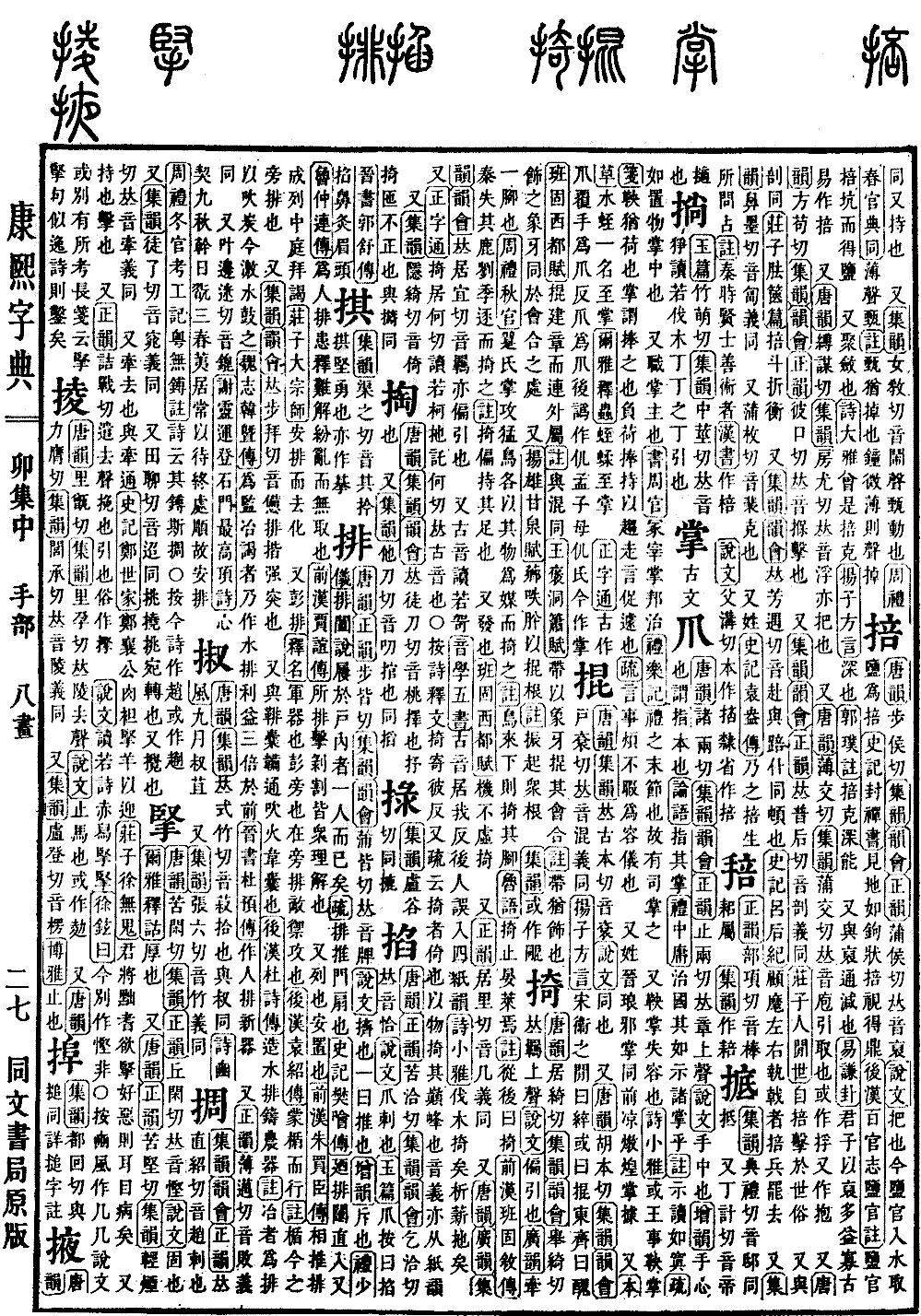
Mao Collection, Middle Volume
Radical: Hand (shǒu)
Kangxi Strokes: 12
Page 437, Entry 19
Pronounced yi (falling tone).
Shuowen (Explaining Graphs and Analyzing Characters): To use one's hands to grab a person by the arm and throw them to the ground. Also refers to assisting or supporting someone.
Book of Odes (Shijing), Preface to the Hengmen Poem: To guide and assist one's ruler. Commentary: To lead from the front is to guide; to support from the side is to assist.
Zuo Zhuan (Zuo Tradition), 25th Year of Duke Xi: Two officials followed the son of the state to inspect the city walls, grasping him and throwing him outside the city. Commentary: Seized him and threw him outside the city.
Also, per Shuowen, it refers to the area under the arm. It is identical to the character for armpit.
Book of Rites (Liji), Rites of the Scholars: Wearing clothing with wide sleeves. Commentary: Feng means large. It refers to a garment with voluminous sleeves.
Records of the Grand Historian (Shiji), Biography of Shang Yang: One thousand sheepskins are not as good as the fur from the armpit of a single fox.
Furthermore, chambers located beside the imperial palace are called the armpit chambers (yetíng); the walls beside the palace are called armpit walls (yèyuán); the small side gates flanking the palace gates are called the left and right armpit gates (yèmén). All take their meaning from the area under the arm.
Book of Han (Hanshu), Table of Officials and Ministers: Emperor Wu of Han renamed the Yongxiang palace area to the Armpit Chambers (Yetíng).
Also, in the Annals of Emperor Cheng: Trespassed into the Shangfang armpit gate. Commentary: The armpit gates are on both sides, just like the area beneath a person's arms.
Du Fu's poetry: At twilight, the armpit walls appear and disappear among the flowers.
Also, names of commanderies and counties.
Book of Han (Hanshu), Treatise on Geography: Zhangye Commandery. Commentary: To spread open the arms of the state, hence it is called Zhangye.
Also: Ye County in Donglai Commandery.
Yunhui (Collection of Rhymes): The characters for assist (ye) and armpit (ye) were originally the same character. Now, the character for assist (ye) is written with the hand radical, and the character for armpit (ye) is written with the moon (flesh) radical. However, in ancient times, the character for armpit was originally written as yi, not with the moon (flesh) radical.