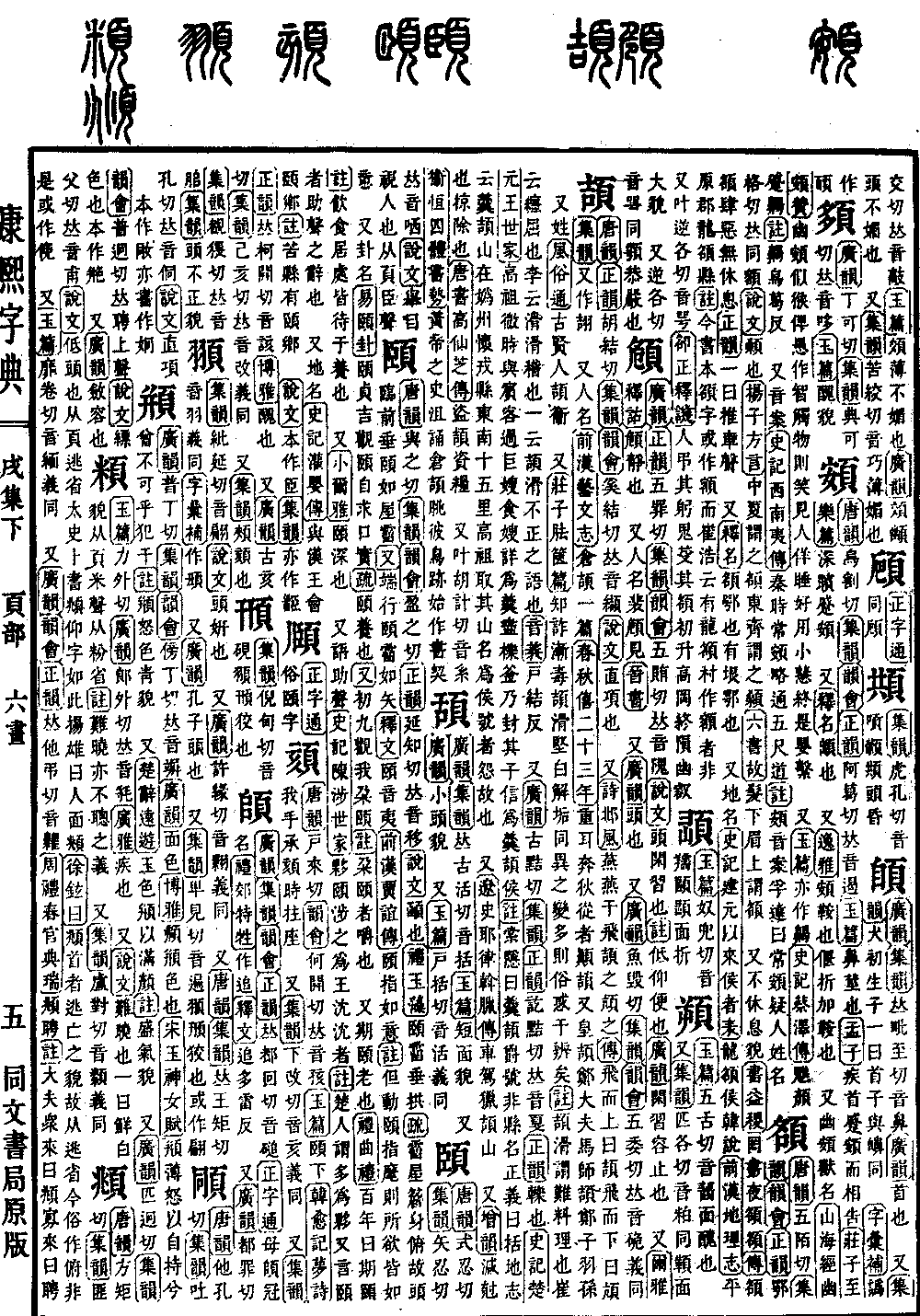
Xu Collection, Lower Volume
Radical: Leaf (yè)
Kangxi Strokes: 15
Page 1403, Entry 01
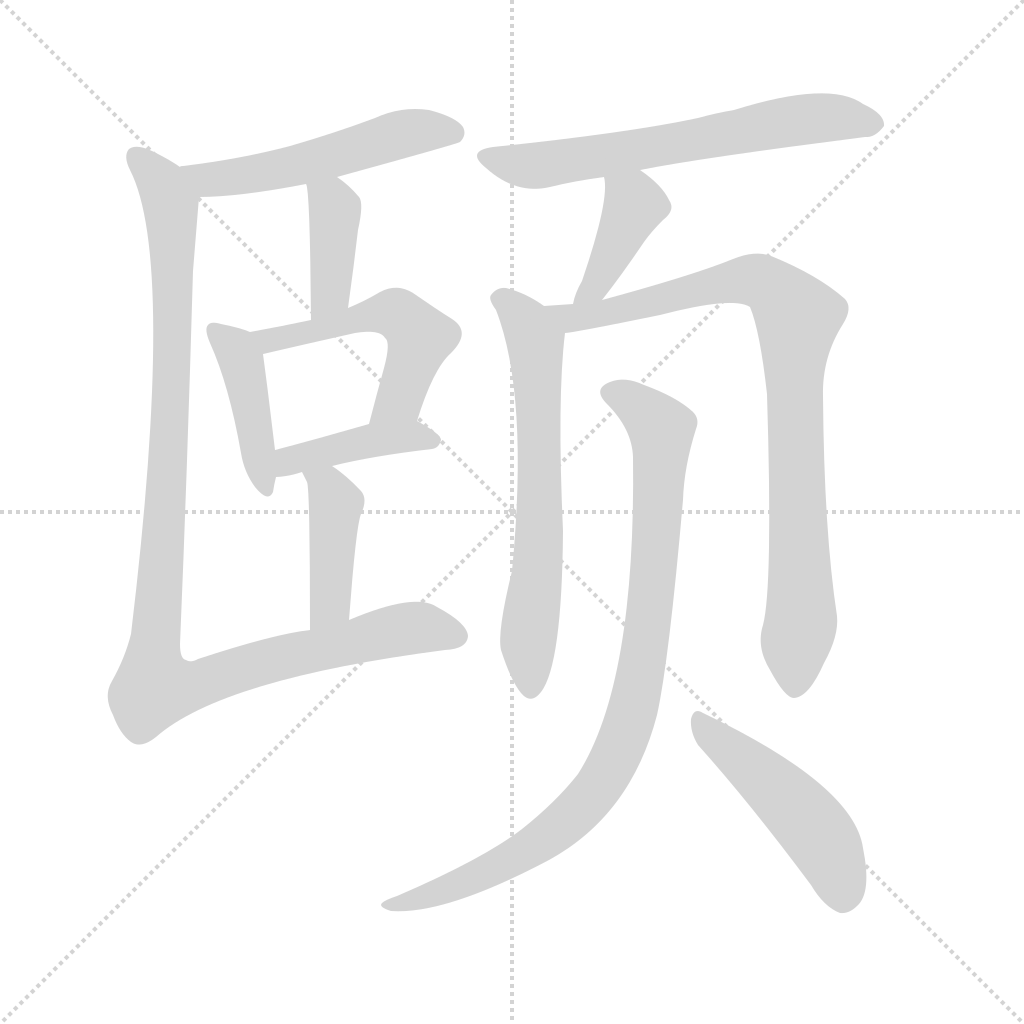
Pronounced yi.
Shuowen Jiezi (Shuowen): The chin.
Book of Rites (Liji): With the chin hanging like a roof eave, the body is bowed. Commentary: The eave is the edge of a roof; the body is bowed forward so the head faces front, and the chin hangs down like a roof eave. Also: Walk with a straight bearing, with the chin hanging like an arrow.
Explanation of Text (Shiewen): Pronounced yi.
History of the Former Han (Qianhan): With a movement of the chin, one gets one's wish. Commentary: One merely moves the chin to gesture, and everything desired is accomplished.
Also a hexagram name. Book of Changes (Yijing): The Yi hexagram. Yi means to nourish. Also: Initial nine, observing my moving jaws. Commentary: Moving jaws means chewing.
Also qi-yi, meaning old age. Book of Rites (Liji): One hundred years is called qi-yi. Commentary: At this age, food, drink, and daily life all depend on being nourished.
Also Small Erya (Xiao Erya): Yi means deep.
Also a sentence-final particle. Records of the Grand Historian (Shiji): Huo yi, She's being king is quite something. Commentary: People of Chu use huo to mean many. Yi is a modal particle.
Also a place name. Records of the Grand Historian (Shiji): Met with the King of Han at Yi Township. Commentary: In Ku County there is an Yi Township.
Shuowen Jiezi (Shuowen): Originally written as a variant form. Also written in a variant form (ji).