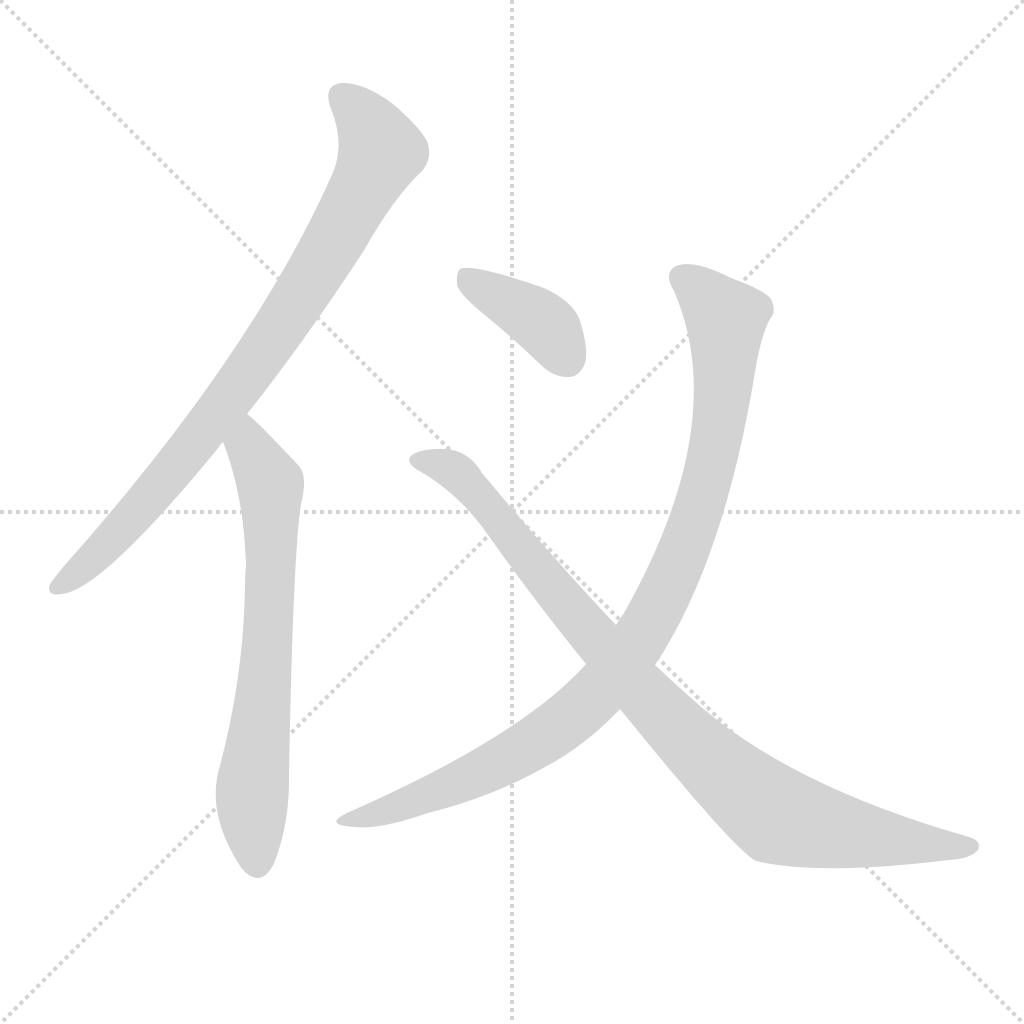
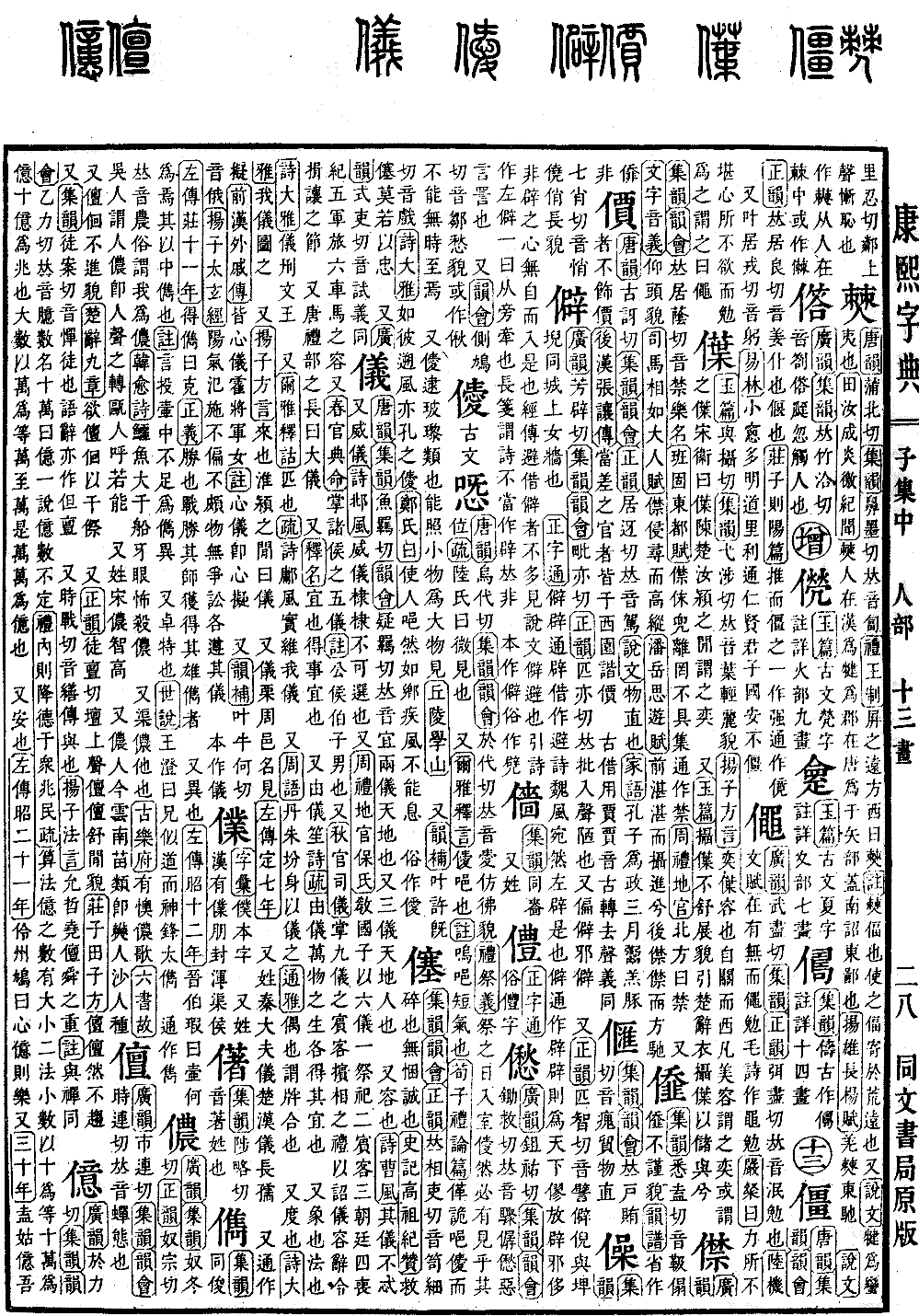
Zi Collection, Middle Volume Radical: Person (rén) Yi; Kangxi stroke count: 15; page 118.
Tangyun (Tangyun), Jiyun (Jiyun): Pronounced yi.
Yunhui (Yunhui): Pronounced yi.
The two manifestations of the universe, referring to Heaven and Earth. Also the three manifestations, referring to Heaven, Earth, and Man. Also refers to demeanor or outward appearance.
Book of Odes (Shijing), Cao Feng section: His demeanor and appearance had no faults.
Also refers to a majestic and dignified manner.
Book of Odes (Shijing), Bei Feng section: A majestic manner that is calm and composed, which must not be treated with levity.
Book of Rites (Liji), Earth Official, Bao Shi section: Teaching the sons of the state six types of demeanor: first is the demeanor during sacrificial rites; second is the demeanor when receiving guests; third is the demeanor at the imperial court; fourth is the demeanor during funeral rites; fifth is the demeanor while on a military campaign; sixth is the demeanor during the travel of carriages and horses.
Book of Rites (Liji), Spring Official, Dian Ming section: In charge of the five grades of ritual ceremony for the feudal lords. Commentary: Refers to the dukes, marquises, counts, viscounts, and barons.
Book of Rites (Liji), Autumn Official, Si Yi section: In charge of the etiquette for meetings between guests within the nine grades of ceremony, and communicating the standards for demeanor, speech, and bowing.
Also, the official in charge of the Ministry of Rites during the Tang dynasty was called the Great Yi.
Shiming (Shiming): Means suitable. Refers to doing things appropriately and correctly.
Youyi, a poem in the Xiao Ya section of the Book of Odes (Shijing). Preface: Youyi describes all things growing and each obtaining what is appropriate for it.
Also refers to a model or standard.
Book of Odes (Shijing), Da Ya section: Emulate King Wen.
Erya (Erya), Shigu section: Means to match or pair. Commentary: In the Yong Feng section of the Book of Odes (Shijing), the word yi in the phrase "he is truly my match" means to match.
Discourses of the States (Guoyu): Dan Zhu relied on himself to match it.
Tongya (Tongya): Means spouse. Refers to two halves joining together.
Also refers to conjecture or consideration.
Book of Odes (Shijing), Da Ya section: I conjecture and consider it.
Yangzi Fangyan (Yangzi Fangyan): Means to come. In the region between the Huai River and the Ying River, the word yi is used to mean to come.
Yili, a place name from the Zhou dynasty. Found in the Zuo Commentary (Zuo Zhuan), seventh year of Duke Ding.
Also a surname. During the Qin state, there was a grand officer named Yi Chu; during the Han dynasty, there was Yi Changru.
Also interchangeable with the character ni (to compare/emulate).
History of the Former Han (Qian Han Shu), Biography of Imperial Relatives: In their hearts, they all favored the daughter of General Huo. Commentary: Heart-yi means heart-ni (a heartfelt yearning or inclination toward).
Yunbu (Yunbu): Rhymes with the sound e.
Yangzi Taixuan Jing (Yangzi Taixuan Jing): The Yang energy is widely distributed, neither leaning nor slanting. All things have no contention, each following its own standards. The original character is written as [variant form].
Textual Research: Regarding Youyi, a Sheng poem. Commentary: Youyi says all things grow and each obtains its own suitability. Note: This is the preface to the poem. The commentary text has been corrected to refer to the preface. Regarding Discourses of the States (Guoyu), Dan Zhu relied on himself to match it. Note: According to the original text, the characters for "fen shen" have been corrected to "feng shen" (to rely on).