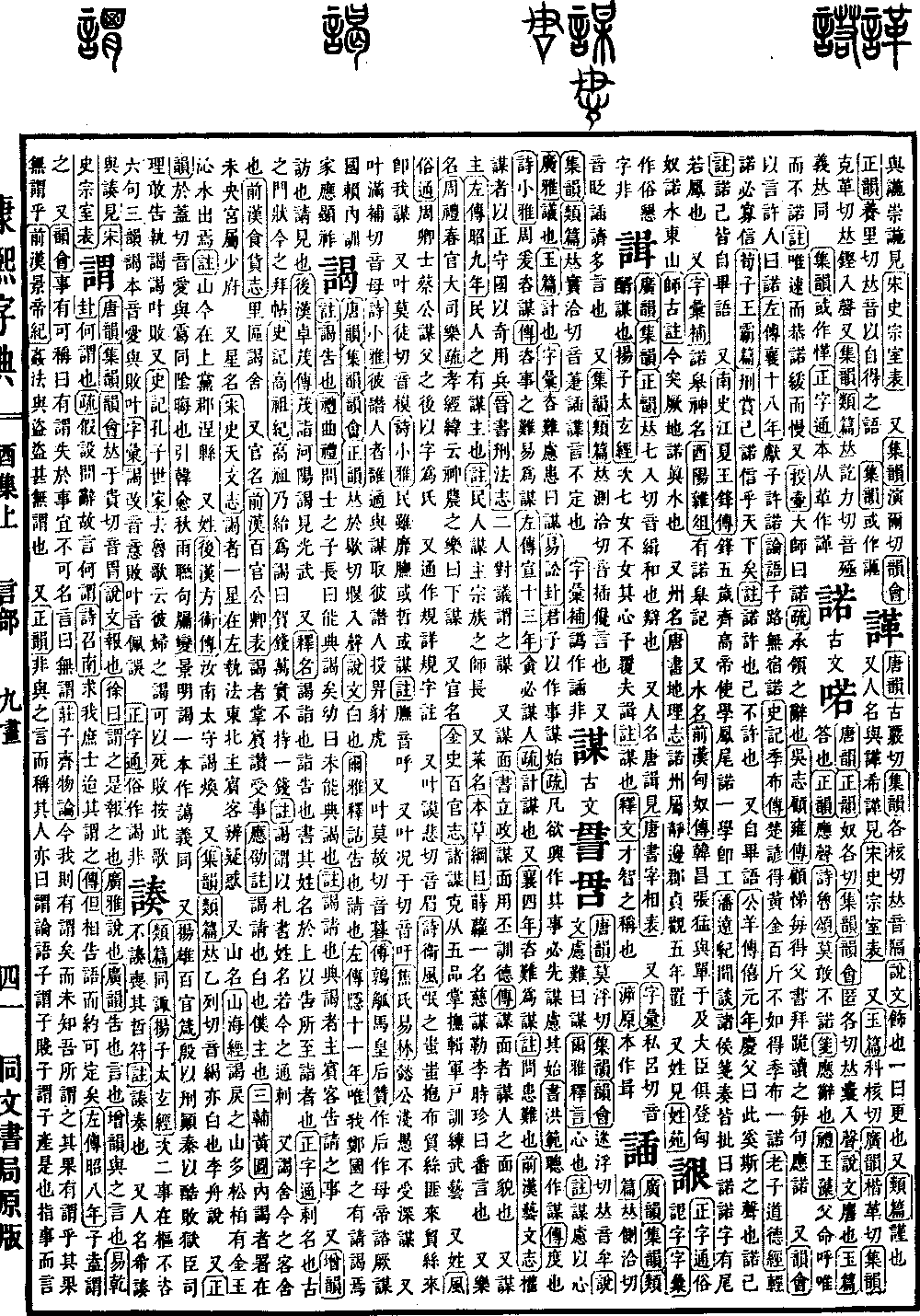
You Collection, Upper Volume
Radical: Speech (yán)
Kangxi Dictionary strokes: 16
Page 1173, Entry 10
Pronounced yan (entering tone).
According to the Analytical Dictionary of Chinese Characters (Shuowen), to report or state.
According to the Erya, a dictionary of synonyms (Erya), to inform or request.
According to the Commentary on the Spring and Autumn Annals (Zuo Zhuan), in the eleventh year of Duke Yin, only my Zheng state can submit a request to you. Commentary: Yan means to inform.
According to the Book of Rites (Liji), when asked about the son of a scholar, if he is of age, one says he is already able to manage receiving guests and announcements; if he is young, one says he cannot yet manage them. Commentary: Yan means to request. The official position of Dianyan is the officer in charge of receiving guests and relaying requests.
Also, according to the Supplement to the Rhyme Dictionary (Zengyun), to visit or request an audience.
According to the History of the Later Han (Hou Hanshu), in the Biography of Zhuo Mao, Zhuo Mao arrived at Heyang and requested an audience with Emperor Guangwu.
Also, according to Explanations of Names (Shiming), Yan means to go; it means to go and inform. One writes their name on a tablet to inform the person they wish to visit.
According to the Correct Dictionary (Zhengzitong), this is a name card. An ancient gate-entry slip, equivalent to a modern calling card.
According to the Records of the Grand Historian (Shiji), in the Annals of Gaozu, Gaozu falsely wrote a name card saying, "I congratulate you with ten thousand coins." In reality, he brought not a single coin. Commentary: Yan refers to writing one's name on a bamboo slip, similar to a modern visitor's calling card.
Also, Yanshe refers to a guest house.
According to the History of the Former Han (Qian Hanshu), in the Treatise on Food and Money, guest houses in the villages and districts.
Also, an official title.
According to the History of the Former Han (Qian Hanshu), in the Table of Officials and Ministers, the Yanzhe (Receptionist) was in charge of managing guests, ceremonial rites, and receiving petitions. Commentary by Ying Shao: Yan means to request or report; it also means to guide guests and relay information.
According to the Yellow Map of the Three Capitals (Sanfu Huangtu), the Office of the Internal Receptionist was located in the Weiyang Palace and was subordinate to the Privy Treasury.
Also, the name of a star.
According to the History of Song (Songshi), in the Treatise on Astronomy, the Receptionist star is located to the northeast of the Left Law-Enforcer star, governing matters regarding guests and clarifying doubts.
Also, the name of a mountain.
According to the Classic of Mountains and Seas (Shanhaijing), Mount Yanli has many pine and cypress trees, along with metal and jade; the Qin River originates there. Commentary: The mountain is currently in Nie County, Shangdang Commandery.
Also, a surname.
According to the History of the Later Han (Hou Hanshu), in the Biography of Occultists, the Governor of Runan, Yan Huan.
Also, according to the Collected Rhymes (Jiyun) and the Categorized Chapters (Leipian), pronounced ye. This also means to report, as stated by Li Zhou.
Also, according to the Correct Rhyme Dictionary (Zhengyun), pronounced ai. It is identical to the character meaning cloudy or gloomy. It appears in Han Yu's "Autumn Rain Linked Verses": The light between the windows changes from bright to dim. Some editions write it as the character for lush, with the same meaning.
Also, in Yang Xiong's Admonition on Officials, the Yin dynasty fell due to chaos, and the Qin dynasty was ruined by cruel punishments. Judicial officials manage criminal cases and daringly report to those in power. Here, "yan" rhymes with the character for ruin.
Also, in the Records of the Grand Historian (Shiji), in the Biography of Confucius, the song sung when leaving the state of Lu says: Those women's slanders can cause one's cause to die and fail. In this six-line song, three rhymes are used; the character "yan" is pronounced "ai," which rhymes with the character for fail.
The Encyclopedia of Characters (Zihui) suggests changing the pronunciation of "yan" to "yi" and "fail" to "pei" to make them rhyme, but this is incorrect.
The Correct Dictionary (Zhengzitong) notes that the common form is incorrect.