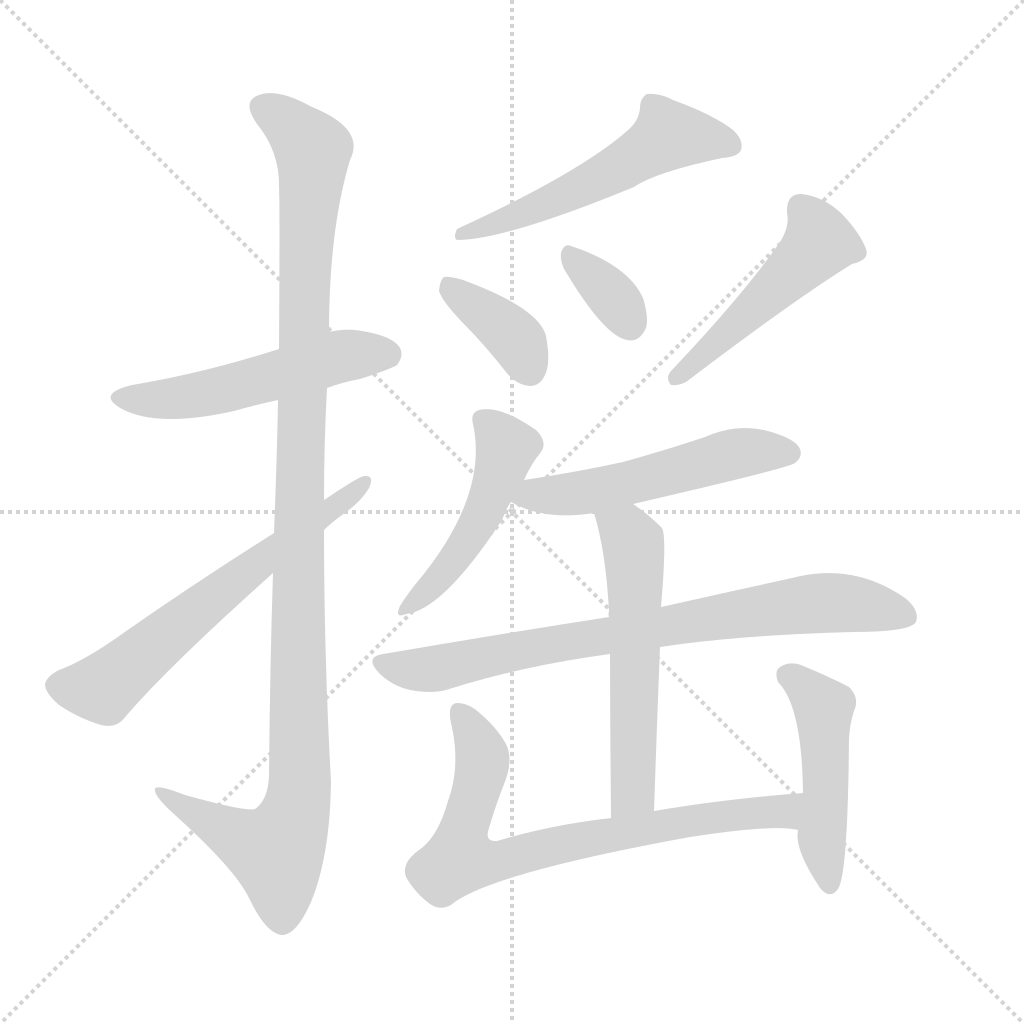
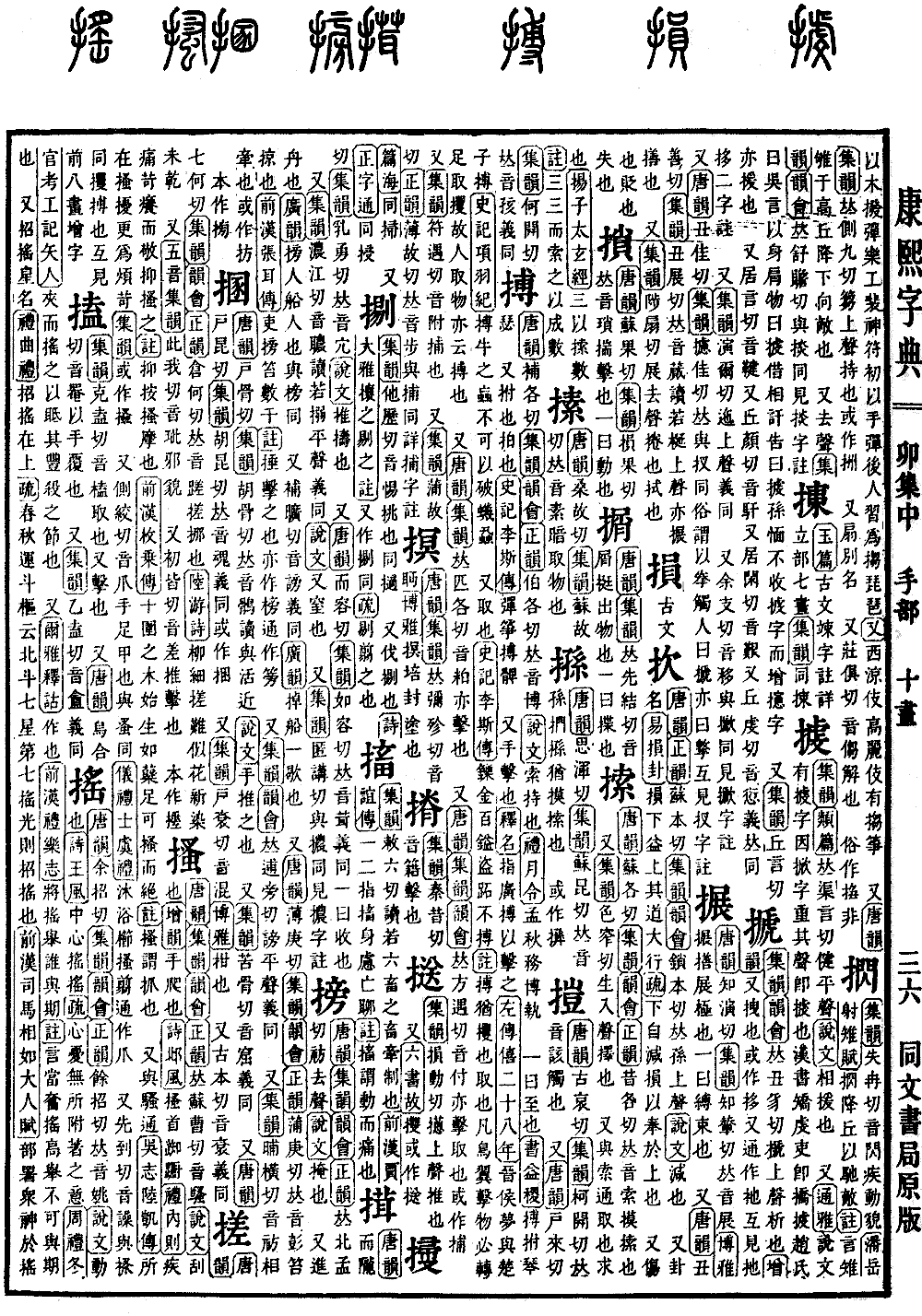
Mao Collection, Middle Volume
Radical: Hand (shǒu)
Kangxi stroke count: 14
Page 446, Entry 14
Pronounced yao.
Shuowen Jiezi (Explanation of Characters and Phrases): To move.
Book of Odes (Shijing), Royal Songs of Wang: The heart is agitated.
Commentary: The meaning of a heart burdened by anxiety with nowhere to attach itself.
Rites of Zhou (Zhouli), Winter Officers, Record of Tradesmen (Kaogongji), Arrow Maker: Grasp and shake it to determine the balance of its thickness and tapering.
Also defined in Erya (Approaching Elegance), Interpretation of Ancient Words, as to act.
History of the Former Han (Qianhan), Record of Rites and Music: About to rise and sway, with whom can one set a time?
Note: It means one should struggle and rise high, and one cannot set a time for it.
Also Zhaoyao, a star name.
Book of Rites (Liji), Summary of Rules of Propriety (Quli): Zhaoyao is in the upper position.
Commentary: The Spring and Autumn period work Yun Doushu states the seventh star of the Northern Dipper is Yaoguang, which is Zhaoyao.
History of the Former Han, Sima Xiangru, Biography of the Great One (Daren Fu): Arranging the deities at Yaoguang.
Note: Zhang Yi says Yaoguang is the first star at the handle of the Northern Dipper. According to the Commentary on the Book of Rites, the two stars are treated as one. This differs from the note in the History of the Former Han.
Also Fuyao, a violent gale.
Erya, Interpretation of the Heavens: Fuyao is called a whirlwind (biao).
Note: Wind that blows from below upwards.
Also Buyao, a hair ornament.
Book of Odes, Odes of Yong: Adorned with hairpins and six gemstones.
Commentary: The Buyao is a design derived from the hair ornament.
History of the Former Han, Biography of Jiang Chong: Wearing a cap with a silk band and a swaying ornament.
Note: The cap has a silk band; thus, when walking, it sways. The silk band is what is now called square-mesh gauze. Sometimes written as a variant form.
Rites of Zhou, Heavenly Officials, Zhuishi Note: The ornament covers the head, like the present-day Bu.
Explanation of Terms: Originally written as yao.
Also xiaoyao, the appearance of soaring or wandering. Same as the term for wandering freely (xiaoyao).
Book of Rites, Tan Gong: Confucius rose early, hands behind his back and leaning on a staff, wandering at the gate.
Also xuyao, meaning for a short moment.
History of the Former Han, Record of Rites and Music: The spirits linger briefly.
Also a surname.
History of the Former Han, Table of Meritorious Officials: The Marquis of Haiyang, Qi Xin, named Yao Wuyu.
Pronounced yao.
Also to move.
Poem by the Latter Ruler (Houzhu) on the moon over the mountain pass: The city walls are high and touch the halo; the moist wind connects with the shadows as they sway. Cold light shifts across the ridges; the cold color dwells on the steep mountains.
Formed with the radical for meat, not the radical for claw. Also written as a variant form. Separately listed under the eleven-stroke section. The character is written with yao below. The meat radical is written as the moon radical.