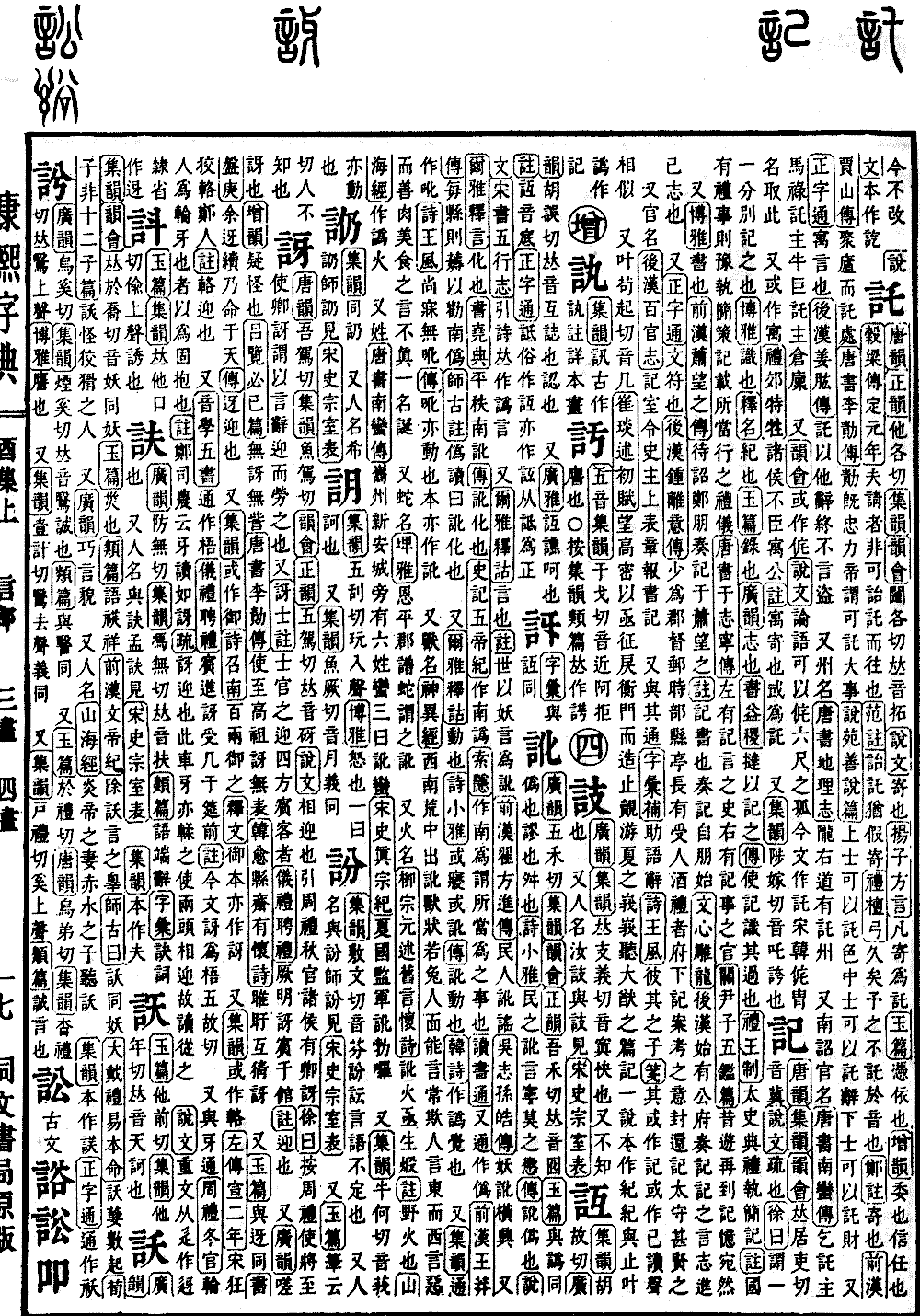
You Collection, Upper Volume
Radical: Speech (yán)
Kangxi Strokes: 11
Page 1149, Entry 01
Pronounced yà
Shuowen Jiezi (Dictionary of Graphic Components): To greet one another. Cites the Rites of Zhou (Zhouli), Autumn Offices section: Among the feudal lords, there are ministers of greeting. Xu Shen states: According to the Rites of Zhou, when an envoy arrives, a minister is sent to greet them. This refers to using polite words to receive and comfort them. Also, a note on greeting officers: These are the officials responsible for receiving guests from all directions.
Book of Etiquette and Ceremonial (Yili), Appointment Rites: The following day, greeting the guest at the guesthouse. Annotation: The meaning is to greet.
Guangyun (Broad Rhymes): To exclaim in surprise.
Zengyun (Additional Rhymes): To suspect or find strange.
Lüshi Chunqiu (Master Lü's Spring and Autumn Annals), Chapter Bi Yi: Do not be surprised and do not disparage.
Old Book of Tang (Tangshu), Biography of Li Ji: When the envoy arrived, the High Ancestor was surprised that there was no memorial.
Han Yu, Poem Written in the County Study: Staring in mutual suspicion and surprise.
Yupian (Jade Chapters): Same as yà (to welcome).
Book of Documents (Shangshu), Pan Geng: I greet and continue your lives by the grace of Heaven. Commentary: Yà means to greet.
Jiyun (Collection of Rhymes): Sometimes written as yù (to drive/meet).
Book of Odes (Shijing), Shao Nan: One hundred carriages to greet her. Explanatory Text: Yù was originally written as yà.
Jiyun (Collection of Rhymes): Sometimes written as lù (to welcome).
Zuo Tradition (Zuo Zhuan), Second Year of Duke Xuan: Kuang Jiao of the State of Song greeted the people of the State of Zheng. Annotation: Lù means to greet.
Yinxue Wushu (Five Books on Phonology): Generally written as wú.
Book of Etiquette and Ceremonial (Yili), Appointment Rites: The guest steps forward with surprise and receives the small table before the mat. Annotation: In the ancient text, yà was written as wú, pronounced wú.
Also interchangeable with yá (tooth).
Rites of Zhou (Zhouli), Winter Offices: The wheelwright makes the wheel's rim to ensure it is firmly joined. Annotation: Zheng Sinong says: Yá is pronounced like yà. Commentary: Yà means to greet. This wheel rim is also shaped so that the two ends meet and greet each other, hence the pronunciation follows it.
Shuowen Jiezi: The variant form written with the radical for movement is yà; in clerical script, it is simplified as yà. The character yà is composed of the radical for movement and the phonetic component for tooth.