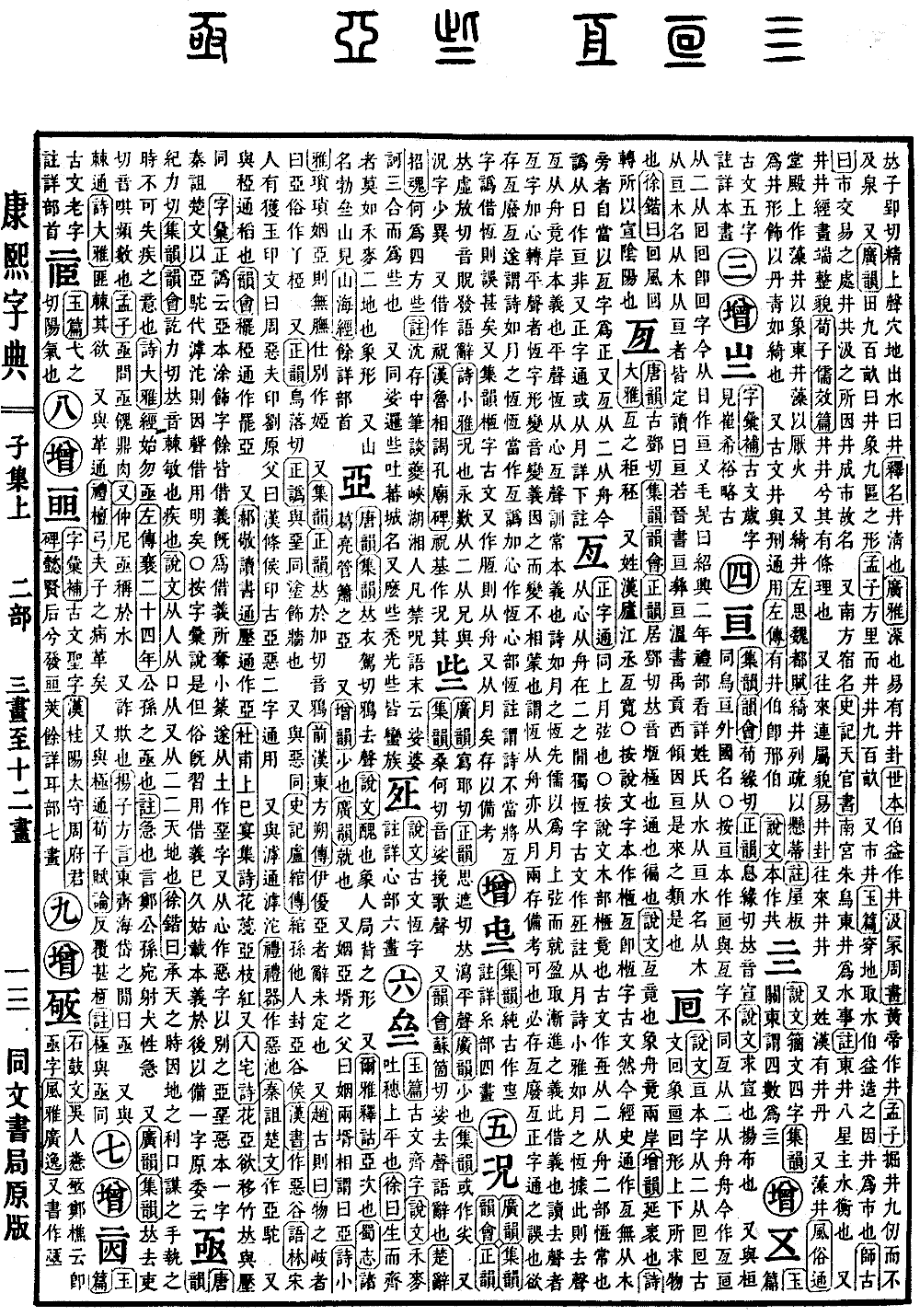
Zi Collection, Page Position: Upper
Radical: Person (rén)
Stroke Count: 8
Page 87, Entry 13
Pronounced yī jià qiè, a falling tone similar to "ya." Explained as ugly, with a character form resembling a hunchbacked person. Also, "ya" signifies the next lower grade. Zhuge Liang was a figure of the caliber of Guan Zhong and Xiao He. It also means few or insufficient. It signifies closeness or drawing near. It also refers to kinship; the father of a son-in-law is called "yin," and two sons-in-law refer to each other as "ya." The "Book of Odes (Shijing)" states that those trivial and incompetent in-laws should not be granted high positions and generous salaries. Also written as "娅."
Pronounced yú jiā qiè, with the same sound as "ya." "Yī yōu yà" in "Book of Documents (Qian Hanshu) - Biography of Dongfang Shuo" means words that are not yet settled. Things that branch are called "ya," commonly written as "丫" or "桠."
Pronounced wū luò qiè. Same as "è," referring to plastering a wall. It is also interchangeable with "è." Lu Wan's grandson, Taren, was enfeoffed as Marquis Yagu. Written as "Egu" in the "Book of Documents (Hanshu)." Yu Lin records that a person from the state of Song obtained a jade seal with the inscription "Zhou E Fu Yin." Liu Yuanfu said that the seal of Marquis Tiao of the Han Dynasty used "ya" and "è" interchangeably in ancient times.
It is also interchangeable with "hū," referring to the Hutuo River. Written as "Èchí" in the "Book of Rites (Liji)." Written as "Yà tuó" in the "Qin Ancestral Chu Inscriptions."
It is also interchangeable with "lù," referring to rice. "Lù" is also used interchangeably with "bà yà."
"Yā" is used interchangeably with "yà." There is a line "Huā ruǐ yà zhī hóng" in Du Fu's "Poem on the Upper Third Day Banquet." There is also a line "Huā yà yù yí zhú" in "Ren Zhai Shi." Here, "ya" is the same as "yā."
The "Zheng'e" section of "Zihui" states that "ya" originally meant to adorn, and other meanings are borrowed. Due to the extensive use of borrowed meanings, small seal script added the "earth" radical to write "è," and added the "heart" radical to write "è" for distinction. "Ya," "è," and "è" were originally the same character. The use of "Yà tuó" to replace "Hūtúo" in the "Qin Ancestral Chu Inscriptions" is a clear example of phonetic borrowing. According to the explanation in "Zihui," it is correct, but the borrowed meanings have been in common use for a long time, so the original meaning is recorded later to complete the origin and development of the character.
According to "Erya - Shigu," "ya" means secondary. The original text's "Shigu" has been changed to "Shiyan." "Zhuge Liang was the 'ya' of Guan Xiao" in "Shuzhi." The original text's "Guan Xiao" has been changed to "Guan Xiao."