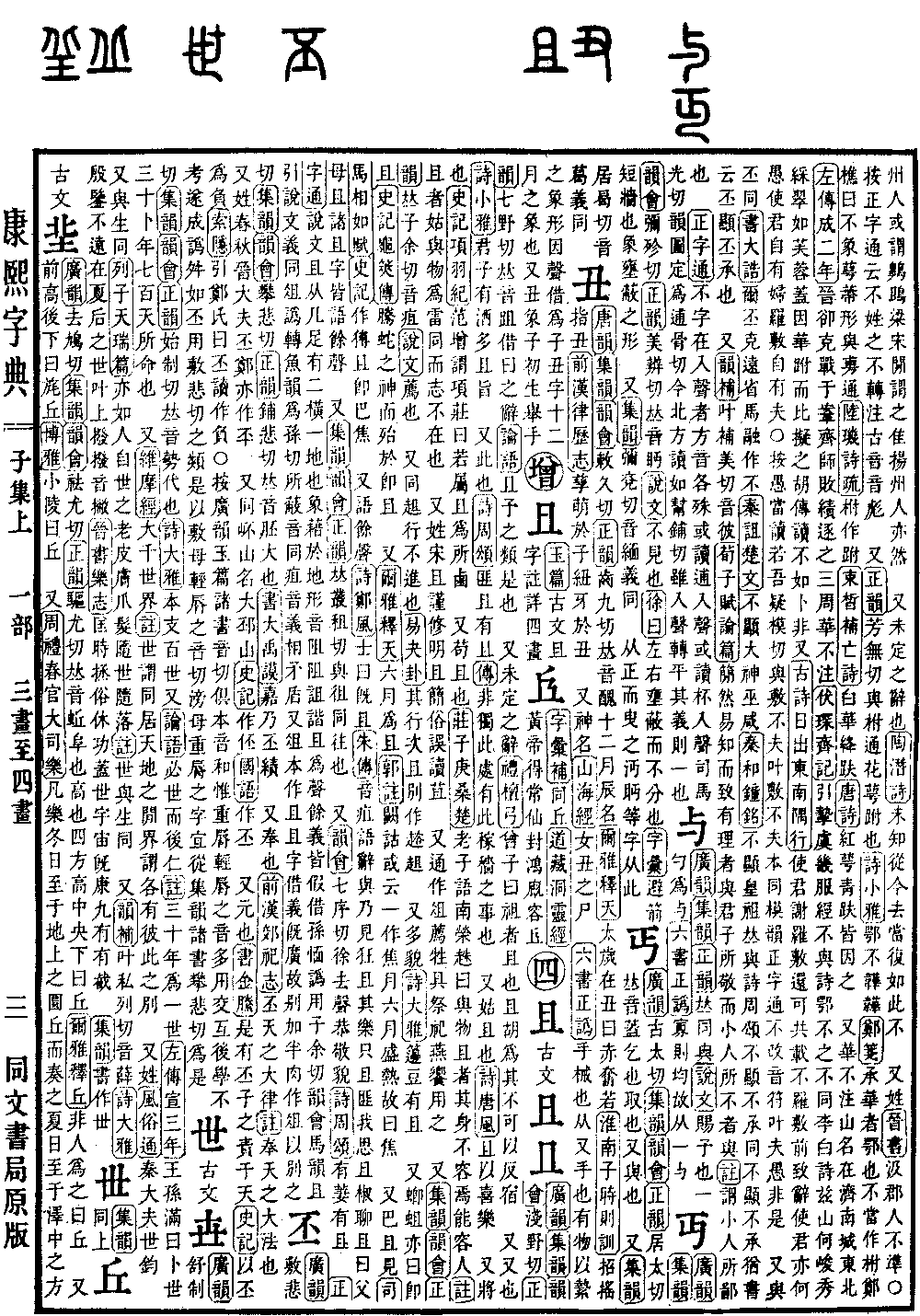
Wei Collection, Lower Volume
Radical: Mortar (jiù)
Page 77, Entry 01
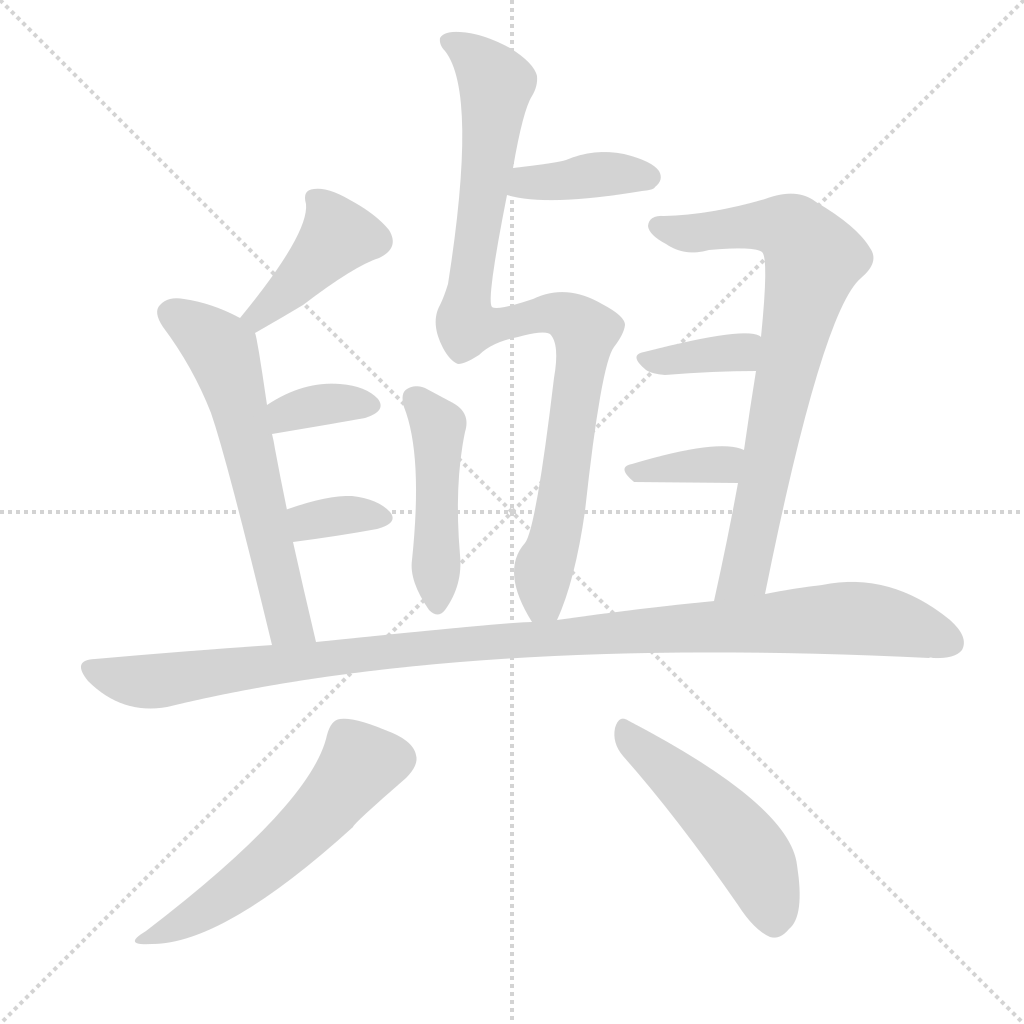
Ancient character. Pronounced yu (rising tone). Pronounced yu (falling tone). Pronounced yan (rising tone). Pronounced yu.
From Shuowen Jiezi (Explanation of Writing): Party or associates.
From Strategies of the Warring States (Zhanguo Ce): Therefore, the ruler will unite with the strong Chu. Note: With means party or associates.
From Guanzi, Eight Observations chapter: If requests are granted from above, then parties and associates are formed below.
Also, to be kind. From Book of Rites (Liji), Rites Conveyed: Feudal lords treat each other with courtesy.
Also, and. From Classic of Changes (Yijing), Treatise on the Hexagrams: Thus, the Way of Heaven is established as Yin and Yang. The Way of Earth is established as soft and hard. The Way of man is established as benevolence and righteousness.
Also, to permit or to follow. From Analects (Lunyu): I agree with Dian.
From Guanzi, Explanation of Circumstances: Spirits and gods assist them, and Heaven and Earth agree with them.
Also, to wait. From Analects (Lunyu): The years do not wait for me.
Also, from Erya (Boya): To be like. From History of the Former Han (Hanshu), Biography of Han Xin: Great King, weigh it yourself: in courage, ferocity, benevolence, and strength, who is like the King of Chu? Note: Shigù says: Yu means like.
From Sima Xiangru, Rhapsody on the Son of Heaven’s Hunt (Zixu Fu): In the hunt of the King of Chu, who is like your humble servant?
Also, to bestow or to give. From Book of Rites (Liji), Summary of the Rules of Propriety: One who gives to others should not inquire about what they desire.
From Rites of Zhou (Zhouli), Spring Officials, Grand Diviner: In managing state affairs, apply the eight commands of the tortoise shell; the first is called levy, the second is called portrait, the third is called gift. Note: Gift refers to giving material goods to people.
Also, to assist. From Strategies of the Warring States (Zhanguo Ce): I will penetrate deep into the Wu army; if I strike one man, if I grapple one man, I do so to assist the resolute. Note: Yu means to assist.
Also, category. From Discourses of the States (Guoyu): When the rituals are established, the complete are for feasts, and the clear and bright great virtues are fulfilled; minor ceremonies are included therein. Note: Yu means category; minor ceremonies are those that can be compared.
Also, by means of. From Classic of Poetry (Shijing), Odes of Zhao and the South: This child returns, and does not take me along. Note: Zhu’s commentary says: Yu is like taking; it means to take one along and travel together.
Also, to harmonize. From Strategies of the Warring States (Zhanguo Ce): If there is no harmony inside, external enemies cannot be repelled. Note: Disorder, with means harmony.
Also, to use. From Classic of Poetry (Shijing), Odes of Tang: The talk of people, if it is so, do not use it. Commentary: Do not use it, means not to employ.
Also, to count. From Book of Rites (Liji), Summary of the Rules of Propriety: Treat the living according to the coming day. Note: Yu means to count.
Also, a modal particle. From Book of Rites (Liji), Record of Examples: A gentleman would rather have promises and duties than have ended resentments.
Also, rongyu, meaning the appearance of being leisurely and comfortable. From Zhuangzi, In the World of Men: Thereby seeking to follow one's heart in leisure. Note: Seeking to follow one's heart in a relaxed and unrestrained manner, satisfying one's extravagant desires.
From Records of the Grand Historian (Shiji), Biography of Sima Xiangru: The King of Chu then pulled on the reins, pacing back and forth, soaring and hovering, leisurely and comfortable. Note: Suoyin says: It means being self-content.
Also, from Zhengzitong: Dayu is an official title; an official in charge of noble ranks and salaries.
Also, Bu-yu is a country name. From Classic of Mountains and Seas (Shanhaijing): There is a country of Bu-yu, with the Lie surname, eating millet.
Also, a surname.
Also, pronounced yu (falling tone). Pronounced yu (rising tone). To participate.
From Zhengzitong: To rely on.
From Doctrine of the Mean (Zhongyong): Even the foolish among husbands and wives can participate in knowing it.
From Rites of Zhou (Zhouli), Winter Officials, Records of Trades: The state has six categories of work, and the hundred craftsmen participate in occupying one of them.
Also, a district name. From Records of the Grand Historian (Shiji), Biography of Chancellor Cao: Can followed with the central attendant, preparing to attack Huling and Fangyu. Note: Suoyin says: According to the Geographical Records, both districts belong to Shanyang. Zhengji says: Yu is pronounced yu.
Also, from Zhengzitong: Doubt and hesitation. Often written as the character for leisure (yu). From History of the Former Han (Hanshu), Biography of the King of Changyi: Yang Chang was still hesitant and did not reach a decision.
From Biography of Chen Tang: The soldiers were still hesitant. Often written as the character for leisure (yu).
Also, pronounced yu. A modal particle.
From Analects (Lunyu): Is that the root of benevolence?
From Book of Rites (Liji), Tan Gong: Zengzi said: If not for that. If one is shamed, one can leave; if one is thanked, one can eat. Commentary: Wei means no. Yu is a modal particle.
Also, from Classic of Poetry (Shijing), Odes of Lesser Elegantia: My millet is lush, my panicled millet is orderly. Commentary: Lush and orderly refer to the appearance of abundance.
Also, from Analects (Lunyu): So lush and dignified. Note: The appearance of being moderate in ritual demeanor.
Also, to stretch. From History of the Former Han (Hanshu), Treatise on Ritual and Music: When the bright summer flourishes and grows, it spreads and bestows upon all things. Note: Shigù says: Spread and bestow means to open and stretch. Yu is pronounced yu.
Also, a person's name. From Book of Documents (Shangshu), Canon of Shun: Chui bowed his head to the ground, yielding to Shu Qiang and Bo Yu. Commentary: Shu Qiang and Bo Yu are the names of two ministers. Explanation: Yu is pronounced yu.
Also, a mountain name. Same as the character for carriage (yu). From Classic of Mountains and Seas (Shanhaijing): The Dun-yu Mountain. Note: According to the Gazetteer, it is written as Dun-yu Mountain.
Also: The beginning of Ku Mountain is called Xiu-yu Mountain. Note: Yu is sometimes written as the character for carriage (yu).
Also, pronounced ai. To give. Note: Shuowen Jiezi defines this as to bestow; one ladle is defined as the character. The character is defined as party or associates. Currently, in common usage, the character is interchangeably written as the character for give (yu).