You Collection, Upper Volume
Radical: Speech (yán)
Yao
Kangxi Strokes: 17
Page 1176, Entry 07
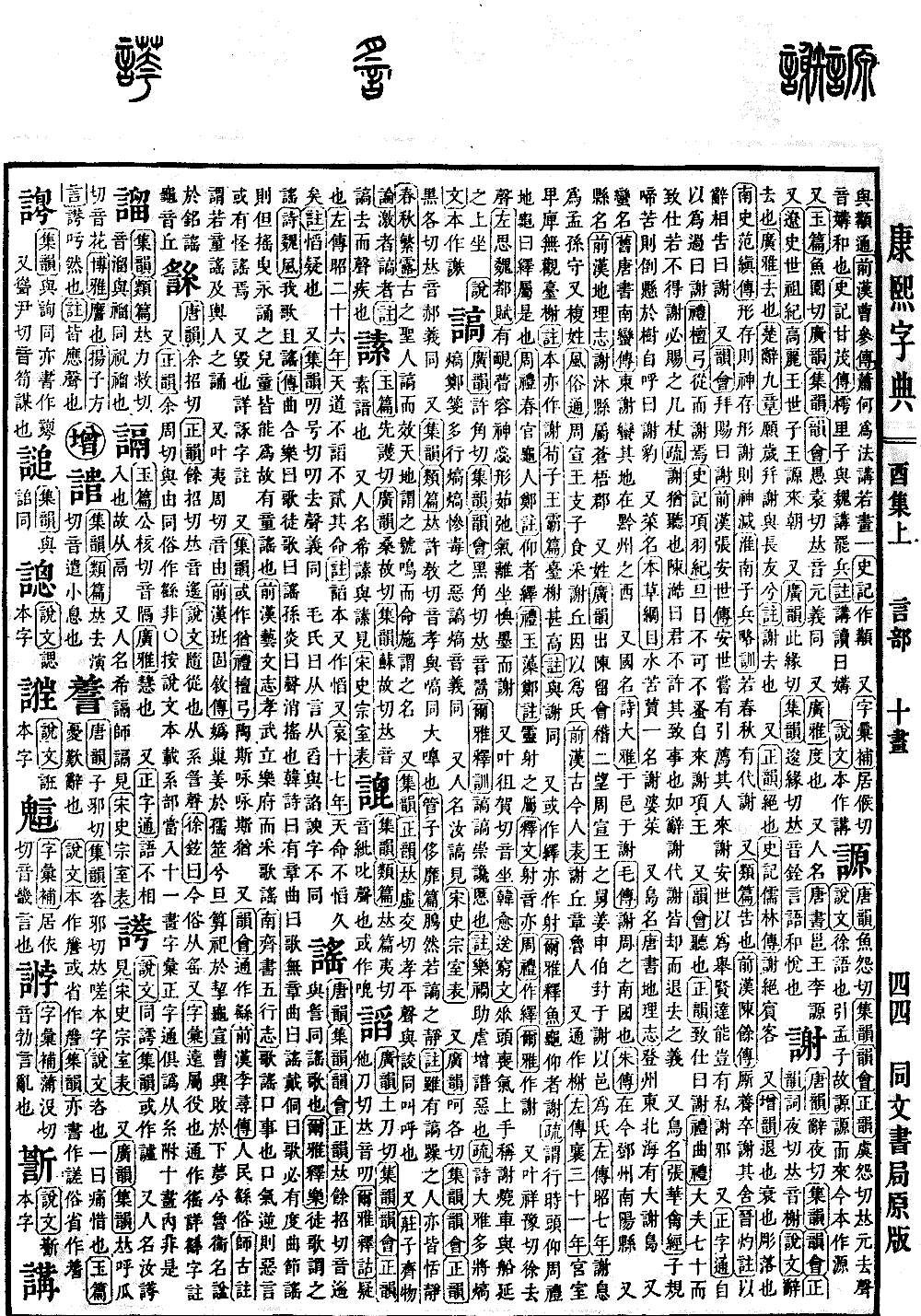
Pronounced yáo. Same as the alternate form. It refers to a folk song or ballad. In the Erya (Erya), a section on music, it states that singing without musical accompaniment is called yao. In the Book of Odes (Shijing), it is written: I sing and I chant. The commentary states: Pieces that harmonize with musical accompaniment are called ge (songs), while unaccompanied singing is called yao. Sun Yan says: It is a sound that drifts and wavers. The Han version of the Odes says: That which has structure and melody is called ge, that without structure and melody is called yao. Dai Tong says: Ge must follow rhythmic patterns and musical structure, whereas yao is simply a swaying, prolonged recitation that even children can perform, hence the term tongyao (children's rhymes). In the Book of Han (Hanshu), Treatise on Arts and Literature, it is noted: Emperor Wu established the Music Bureau to collect folk songs and ballads. In the Book of Southern Qi (Nanqishu), Treatise on the Five Elements, it states: Songs and ballads are matters of the mouth. If the breath of the mouth is contrary, it produces evil speech, or there may be strange rumors. It also means to slander; see the annotation under the character zhuo. It is also found in the Jiyun (Jiyun) written as the variant form you. In the Book of Rites (Liji), specifically the Tan Gong chapter, it states: To mold is to chant, to chant is to you. In the Yunhui (Yunhui), it is also used interchangeably with yao. In the Book of Han (Hanshu), Biography of Li Xun, it is written: The people are influenced by customs. The commentary by Shi Gu states: This refers to things like children's rhymes and the chanting of common people. It also rhymes with the sound you. In the Book of Han (Hanshu), Treatise on the Narrative of Ban Gu, it is written: The Gui family nested the Jiang line at the time of divination, and the morning calculations offered sacrifice to the tortoise shell. The rise and fall of the Xuan and Cao states were dreamt of below, and the posthumous titles of Lu and Wei were inscribed in ballads. The character for tortoise is pronounced qiu.