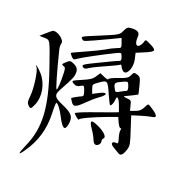
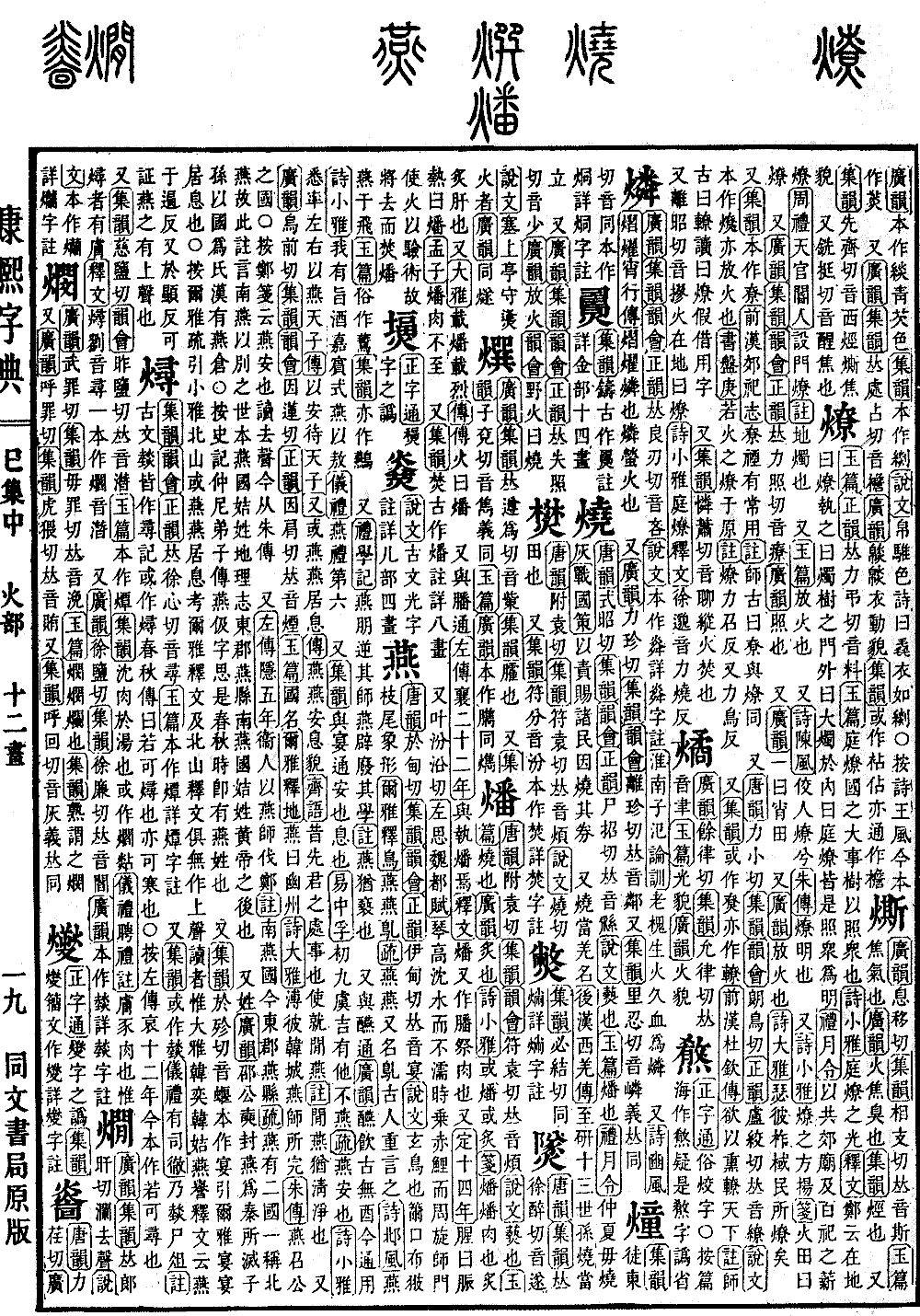
Si Collection, Middle Volume. Radical: Fire (huǒ). 16 strokes. Page 683, Entry 17.
According to Collected Rhymes (Jiyun), Rhyme Meetings (Yunhui), and Orthodox Rhymes (Zhengyun), it is pronounced xun (rising tone). According to Jade Chapters (Yupian), it was originally written as the character for heating (tan). See the detailed annotation for that character.
According to Collected Rhymes (Jiyun), it is also written in a variant form (qin). In the Book of Etiquette and Ceremonial (Yili), it states: Then one scalds the sacrificial meat. The commentary notes that in ancient texts, the variant form was all written as xun. Some records also write it as the current entry. The Zuo Commentary to the Spring and Autumn Annals (Chunqiu Zuo Zhuan) says: If it can be scalded, it can also be cooled. Note that in the current version of the Zuo Commentary for the twelfth year of Duke Ai, it is written as xun.
According to Collected Rhymes (Jiyun) and Rhyme Meetings (Yunhui), it is pronounced qian. According to Jade Chapters (Yupian), it was originally written as the character for heating (tan). According to Collected Rhymes (Jiyun), it means to immerse meat in hot water. It is sometimes written as the variant forms yan or shan. In the commentary to the Book of Etiquette and Ceremonial (Yili), it refers to the skin of pork. Only when scalded does it retain the skin. The Explanation of Text (Shiwen) states that for this character, Liu provides the pronunciation xun. One version uses the variant form yan, pronounced qian.
According to Broad Rhymes (Guangyun) and Collected Rhymes (Jiyun), it is pronounced yan (rising tone). According to Broad Rhymes (Guangyun), it was originally written as the variant form (qin). See the detailed annotation for that character.