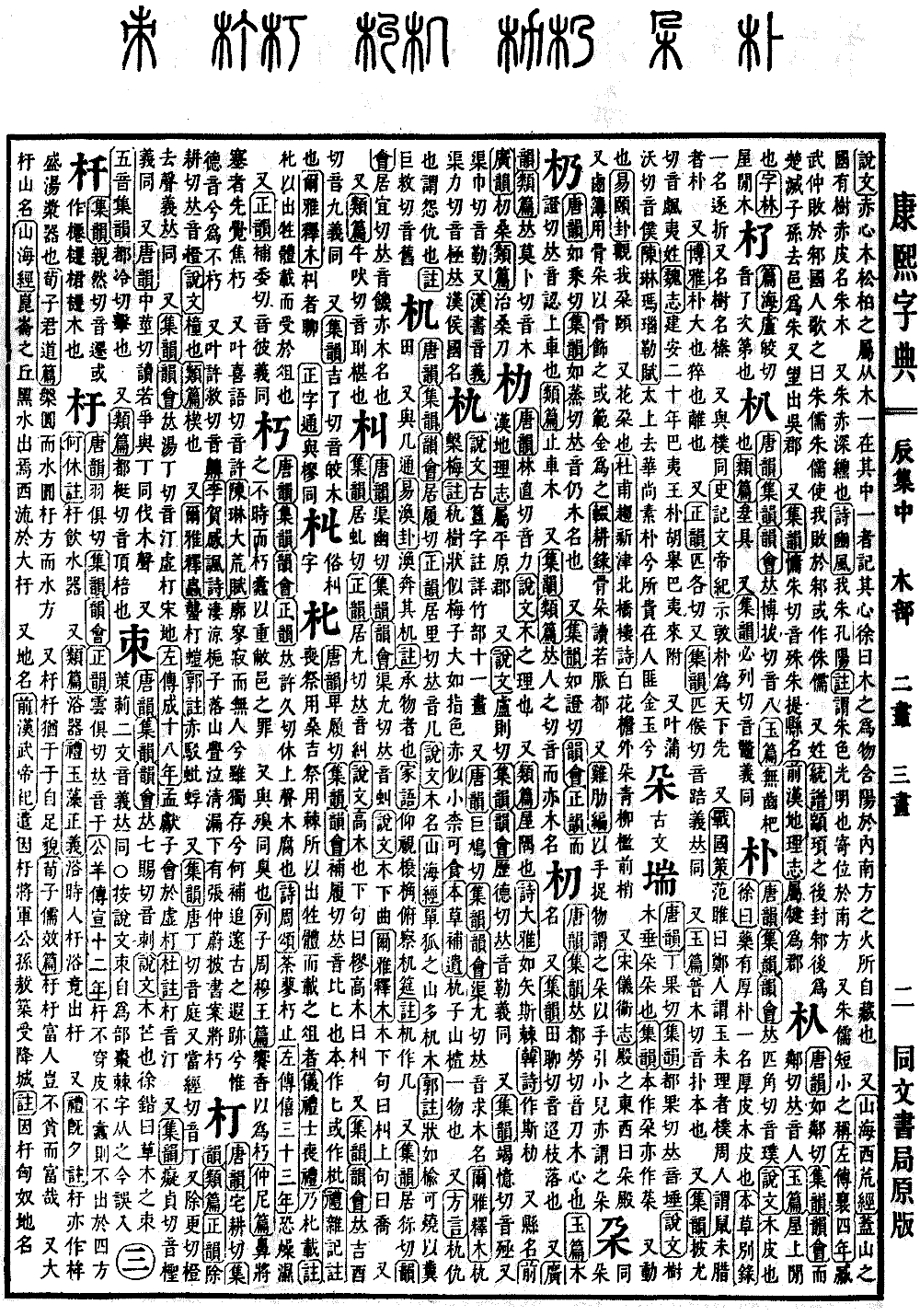
Chen Collection, Middle Volume
Radical: Tree (mù)
朽
Kangxi Strokes: 6
Page 510, Entry 16
Tang Dynasty Rhyme (Tangyun), Collection Rhyme (Jiyun), Rhyme Compilation (Yunhui), Correct Rhymes (Zhengyun): Pronounced xiu (rising tone). Wood that is rotten. Book of Odes (Shijing), Zhou Odes: The bitter herbs and smartweeds have rotted. Zuo Commentary (Zuozhuan), 31st Year of Duke Xiang: Worried that if the dryness and moisture were not suitable, the grain would rot and be eaten by insects, thereby increasing the guilt of our state.
Also written as the variant form (chou). Refers to a foul odor. Liezi, Zhou King Chapter: To enjoy a fragrance but perceive it as a foul odor. Zhongni Chapter: A person whose nose is about to be blocked will first smell something scorched or foul.
Also rhymed as xi, pronounced xu. Chen Lin, Great Wilderness Rhapsody (Dahuang Fu): Empty, silent, and without a person; even if one exists alone, what is the benefit? Chasing the distant traces of the ancients, only moral reputation can never rot.
Also rhymed as xiu, pronounced xiu. Li He, Satirical Reflections (Ganfeng Shi): The desolate gardenia flowers wither, and the mountain stream drips with the sound of a cold water clock. Below, there is Zhang Zhongwei, who turns the pages of his books until the desk is about to rot. The character for foul odor was originally composed of two nose characters, written as nose-nose.
Textual research: Zuo Commentary, 33rd Year of Duke Xi. Worried that if the dryness and moisture were not suitable, the grain would rot and be eaten by insects, thereby increasing the guilt of our state. Carefully corrected according to the original text to the 31st Year of Duke Xiang.