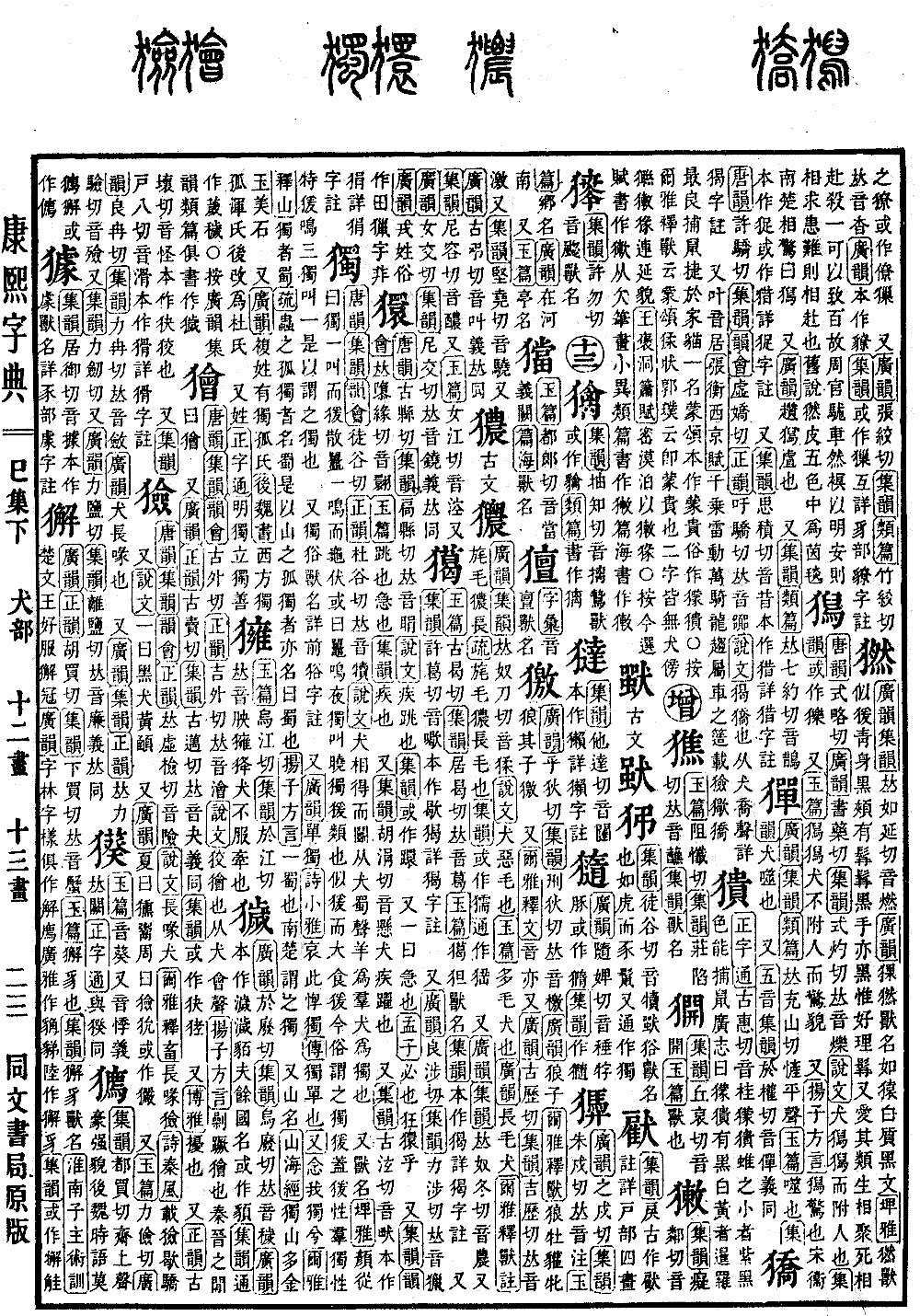
Si Collection, Lower Volume
Radical: Dog (quǎn)
17 Kangxi strokes
Page 719, Entry 01
Tang Rhyme (Tangyun), Collection Rhymes (Jiyun), Rhyme Meetings (Yunhui), and Orthodox Rhymes (Zhengyun) record the pronunciation as xian (rising tone).
Explaining Graphs and Analyzing Characters (Shuowen) defines this as a long-snouted dog.
Approaching the Standard (Erya), section on domestic animals, states that a long-snouted dog is called xian.
Book of Odes (Shijing), Qin Wind section, records two types of hunting dogs: the xian and the xiejiao.
Also, Explaining Graphs and Analyzing Characters (Shuowen) offers another definition as a dog with black fur and a yellow body.
Also, Broad Rhyme (Guangyun) notes that during the Xia dynasty these were called xunyu, and during the Zhou dynasty they were called xianyun. Sometimes also written in a variant form (xian).
Also, Jade Chapters (Yupian) provides the pronunciation as li (falling tone), Broad Rhyme (Guangyun) as liang (rising tone), and Collection Rhymes (Jiyun) as li (rising tone), all pronounced the same as lian.
Broad Rhyme (Guangyun) defines this as a dog with a long snout.
Also, Broad Rhyme (Guangyun), Collection Rhymes (Jiyun), and Orthodox Rhymes (Zhengyun) provide the pronunciation as li (falling tone), pronounced the same as lian.
Also, Collection Rhymes (Jiyun) provides the pronunciation as li (falling tone).
Also, Broad Rhyme (Guangyun) provides the pronunciation as li (rising tone) and Collection Rhymes (Jiyun) as li (rising tone), pronounced the same as lian.
All the above pronunciations carry the same meaning.