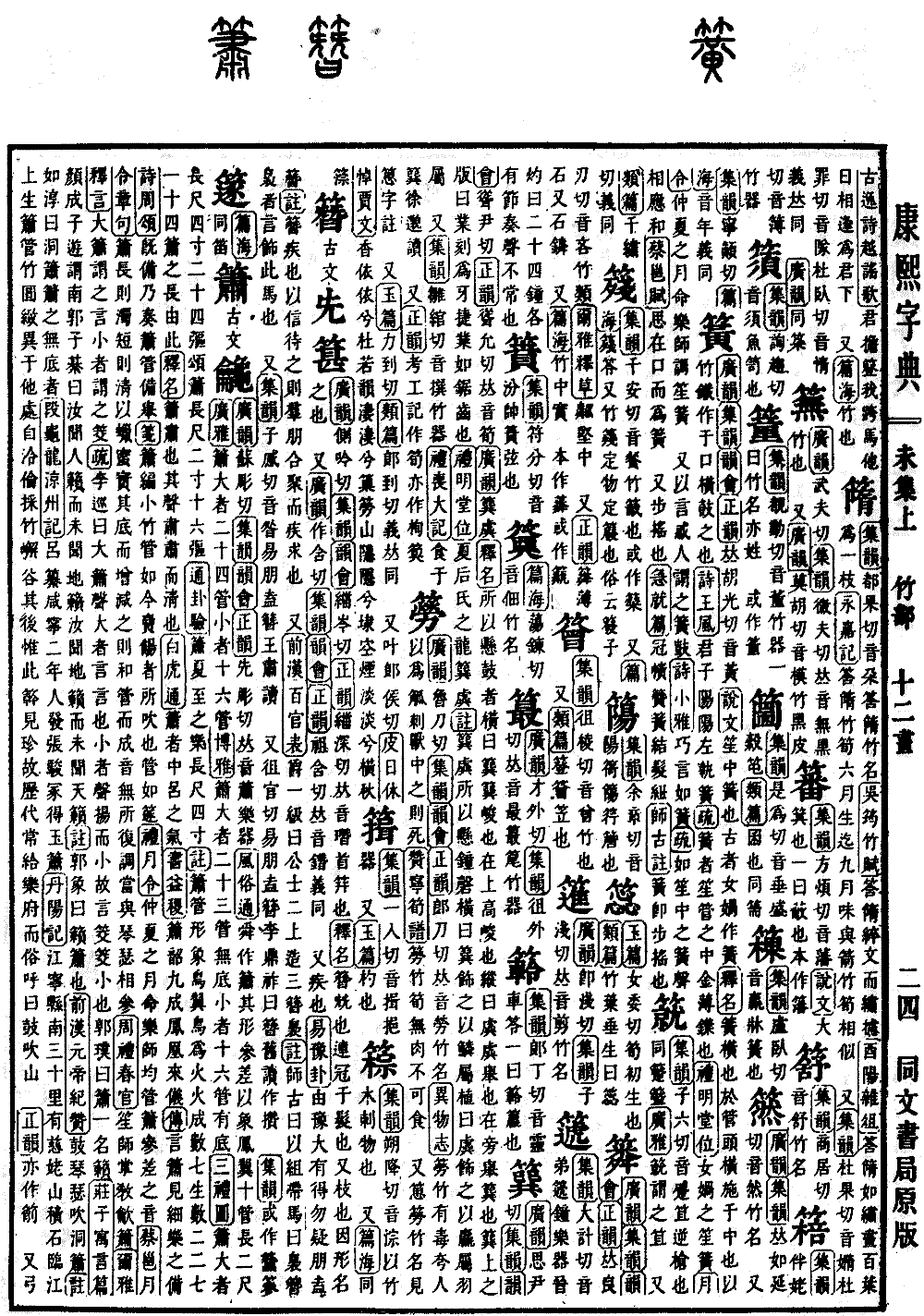
Wei Collection, Upper Volume
Radical: Bamboo (zhú)
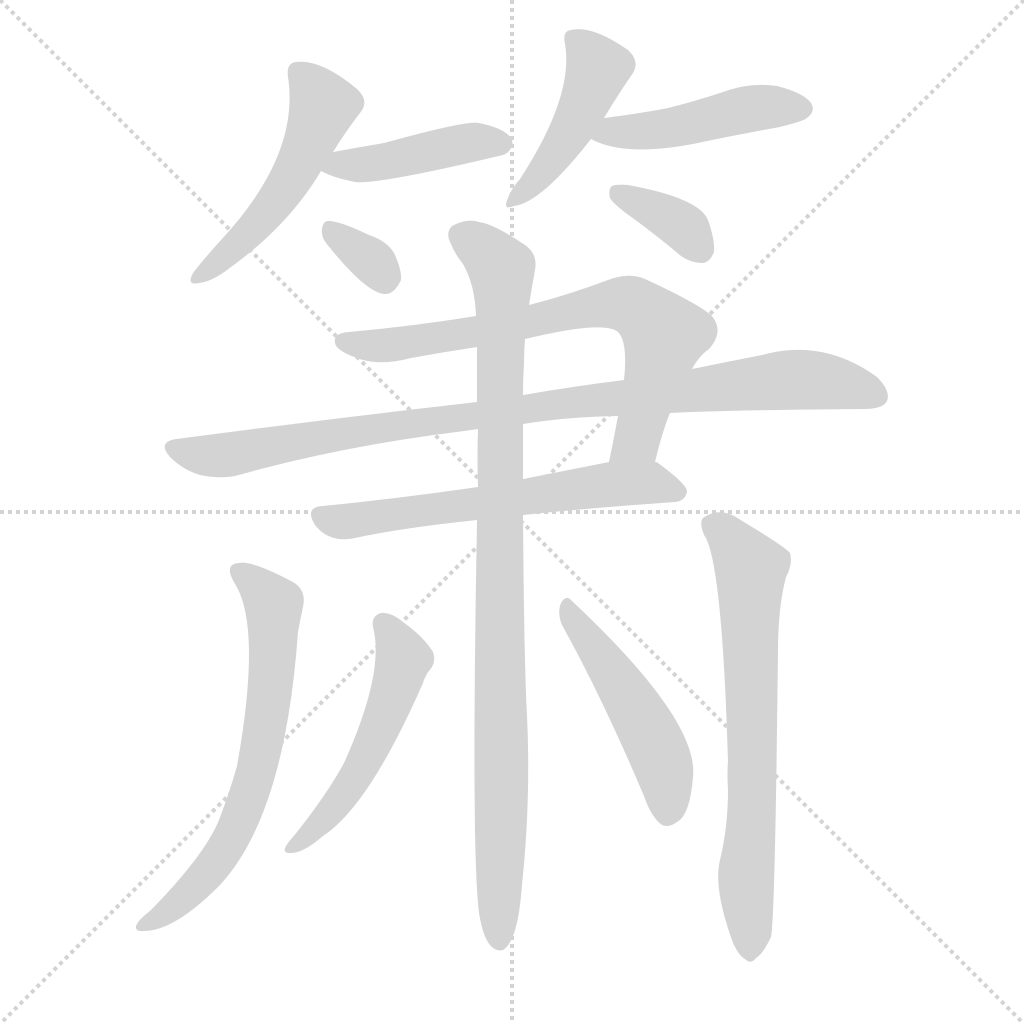
Xiao (panpipe)
Kangxi Strokes: 18
Page 900, Entry 01
Ancient form. Pronounced xiao. A musical instrument.
Book of Popular Traditions and Customs (Fengsu Tong): Shun created the xiao; its shape is uneven to resemble the wings of a phoenix. It has ten pipes and is two feet long.
Broad Refinements (Guangya): The large xiao has twenty-four pipes; the small one has sixteen pipes.
Explanatory Notes (Boya): The large xiao has twenty-three pipes and no bottom; the small one has sixteen pipes and a bottom.
Illustrations of the Three Rituals (Sanli Tu): The large xiao is one foot and four inches long with twenty-four holes. The ode-xiao is one foot and two inches long with sixteen holes.
Verification of the Hexagrams (Tonggua Yan): The xiao is the music of the summer solstice, one foot and four inches long. Commentary: The pipes of the xiao are shaped like bird wings. Birds correspond to fire; the generative number of fire is two, and the constant number is seven; two times seven is fourteen, which is the origin of the xiao's length.
Explanation of Names (Shiming): Xiao means solemn; its sound is solemn and clear.
Comprehensive Discussions in the White Tiger Hall (Baihu Tong): The xiao represents the energy of the middle-lu pitch.
Classic of History (Shujing): When the xiao-shao music is played in nine parts, the phoenix arrives in state. Commentary: This refers to the completeness of the subtle music provided by the xiao.
Classic of Poetry (Shijing): When the preparations were complete, they played the xiao and the guan. Commentary: The xiao is made of small bamboo pipes bound together, like the ones blown by taffy sellers today.
Book of Rites (Liji): In the month of mid-summer, command the music masters to tune the qin, the se, the guan, and the xiao.
Cai Yong's Commentary on the Monthly Ordinances (Yueling Zhangju): If the xiao is long, the tone is murky; if short, the tone is clear. By using wax and honey to fill the bottom and adjusting the amount, the pipes harmonize to create a sound; once set, it needs no further tuning and should harmonize with the qin and se.
Rites of Zhou (Zhouli): The sheng master is responsible for teaching how to blow the xiao.
Approaching Elegance (Erya): A large xiao is called yan; a small one is called jiao. Commentary: Li Xun stated: The large xiao has a grand sound, hence it is called yan. The small one has a high, small sound, hence it is called jiao. Jiao means small. Guo Pu stated: The xiao is also called lai.
Zhuangzi (Zhuangzi): Yan Cheng Zi You said to Nan Guo Zi Qi: You have heard the music of men, but you have not yet heard the music of the earth. You have heard the music of the earth, but you have not yet heard the music of heaven. Commentary: Guo Xiang stated: Lai is the xiao.
History of the Former Han (Qianhan Shu): Strumming the qin and se, and blowing the dong-xiao. Commentary: Ru Chun stated: The dong-xiao is a xiao without a bottom.
Record of Liangzhou (Liangzhou Ji): In the second year of the Xianning era, someone opened the tomb of Zhang Jun and found a jade xiao.
Record of Danyang (Danyang Ji): Thirty miles south of Jiangning County is Mount Cimu; it has cliffs overlooking the river. On it grows bamboo suitable for xiao pipes, which is rounder and more distinctive than that found elsewhere. Ever since Ling Lun collected bamboo at Xie Valley, only this variety has been prized; thus, it has been supplied to the Music Bureau throughout the dynasties, and the common people call the mountain the Drum and Horn Mountain.
Also written in a variant form (shuo).
Also refers to the ends of a bow.
Book of Rites (Liji): Anyone presenting a bow to another person should hold the xiao with the right hand and support the middle of the bow with the left hand. Commentary: Xiao refers to the ends of the bow. It is called xiao because it is slanted. Corrected Interpretation states: The xiao is the bow tip; the tip is slightly carved and slanted, resembling a xiao, hence it is called a xiao.
Also interchangeable with xiao (a type of small bamboo).
Ma Rong's Rhapsody on the Long Flute (Changdi Fu): The bamboo forests of xiao and man-jing. Commentary: Xiao is interchangeable with xiao.
Also pronounced xiu (in rhyme).
Liu Shao's Rhapsody on the Capital of Zhao (Zhao Du Fu): Striking the spirit-drums, sounding the xiao-flutes. Riding the plain waves, reflecting the clear stream.