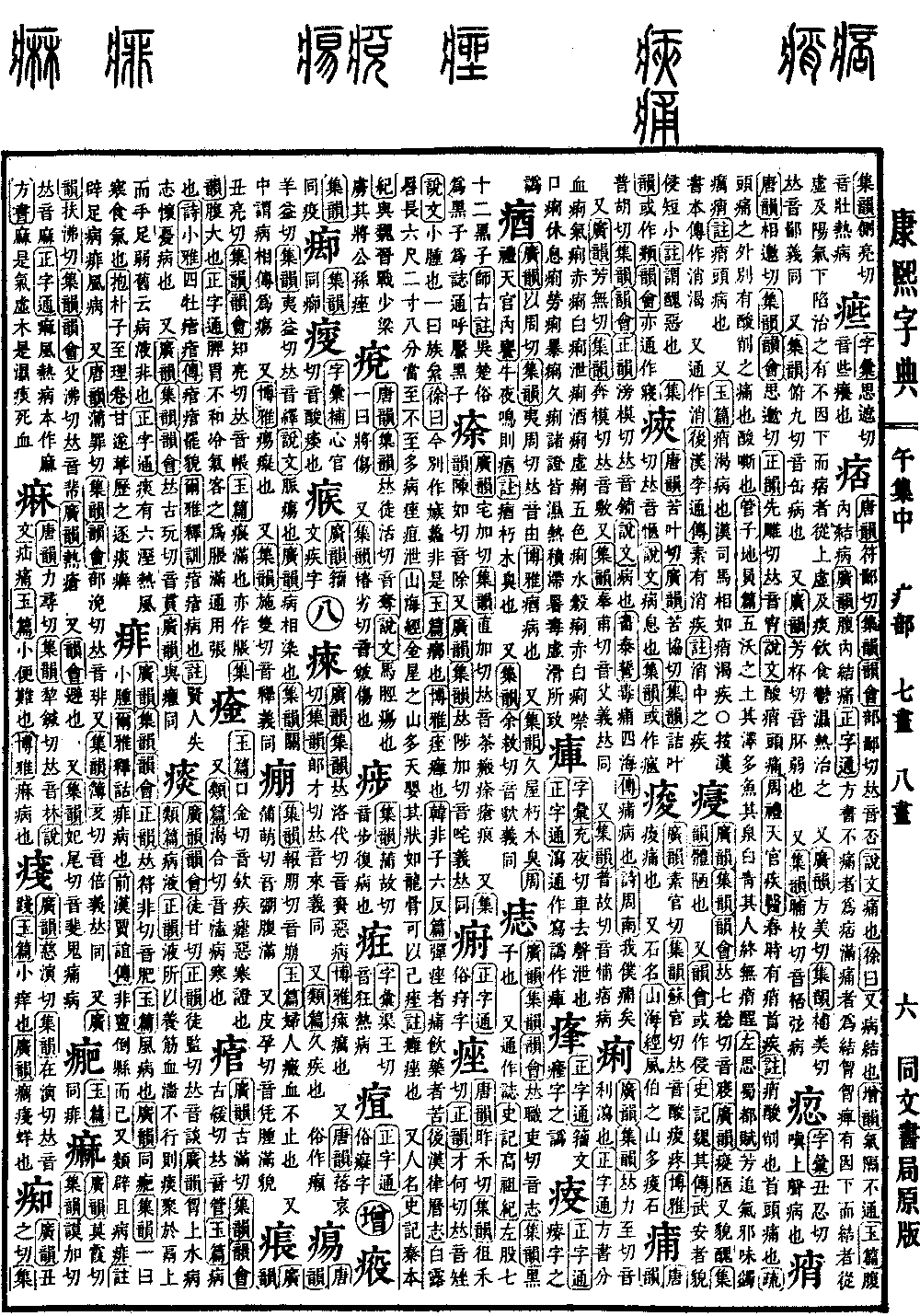
Wu Collection, Middle Volume
Radical: Sickness (nì)
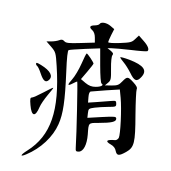
Xiao
Kangxi Stroke Count: 12
Page 774, Entry 04
Pronounced xiao.
According to the Explanation of Simple and Compound Characters (Shuowen Jiezi), it refers to a sour, aching pain, specifically a headache.
The Rites of Zhou (Zhouli), Section on the Officials of Heaven, specifically the Physician of Diseases, records that in spring, one is prone to head ailments termed xiao. The commentary notes that xiao refers to a sour, cutting sensation, and head ailment refers to a headache. The sub-commentary adds that in addition to headaches, this includes sensations of soreness and weakness. The word sour here refers to a rasping sensation.
The Guanzi, section on Earth and Resources (Diyuan), states that in fertile lands with abundant fish in the marshes and springs of a white-green color, the inhabitants never suffer from the illness known as xiao-xing.
The Rhapsody on the Capital of Shu (Shudu Fu) by Zuo Si states that the fragrance can dispel evil influences, and the flavor can eliminate plagues and the xiao disease. The commentary notes that xiao refers to a disease of the head.
Furthermore, the Jade Sea (Yupian) states that xiao is a wasting-thirst disease. Sima Xiangru of the Han dynasty suffered from this wasting-thirst ailment. According to the History of the Former Han (Hanshu), in his biography, it is written as xiao-ke (wasting thirst). It is also commonly written as the variant form xiao. The Book of the Later Han (Houhanshu), Biography of Li Tong, states that he suffered from a chronic xiao disease. The commentary notes that xiao disease is the same as the ailment known as xiao-zhong (wasting-middle).