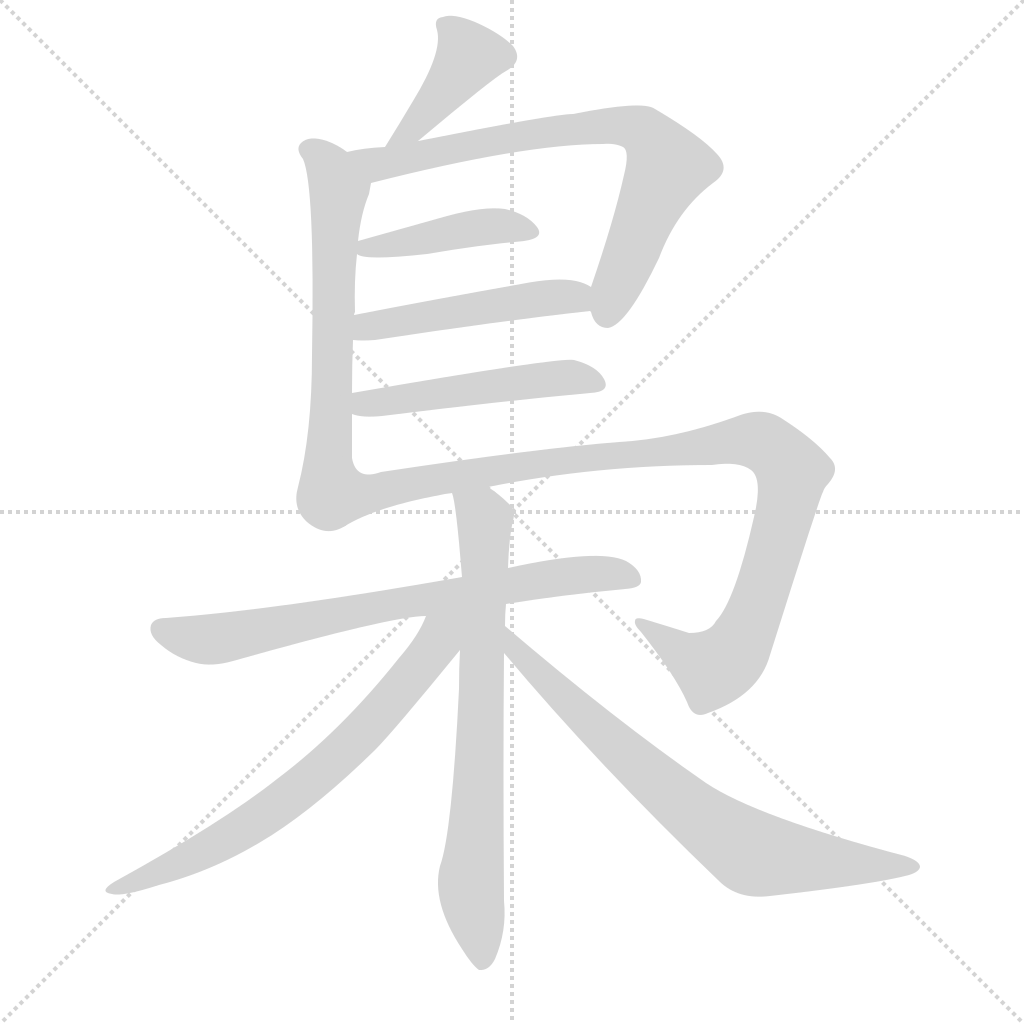
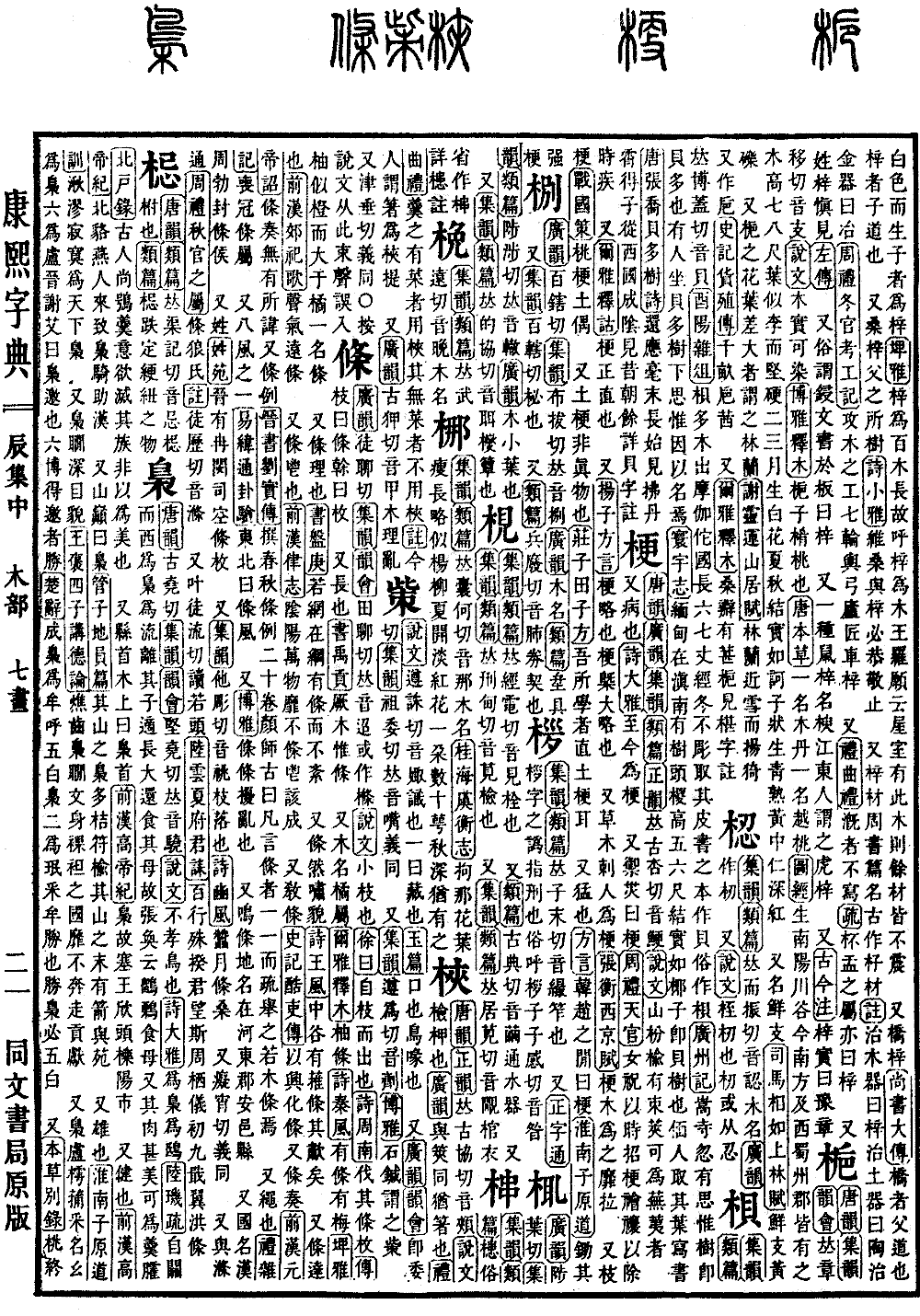
Chen Collection, Middle Volume. Radical: Tree (mù). 11 Kangxi strokes. Page 529, Entry 16.
Pronounced xiao.
According to the Shuowen Jiezi (Explanation of Simple and Compound Characters), it is an unfilial bird. In the Book of Odes (Shijing), it is written: To be a screech owl, to be a kite. Lu Ji, in his commentary, notes that from the passes to the west, it is called a screech owl or a wandering bird. When its young mature, they eat their mother. Therefore, Zhang Huan said: The owl (liuli) is a bird that eats its mother. Furthermore, its meat tastes delicious and can be made into a thick soup. The Beihu Lu (Record of the Northern Regions) states that the ancients also ate owl soup, intending to exterminate its kind, not because they found it delicious.
It also refers to the act of decapitating someone and hanging the head on a wooden pole, known as xiao shou (exposing the head). In the History of the Former Han (Qianhan Shu), it is recorded that the head of the deceased King of Sai, Sima Xin, was hung in the market of Yueyang.
It also means brave and vigorous. In the History of the Former Han, it is recorded that the northern nomads and the people of Yan came to present valiant cavalry to assist the Han army.
It also refers to a mountain peak. In the Guanzi (Book of Master Guan), the chapter on earth and geography states: On the peak of that mountain, there are many tangerine trees, fu trees, and elm trees. At the foot of that mountain, there are arrow bamboo and yuan grass.
It also refers to a powerful leader. In the Huainanzi (Book of the Prince of Huainan), it is stated: By remaining in a state of purity and tranquility, one can become a heroic leader of the world.
Also xiao xian, describing the appearance of deep-set eyes. In the Four Masters Discoursing on Virtue (Sizi Jiangde Lun) by Wang Bao, it is written: Those countries with scorched teeth, deep-set eyes, tattooed bodies, and naked forms, all came running to pay tribute.
Also xiao lu, which is the name of a winning throw in the game of bo (a traditional board game). A throw of one is xiao, and six is lu. Xie Ai of the Jin dynasty said: Xiao means to seize. In the game of liubo, the person who achieves the xiao throw wins. In the Chu Ci (Songs of Chu), it is written: Throwing a xiao to win, calling out in hope of obtaining the five white tokens. Xiao plus two points is called min cai, and mou means to take. To exceed the xiao throw, one must throw the five white tokens.
According to the Bie Lu (Additional Record) of the Bencao (Materia Medica), a peach that does not wither until winter is called a xiao peach.
It is also a surname. According to the Xingpu (Genealogy of Surnames), after Emperor Yang of Sui executed Yang Xuangan, he changed his surname to Xiao.
Editorial notes: In the Chu Ci, the text reads as win by mou. Based on the original text, this has been corrected to and mou.