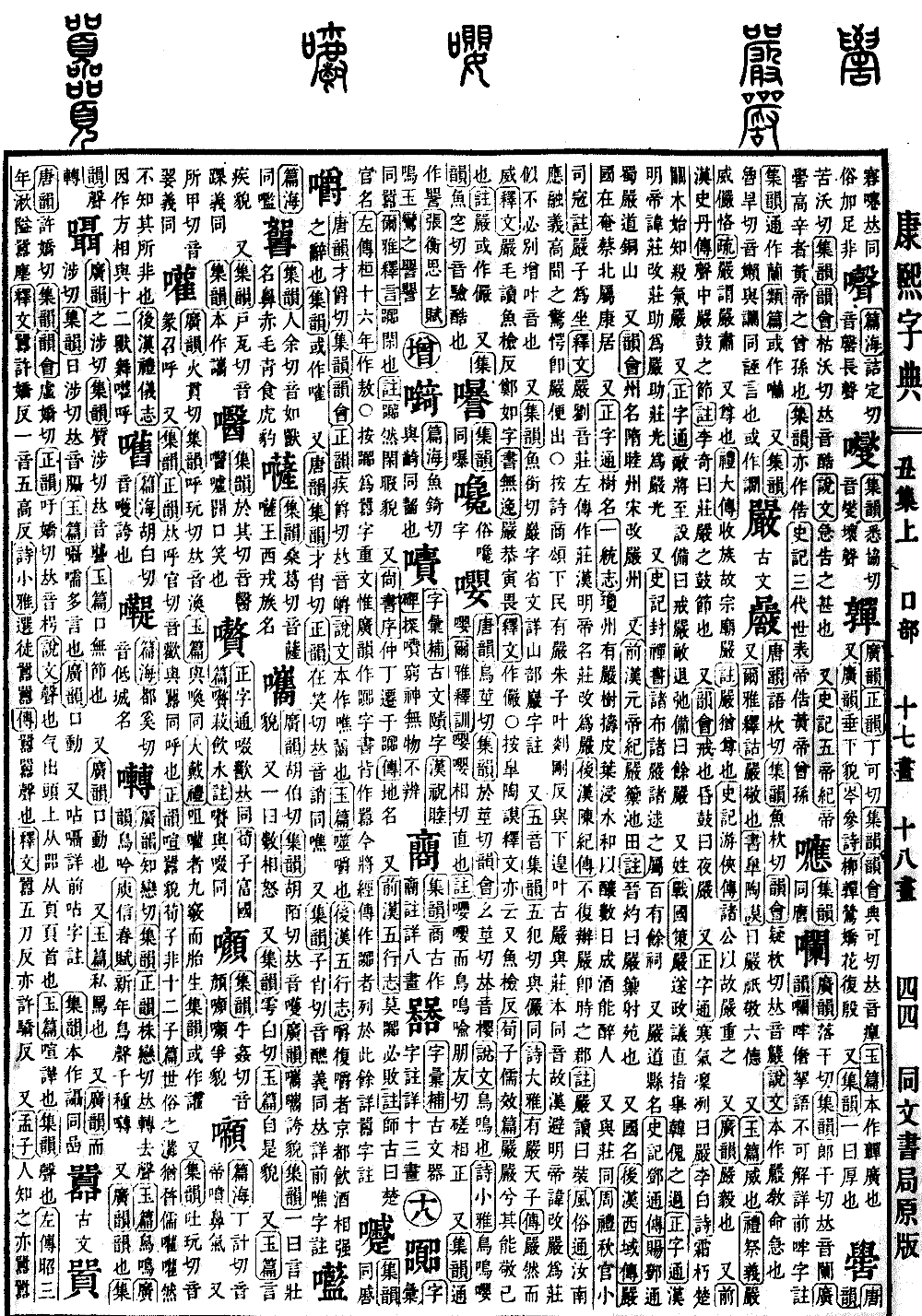
Chou Collection, Upper Volume
Radical: Mouth (kǒu)
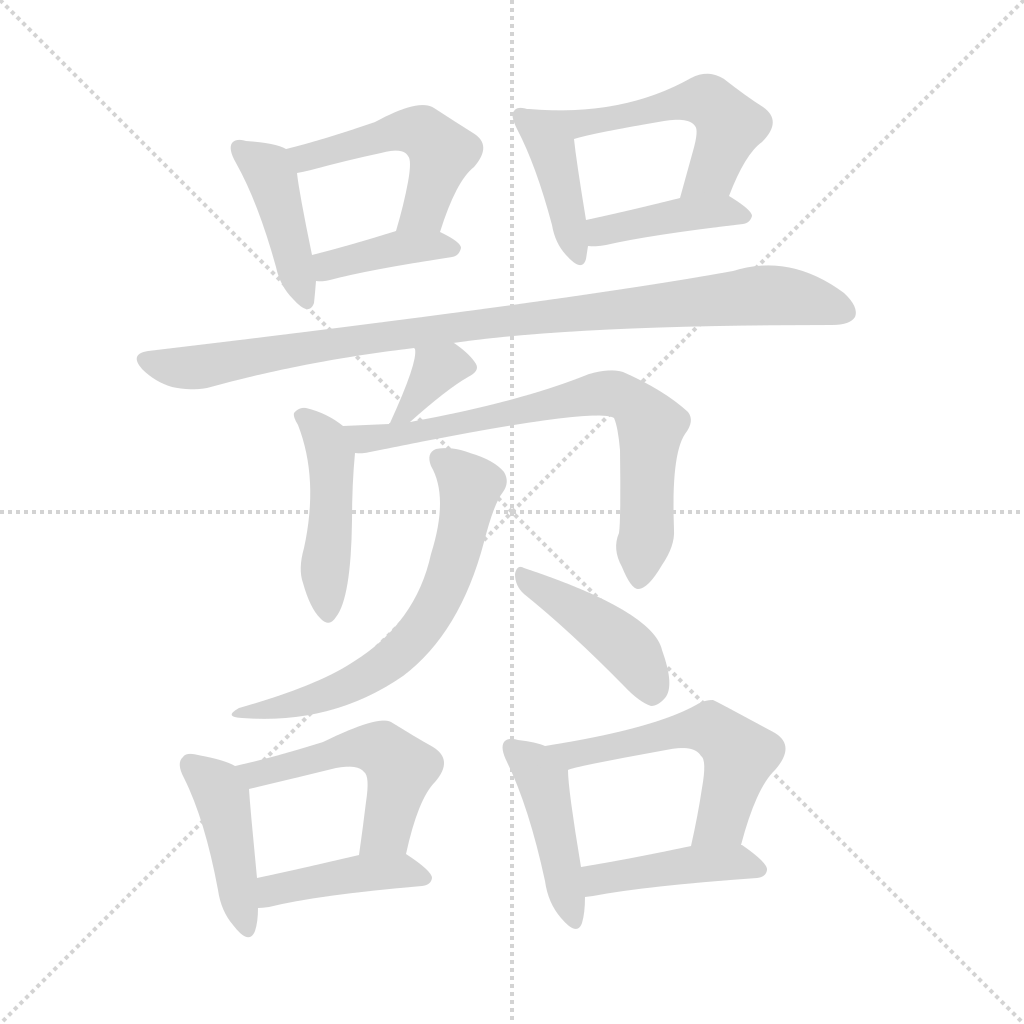
Character: Xiao
Kangxi stroke count: 21
Page 214, Entry 01
Ancient form. Pronounced xiao. According to the Shuowen Jiezi (Shuowen), it refers to sound; breath coming out over the head. Composed of two mouth symbols and the radical for head. According to the Yupian, it means clamorous or noisy. According to the Jiyun, it refers to sound. In the Zuo Zhuan (Zuo Zhuan), it refers to a swampy, narrow place with clamor and dust. In the Book of Odes (Shijing), Xiaoya, it describes selected troops making noise. In the Mencius, it describes a person who is content and without desire, whether known or unknown by others. Also used as a personal name. In the Records of the Grand Historian (Shiji), the Yellow Emperor had two sons, one named Xiao, who was known as Qingyang. Pronounced ao. The meaning is the same. In the Rites of Zhou (Zhouli), the official in charge of noise control. In the Book of Odes (Shijing), Xiaoya, it describes the clamor of slanderous mouths. In the History of the Former Han (Qianhan), it describes the people suffering from insufficiency and feeling clamorous. Also, a mountain recess is called xiao. In the Seven Mountains Temple Rhapsody by Emperor Xuan of Liang, it describes the spirit of the mountain as imposing and standing alone. Also, the name of a bird. According to the Classic of Mountains and Seas (Shanhaijing), on Liangqu Mountain there is a bird that looks like a Kuafu, with four wings, one eye, and a dog's tail, named Xiao. Also, the name of a beast. According to the Classic of Mountains and Seas (Shanhaijing), on Yucich Mountain there is a beast that looks like a monkey, with long arms and skilled at throwing, named Xiao. Also, the name of a river. According to the Classic of Mountains and Seas (Shanhaijing), the Xiao River originates from Bozhong Mountain. Also, the name of a mountain. According to the Classic of Mountains and Seas (Shanhaijing), Beixiao Mountain has no stone; its sunny side has much green jade, and its shady side has much jade. Also, a place name. Commonly written as ao or ao. Refer to the note under the character ao. Note that in the classics and commentaries, xiao is often pronounced ao, with the exception of the Che Gong chapter of the Book of Odes and the Zuo Zhuan, where the commentaries provide both the ao and xiao pronunciations.