Hai Collection, Upper Volume
Radical: Carriage (chē)
Xiang
Kangxi strokes: 27
Page 1447, Entry 24
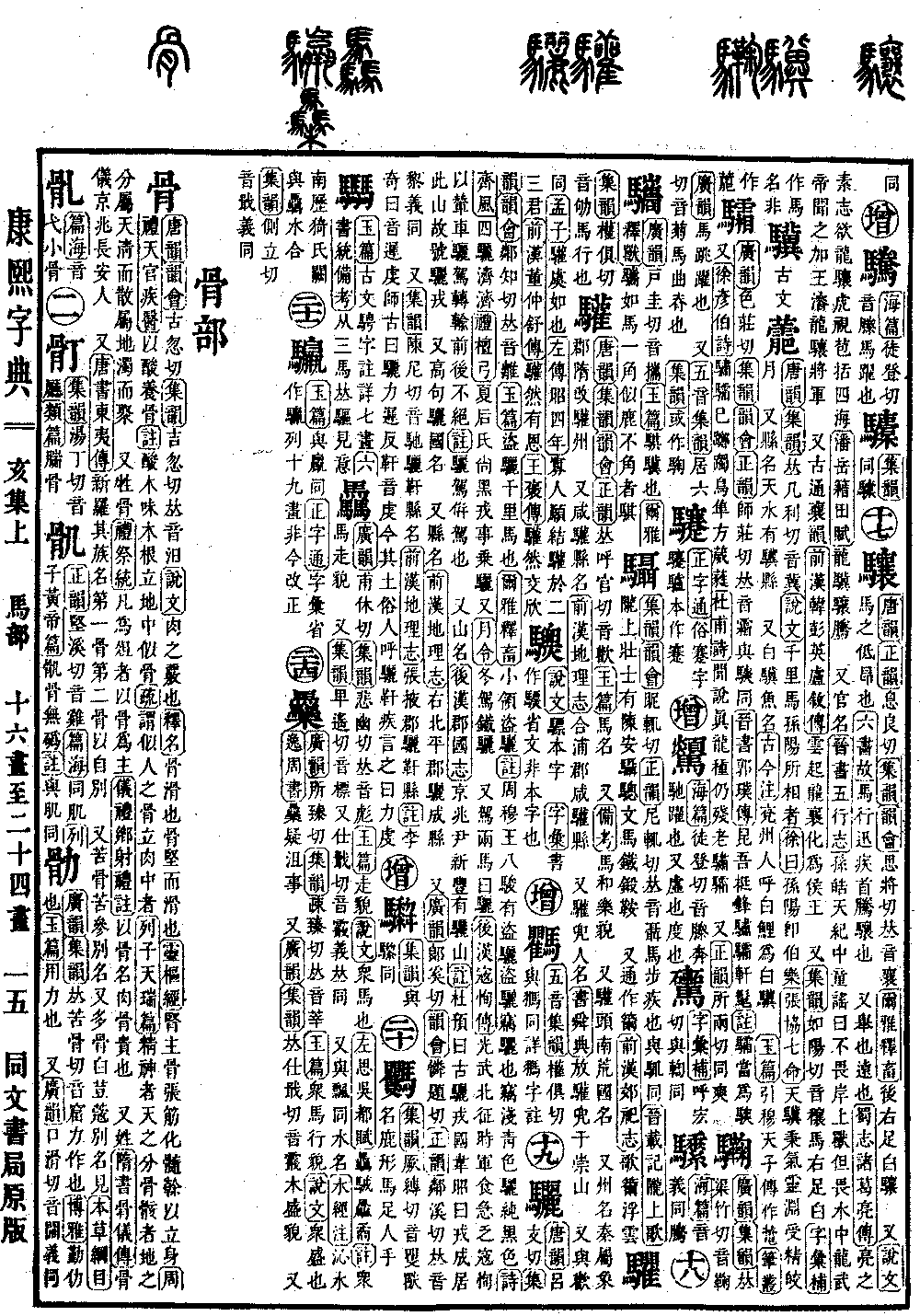
Pronounced xiang. According to the Erya (Erya), a horse with a white right hind foot is called xiang. According to the Shuowen (Shuowen), it refers to the rising and lowering of a horse's head. According to the Liushu Gu (Liushu Gu), it refers to a horse running swiftly with its head held high. It also means to raise or to be distant. In the Records of Shu (Shu Zhi), specifically the Biography of Zhuge Liang, it states that Zhuge Liang’s ambition was to rise like a dragon and watch like a tiger, encompassing the four seas. In the Rhapsody on Tilling the Fields (Jitian Fu) by Pan Yue, it is written that the dragon steed rises and leaps. It is also an official title. According to the History of Jin (Jin Shu), in the section on the Five Elements, a children’s ballad during the Tianji era of Sun Hao said: Do not fear the beasts on the shore, but fear the dragon in the water. When Emperor Wu heard this, he appointed Wang Jun as General of Dragon-Rising. It is also used interchangeably with the sound xiang in ancient texts. In the History of the Former Han (Qian Han Shu), in the biographies of Han Xin, Peng Yue, Ying Bu, and Lu Wan, it says that clouds rise and dragons soar, transforming into marquises and kings. Pronounced rang. A horse with a white right foot. According to the Zihui Bu (Zihui Bu), it is listed as a horse name, which is incorrect.