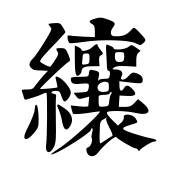
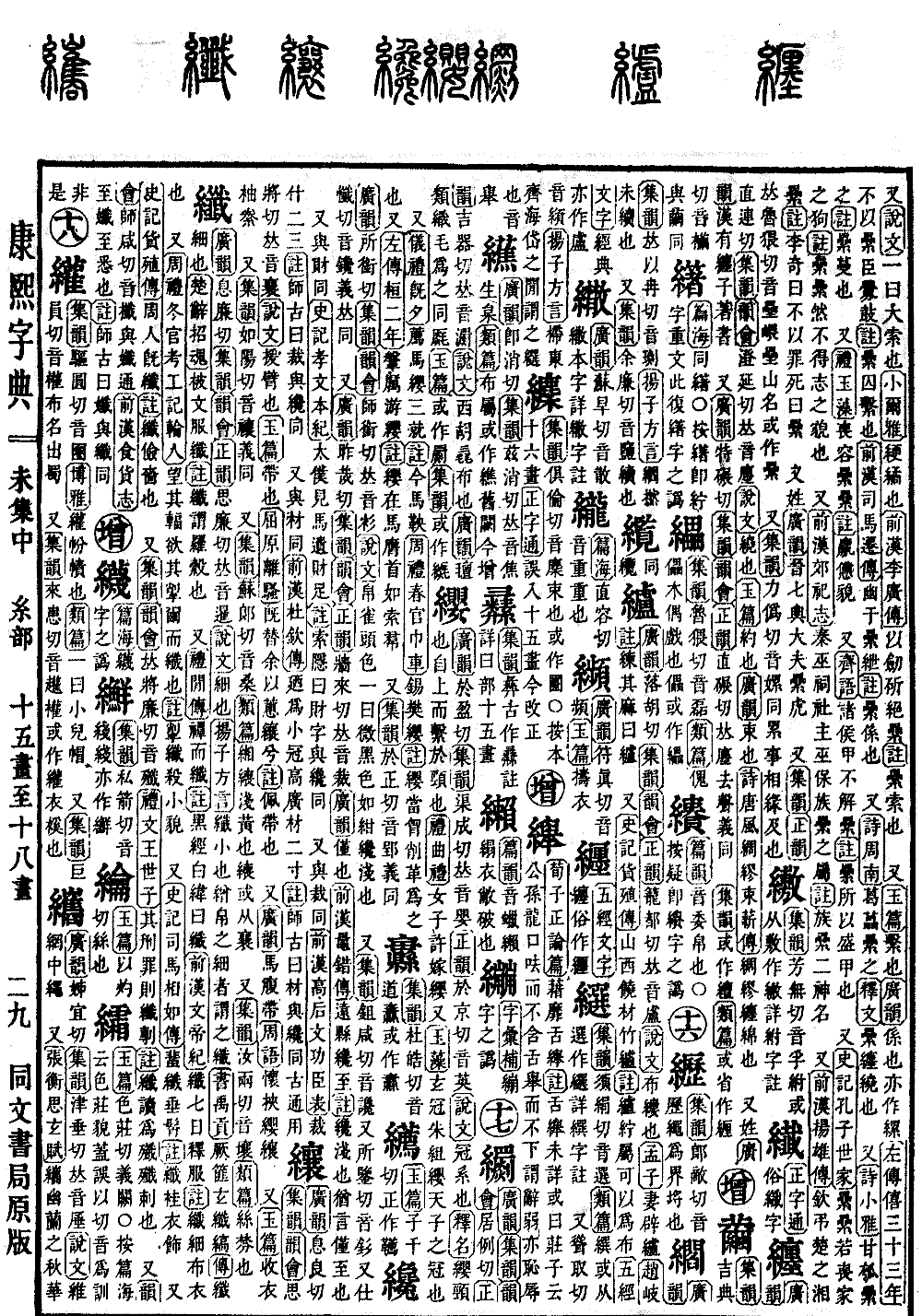
Wei Collection, Middle Volume
Radical: Silk (mì)
Kangxi Strokes: 23
Page 943, Entry 28
Pronounced xiang.
According to the Analytical Dictionary of Chinese Characters (Shuowen Jiezi), it means to pull up one's sleeves.
According to the Jade Chapters (Yupian), it refers to a belt or sash.
In the poem Encountering Sorrow (Lisao) by Qu Yuan, it is written: Having replaced my belt with fragrant herbs.
Commentary: It refers to a decorative belt worn at the waist.
Also, according to the Extensive Dictionary of Sounds and Meanings (Guangyun), it refers to the belly band of a horse.
According to the Discourses of the States (Guoyu), one carries a belt and a sash.
Note: The original text cited the Discourses of Jin (Jinyu) for this passage, but it has been corrected to the Discourses of the States (Guoyu) to match the primary source.
Also, according to the Jade Chapters (Yupian), it refers to gathering up one's sleeves.
Also pronounced xiang. The meaning is the same.
Also pronounced sang. According to the Classified Dictionary (Leipian), it refers to a light yellow color. This is a variant form, sometimes written using the character for side (xiang) as a phonetic component.
Also pronounced rang. According to the Classified Dictionary (Leipian), it refers to tangled silk threads.