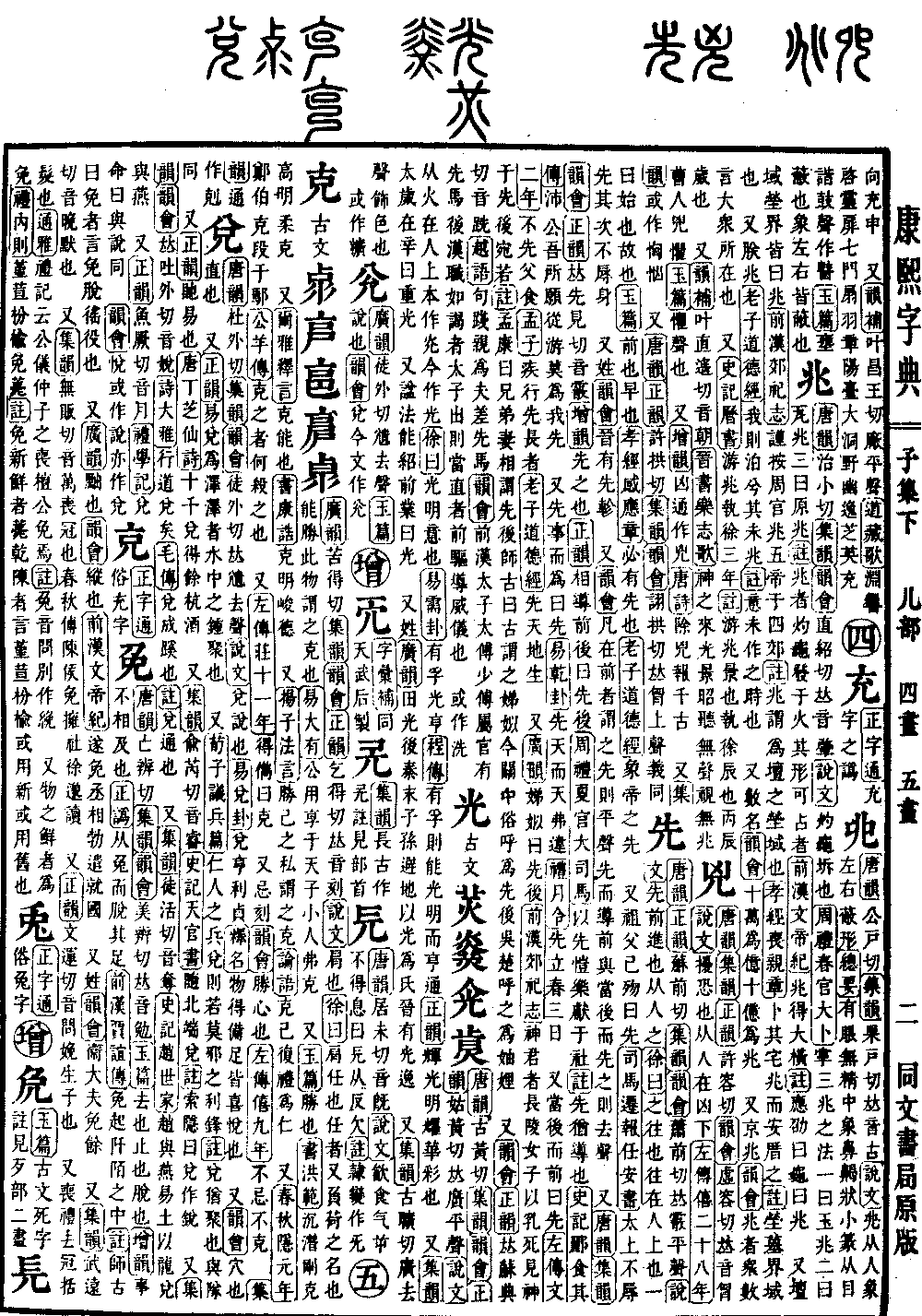
Zi Collection, Page Position: Lower
Radical: Man (ér)
Character: xiān
Kangxi stroke count: 6
Page 124, number 05
Tang Rhymes (Tangyun) and Zheng Rhymes (Zhengyun): Pronounced with the initial s and final ian. Collected Rhymes (Jiyun) and Rhyme Compendium (Yunhui): Pronounced with the initial x and final ian, level tone.
Explaining Writing and Analyzing Characters (Shuowen Jiezi) states that xiān means to advance. It is composed of the radicals for man and to go. Xu says that to go means to proceed, and it refers to proceeding ahead of another person. Another definition says it means the beginning or of old.
Jade Chapters (Yupian) defines it as in front or early.
There must be a predecessor — Classic of Filial Piety (Xiaojing).
Existing before the Heavenly Emperor — Classic of the Way and Virtue (Daodejing).
Also, a deceased father or grandfather is referred to as xiān.
The highest priority is not to disgrace one's ancestors; the next is not to disgrace one's person — Letter in Reply to Ren An (Bao Ren An Shu).
Also a surname. Rhyme Compendium (Yunhui) notes that there was a person named Xian Zhen in the state of Jin.
The Rhyme Compendium (Yunhui) also states that generally, anything that is in front is called xiān, using the level tone. When used to mean leading in front or taking precedence over what should follow, it is pronounced in the departing tone.
In the Tang Rhymes, Collected Rhymes, Rhyme Compendium, and Zheng Rhymes, it is also pronounced as xiàn. Augmented Rhymes (Zengyun) defines this as to put something first.
Zheng Rhymes (Zhengyun) states that guiding one another before and after is called xiānhòu.
To lead with the music of victory and present it at the altar of the god of the soil — Rites of Zhou (Zhouli).
The commentary states that xiān is like leading.
The Lord of Pei is one whom I wish to follow, but there is no one to lead me to him — Records of the Grand Historian (Shiji).
Also, doing something before an event occurs is called xiān.
Acting before Heaven, and Heaven does not go against it — Classic of Changes (Yijing).
Three days before the beginning of spring — Book of Rites (Liji).
Also, taking precedence when one should follow is called xiān.
Not taking precedence over one's father at a meal — Zuo Tradition (Zuozhuan).
Walking quickly to precede one's elders — Mencius (Mengzi).
Born before Heaven and Earth — Classic of the Way and Virtue (Daodejing).
In the Expanded Rhymes (Guangyun), sisters-in-law are called xiānhòu.
The Divine Sovereign was a woman of Changling who died in childbirth and appeared as a spirit to her sister-in-law Wan Ruo — History of the Former Han (Qian Hanshu).
The commentary by Meng Kang states that the wives of brothers call each other xiānhòu. Yan Shigu states that anciently they were called dìsì; currently in the Guanzhong region they are commonly called xiānhòu, while in the Wu and Chu regions they are called zhóulǐ.
In the Rhyme Compendium (Yunhui) and Zheng Rhymes (Zhengyun), it is also pronounced as xiǎn.
Goujian personally acted as an outrider for Fuchai — Discourses of the States (Guoyu).
The Rhyme Compendium (Yunhui) states that during the Former Han, the subordinate officials of the Crown Prince's Grand Tutor and Junior Tutor included the xiǎnmǎ. In the Latter Han, the position was similar to a receptionist; when the Crown Prince went out, the official on duty would ride ahead to lead the procession. This is sometimes also written in a variant form pronounced xǐ.