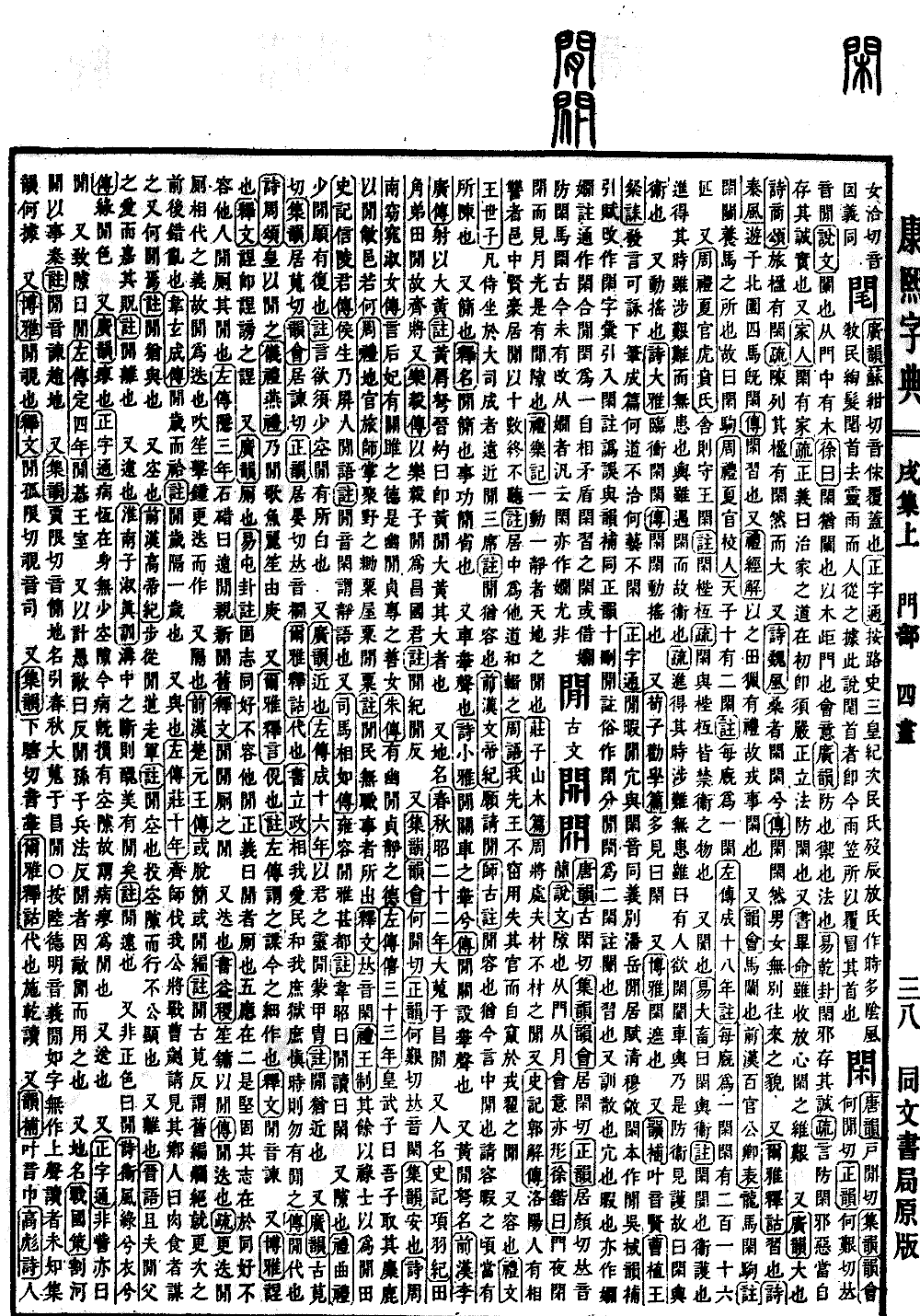
Xu Collection, Upper Volume
Radical: Gate (mén)
Kangxi Strokes: 12
Page 1332, Entry 02
Pronounced xian
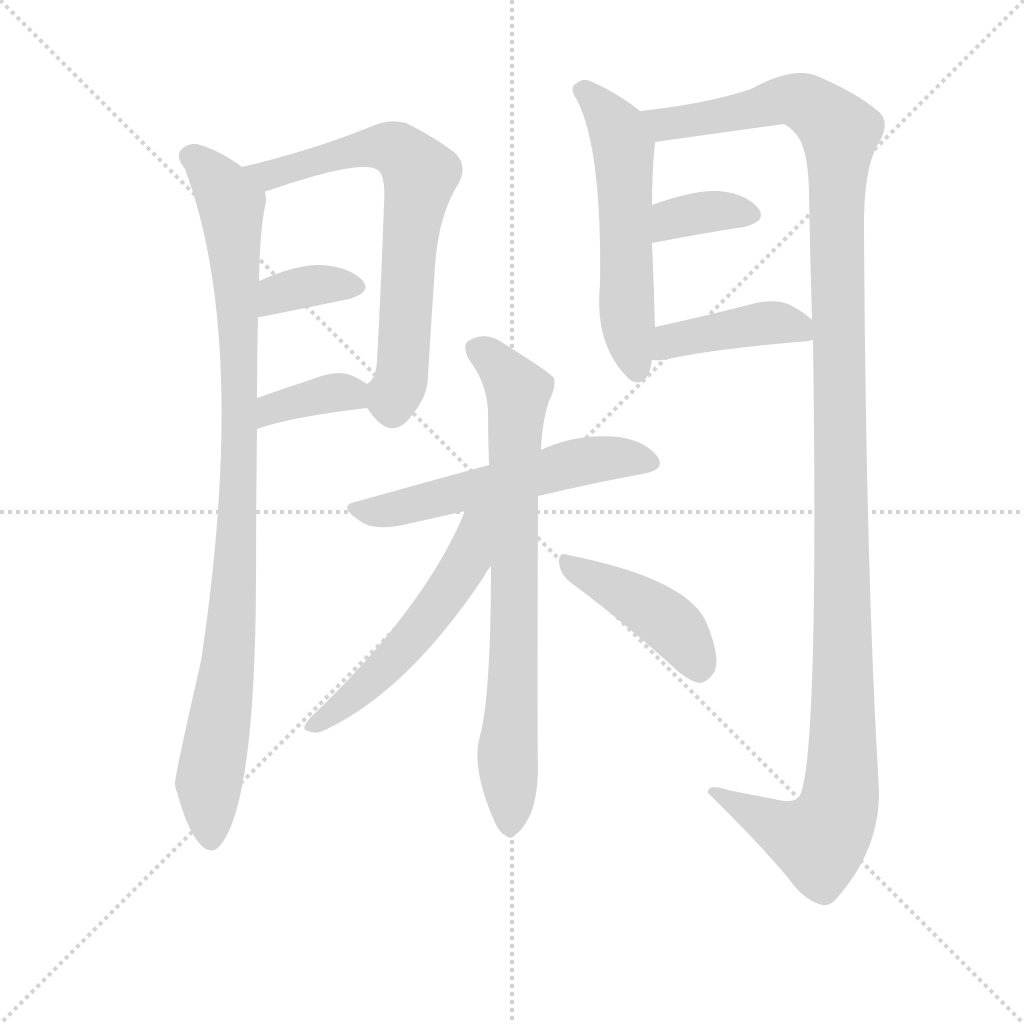
According to Explaining Graphs and Analyzing Characters (Shuowen Jiezi), it means a barrier. Composed of the gate radical with wood in the middle. Xu says: it is like a barrier, using wood to block a gate. It is a compound ideograph.
In Broad Rhymes (Guangyun), it means to prevent, to resist, or to establish law.
Book of Changes (Yijing), Qian hexagram: Prevent evil and preserve one's sincerity. The commentary states: This refers to preventing evil and wickedness; one should personally preserve one's sincerity.
Also, in the Family hexagram: Regulate the family. The commentary states: The way to govern a family lies in the beginning; one must strictly establish laws and preventions.
Book of Documents (Shujing), Bi Ming chapter: Though one may restrain a wandering heart, it is difficult to maintain this restraint.
Also, in Broad Rhymes: Great.
Book of Odes (Shijing), Shang Song section: The rows of pillars are great. The commentary says: The arrangement of the pillars is grand and large.
Also, in Book of Odes, Wei Feng section: The mulberry pickers are leisurely. The commentary says: Leisurely describes the appearance of men and women coming and going without clear separation.
Also, in Er Ya (Glossary of Terms), Shi Gu chapter: To practice.
Book of Odes, Qin Feng section: Wandering in the northern garden, the four horses are well-trained. The commentary says: Xian means to practice.
Record of Rites (Liji), Jing Jie chapter: By using hunting to teach etiquette, military affairs become practiced.
Also, in Rhyme Compilation (Yunhui): A horse enclosure.
History of the Former Han (Qianhan Shu), Table of Officials and Ministers: Royal steeds and corralled colts. The annotation says: Xian is an enclosure, a place for raising horses. Thus, it is called a corralled colt.
Rites of Zhou (Zhouli), Xia Guan section, Master of Horses: The Son of Heaven has twelve enclosures. The annotation says: Each stable constitutes one enclosure.
Zuo Tradition (Zuozhuan), annotation to the 18th year of Duke Cheng: Each stable is one enclosure, and an enclosure holds two hundred sixteen horses.
Also, in Rites of Zhou, Xia Guan section, Tiger Gallant Officers: When staying, guard the royal enclosure. The annotation says: Xian refers to a wooden barrier. The commentary says: Both xian and bianhu are objects used for restricted guarding.
Also, to obstruct.
Book of Changes, Da Chu hexagram: The daily blocking of the carriage and its guards. The annotation says: Xian means to obstruct. Wei means to protect. Advancing at the right time, though one may encounter hardship, there is no disaster. Though the carriage meets an obstruction, it is protected. The commentary says: Advancing at the right time and encountering difficulties without disaster means that even if someone intends to block the carriage, it is a matter of defensive protection, hence it is called blocking the carriage and guards.
Also, to shake or move.
Book of Odes, Da Ya section: The scaling ladders and battering rams sway. The commentary says: Xian-xian means shaking or moving.
Also, in Xunzi, Exhortation to Learning chapter: To have seen much is called being practiced (xian).
Also, in Guang Ya: Xian means to screen or cover.
Also, in Rhyme Supplement (Yunbu): Rhymes with xian. Cao Zhi, Eulogy for Wang Can: Words are worth chanting, brush strokes form chapters. What path is not harmonious, what art is not practiced?
Zhengzitong states: The terms for leisure (xian) and idleness (xian) have the same pronunciation but different meanings. In Pan Yue's Rhapsody on Living in Seclusion, the original text used the form for leisure; Wu Yu's Rhyme Supplement cited the rhapsody but changed it to this character. The Dictionary of Characters incorporated this into the entry for this character, which is an error shared with the Rhyme Supplement. The Zheng Yun dictionary in the ten-shan rhyme category lists the variant form for leisure; vulgar usage creates this character, erroneously splitting leisure into two. The entry for this character defines it as a barrier or to practice; it also defines it as scattered, idle, or leisure. It is also written as xian. The entry for xian says it is interchangeable with this character. Combining leisure into one is self-contradictory. The use of xian for practice is sometimes borrowed from the xian character, but for defense or horse enclosures, no historical precedent exists to change them to xian; the general claim that this character is also written as xian is particularly incorrect.