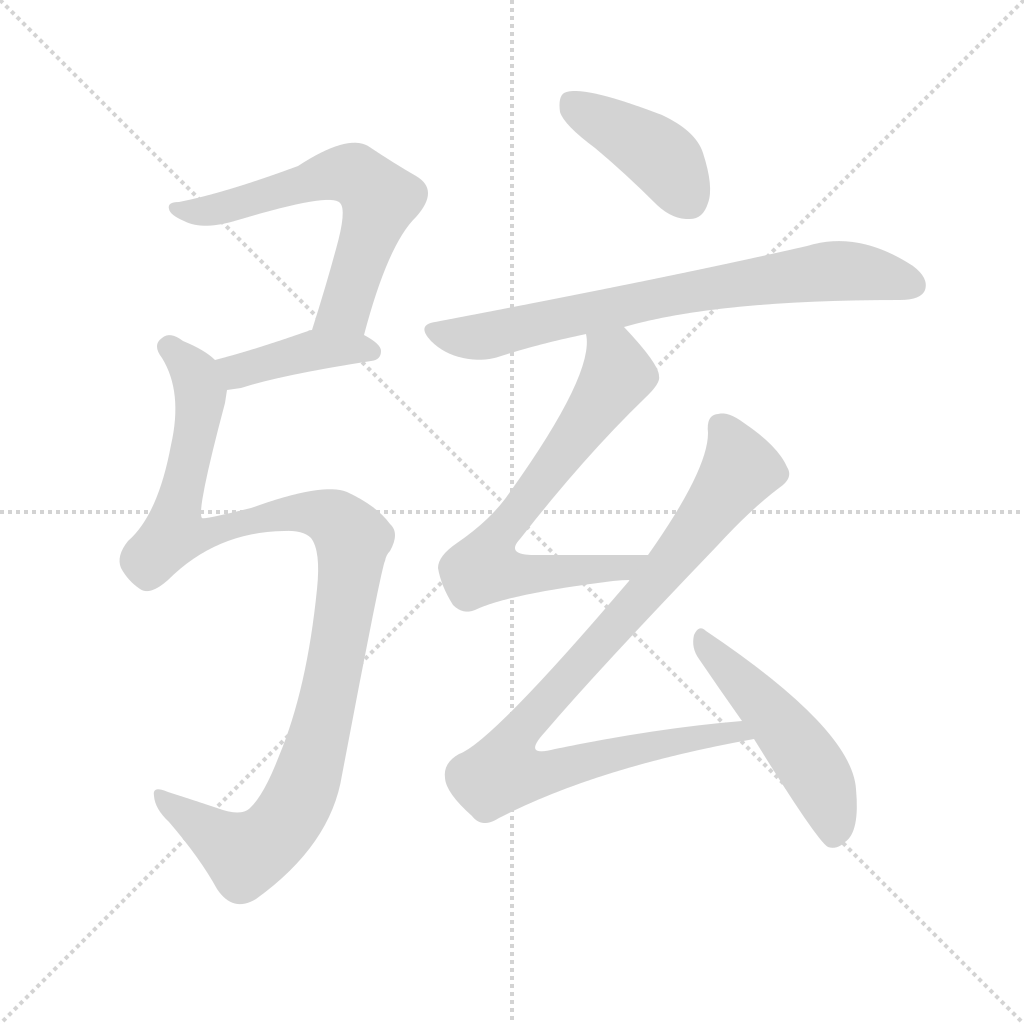
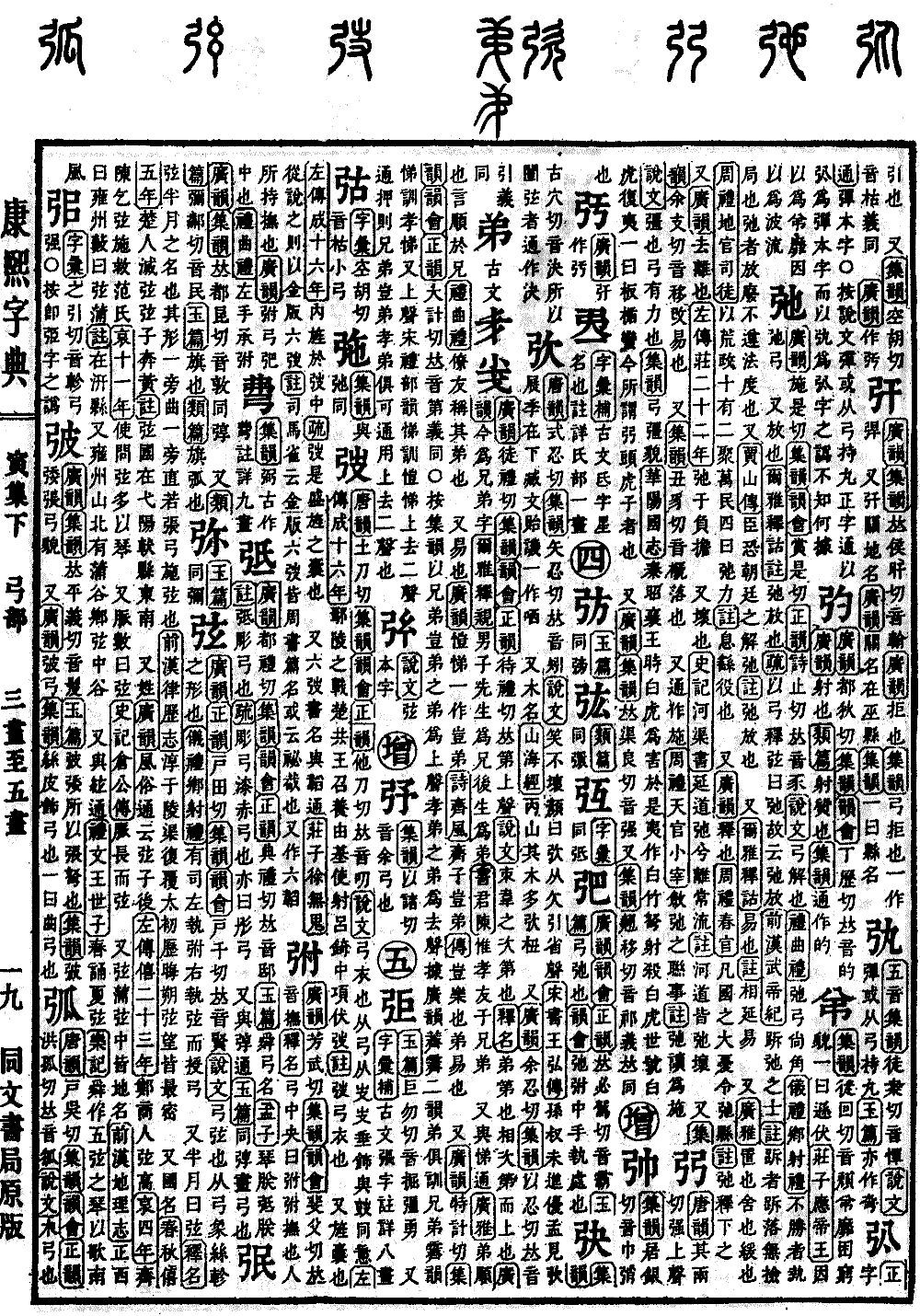
Yin Collection, Lower Volume
Radical: Bow (gōng)
Kangxi Strokes: 8
Page 357, Entry 31
Broad Rimes (Guangyun) and Correct Rimes (Zhengyun): pronounced xian. Collected Rimes (Jiyun) and Rhyme Collection (Yunhui): pronounced xian.
Explanatory Dictionary of Characters (Shuowen): The string of a bow. Formed from the bow radical, depicting the shape of silk being wound.
Book of Etiquette and Ceremonial (Yili), Rites of Rural Archery: The officer holds the bow grip with the left hand and the string with the right hand when handing over the bow.
Also, the half-moon is called xian.
Explanation of Names (Shiming): Xian is the name for the half-moon. Its shape is curved on one side and straight on the other, like a taut bow with a string attached.
History of the Former Han (Qianhan), Treatise on Music and Calendars: Chunyu Lingqu re-examined the Taichu Calendar; the darkness, new moon, half-moon, and full moon were all calculated with high precision.
Also, the name of a state.
Spring and Autumn Annals (Chunqiu), Fifth Year of Duke Xi: The people of Chu destroyed the State of Xian; the Viscount of Xian fled to Huang.
Commentary: The State of Xian was located southeast of Dai County in Yiyang.
Also, a surname.
Broad Rimes (Guangyun): According to the Comprehensive Customs (Fengsu Tong), they are descendants of the Viscount of Xian.
Commentary of Zuo (Zuozhuan), Twenty-third Year of Duke Xi: Xian Gao, a merchant from Zheng.
Fourth Year of Duke Ai: Qi, Ge, and Xian Shi went to rescue the Fan clan.
Eleventh Year of Duke Ai: Sent to ask Xian Duo about the zither.
Also, a pulse that is taut is called xian.
Records of the Grand Historian (Shiji), Biography of Master Cang: The pulse is long and taut.
Also, Xianpu and Xianzhong are both place names.
History of the Former Han (Qianhan), Treatise on Geography: Directly to the west is Yong Province; the marsh is called Xianpu.
Commentary: Located in Qian County; also, north of the mountains in Yong Province there is Pugu Township and Xianzhong Valley.
Also written in a variant form (xian).
Book of Rites (Liji), Hereditary Household of King Wen: Reciting in spring and playing stringed instruments in summer.
Record of Music (Yueji): Emperor Shun created the five-stringed zither to sing the South Wind.