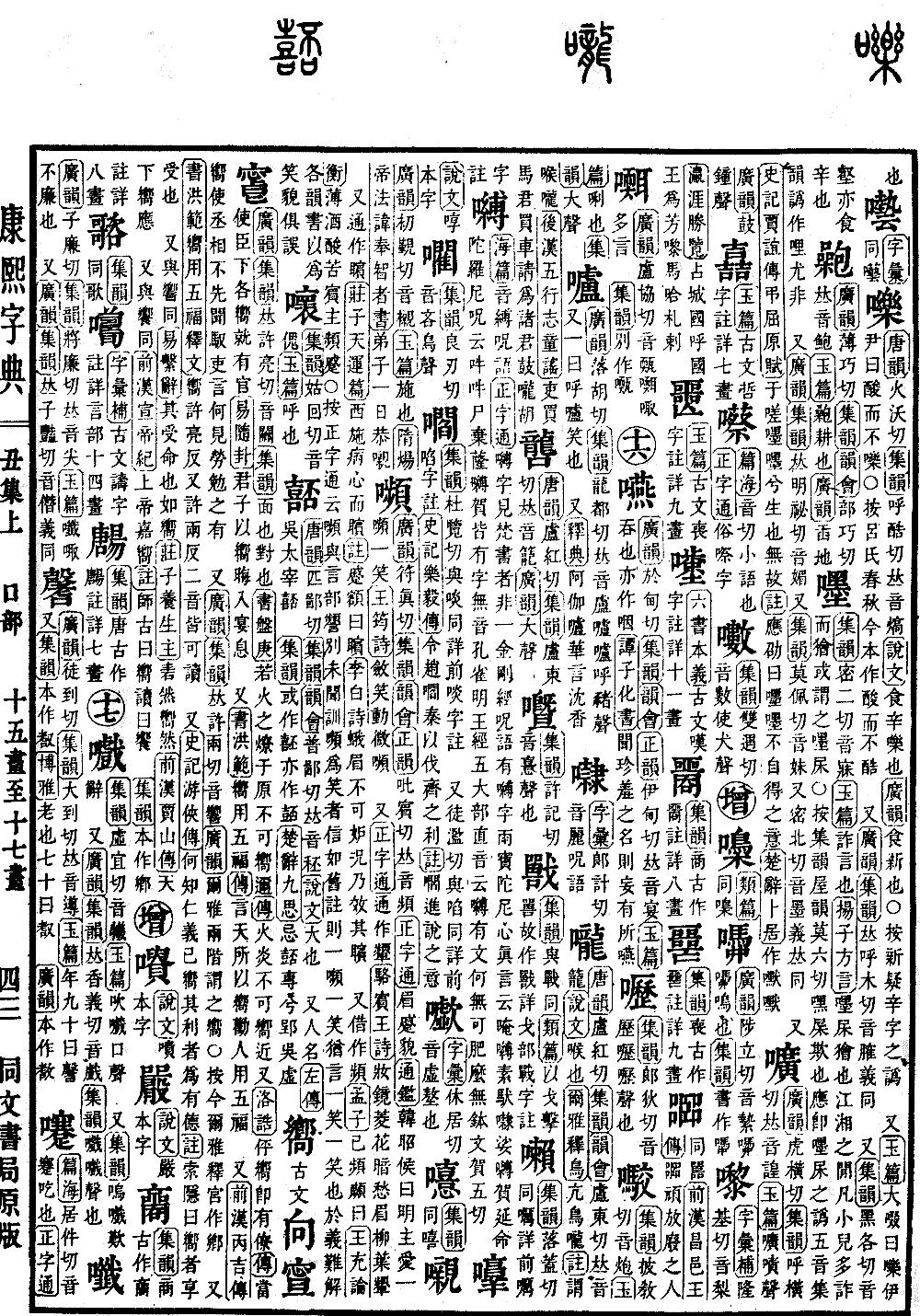
Chou Collection, Upper Volume
Radical: Mouth (kǒu)
嚮
Kangxi stroke count: 19
Page 213, Entry 38
Ancient form of the character Xiang.
Broad Rimes (Guangyun), Collected Rimes (Jiyun): Pronounced xiang (falling tone).
Collected Rimes (Jiyun): Meaning to face toward, or to be opposite.
Book of Documents (Shangshu), Pan Geng chapter: Like fire burning on the plains, one cannot draw near. Commentary: The flames are intense and cannot be approached.
Also, Luo Gao chapter: Cause the ministers to each return to their duties. Commentary: One should cause the ministers to each return to their respective official positions.
Book of Changes (Yijing), Sui hexagram: The gentleman retires to rest at dusk.
Also, Book of Documents (Shangshu), Great Plan (Hongfan) chapter: Use the five blessings to guide and encourage. Commentary: It is said that Heaven uses the five blessings to guide and encourage people.
Also, History of the Former Han (Qian Hanshu), Biography of Bing Ji: If the Chancellor had not first heard the words of the coachman, how would he have received consolation and praise?
Also, Broad Rimes (Guangyun), Collected Rimes (Jiyun): Pronounced xiang (rising tone).
Broad Rimes (Guangyun): Er Ya says that the space between two sets of stairs is called xiang. Note: In the current Er Ya, Explaining Palaces (Shigong), it is written as xiang.
Also, Book of Documents (Shangshu), Great Plan (Hongfan), Xiangyong wufu, Explanatory Text: Xiang, pronounced xiang (falling tone), and also pronounced xiang (rising tone); both pronunciations are acceptable.
Also, Records of the Grand Historian (Shiji), Biographies of Knight-Errants: How can those who do not understand benevolence and righteousness, yet have already enjoyed the benefits, be considered virtuous? Commentary: The Suoyin commentary says: Xiang means to enjoy.
Also, the same as xiang (echo).
Book of Changes (Yijing), Appended Remarks (Xici): It receives orders just like an echo.
Zhuangzi, Nourishing the Lord of Life: A clattering sound.
History of the Former Han (Qian Hanshu), Biography of Jia Shan: The whole world responded to the call.
Also, the same as xiang (offer sacrifice).
History of the Former Han (Qian Hanshu), Annals of Emperor Xuan: Heaven approves and accepts the offerings. Commentary: Shigu says: Xiang is read as xiang (to offer).
Collected Rimes (Jiyun): Originally written as xiang.
Textual Research: Broad Rimes (Guangyun), Er Ya says two sets of stairs is called xiang. According to the original text, the word space has been added after two sets of stairs.