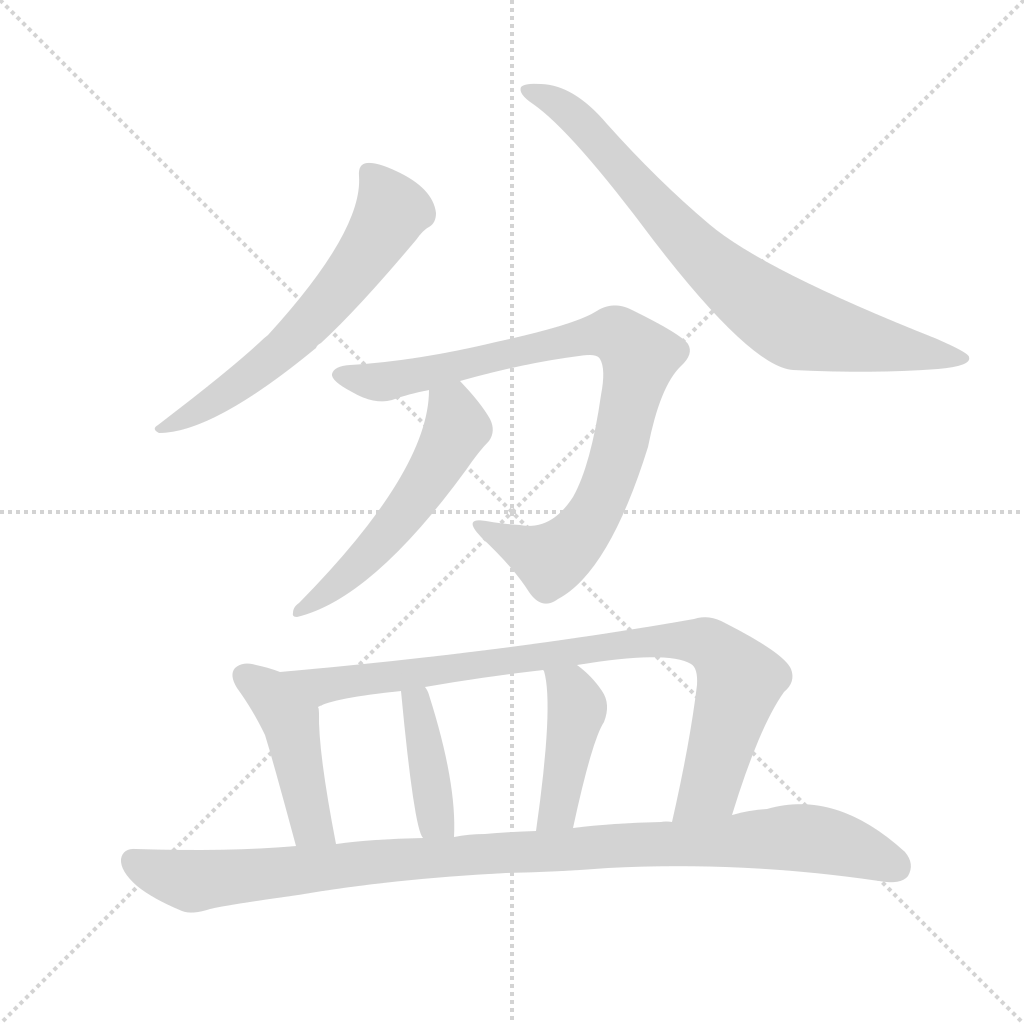
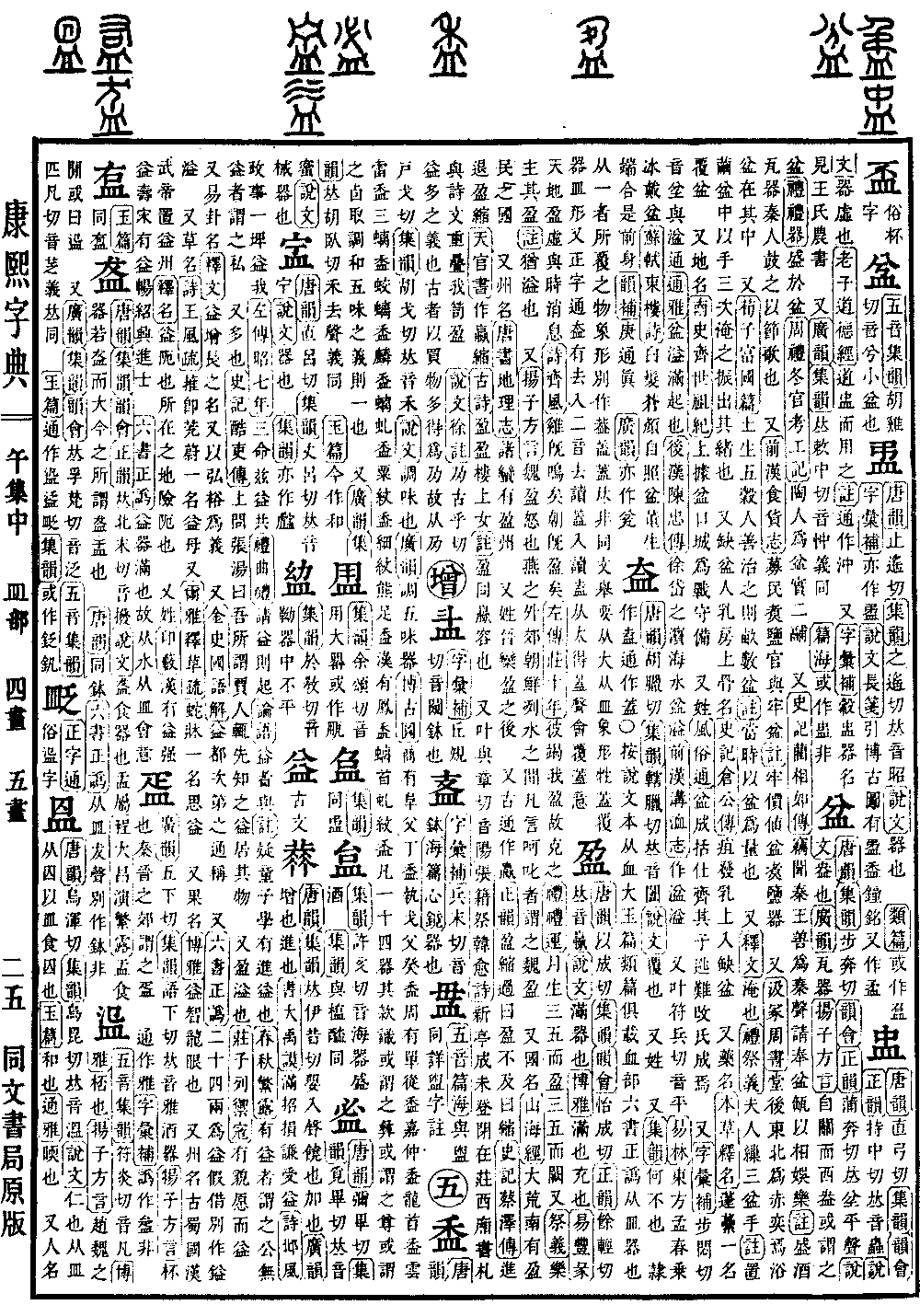
Wu Collection, Middle Volume
Radical: Vessel (mǐn)
Kangxi Strokes: 9
Page 793, Entry 05
Pronounced ben (level tone). According to the Tang Rhyme (Tangyun) and the Collected Rhymes (Jiyun), it is pronounced bu-ben. According to the Rhyme Compendium (Yunhui) and the Correct Rhymes (Zhengyun), it is pronounced pu-ben, read as the level tone of ben.
The Explanation of Script and Elucidation of Characters (Shuowen Jiezi) defines it as a vessel (a container with a large belly and a narrow mouth). The Broad Rhyme (Guangyun) describes it as an earthenware vessel.
The Yangzi Dialect (Fangyan) records: In the regions west of Hangu Pass, a vessel is sometimes called a basin (pen).
The Book of Rites (Liji), Rites and Ceremonial Vessels (Liqi), records: Use a basin to hold items.
The Rites of Zhou (Zhouli), Winter Official: Artificers' Record (Kaogongji), records: The potter makes a basin with a capacity of two fu (an ancient unit of capacity).
Also, the Records of the Grand Historian (Shiji), Biography of Lin Xiangru, records: I have privately heard that the King of Qin excels at playing the music of the Qin region; I request permission to present a basin and a pottery drum to provide mutual entertainment. The commentary notes: The basin is an earthenware vessel for holding wine; the Qin people beat upon it to keep time for singing.
Also, the History of the Former Han (Qianhanshu), Treatise on Food and Money, records: When recruiting the common people to boil salt, the government provides the necessary boiling utensils and salt-boiling basins. The commentary notes: The term lao refers to the value, and the term pen refers to the salt-boiling utensil.
Also, the Bamboo Annals (Jizhu Zhoushu) records: To the northeast behind the hall is the area of Chi-yi; the bathing basin is placed inside.
Also, the Xunzi, Chapter on Wealth and State, records: If the land grows the five grains and the people are skilled at farming, each acre can harvest several basins. The commentary notes: At that time, the basin was used as a unit of measurement.
Also, the Explication of Text (Shiwen) defines it as to submerge (to soak). The Book of Rites (Liji), Meaning of Sacrifices (Jiyi), records: When the wife reels silk, she immerses her hands into the basin three times. The commentary notes: The silkworm cocoons are placed in a basin, and they are submerged three times by hand to draw out the silk threads.
It also refers to the notch of the collarbone, a name for the bone located above the human breast. The Records of the Grand Historian (Shiji), Biography of Cang Gong, records: The malignant sore grew above the breast and penetrated the notch of the collarbone.
It also refers to a medicinal name. The Materia Medica (Bencao), Definition of Names, records: The plant known as peng-lei is also called the raspberry (fupenzi).
It also refers to a place name. The History of the Southern Dynasties (Nanshi), Annals of Emperor Wu of Qi, records: The Emperor occupied the city of Penkou, making preparations for both battle and defense.
It also refers to a surname. The Comprehensive Customs (Fengsu Tong) records: Pencheng Kuo served as an official in the state of Qi; his son, to avoid calamity, changed the surname to Cheng.
Also, the Supplement to the Collection of Characters (Zihuibu) records: Pronounced bu-men, having the same sound as ben. It is interchangeable with the character for overflowing water (pen).
The General Erudition (Tongya) explains: The term pen refers to water overflowing. The Book of the Later Han (Houhanshu), Biography of Zhong, records: Along the coastline near Xu Dai, the sea water surged and overflowed. The History of the Former Han (Qianhanshu), Treatise on Rivers and Canals, writes it as pen-yi (overflowing).
Also, rhyming with bing: Pronounced ping. The Forest of Changes (Yilin) records: In the early spring of the eastern region, one walks upon the ice with a basin on the head.
Su Shi, in his poem for the East Pavilion, writes: With white hair and an aged face, I reflect myself in the basin; Master Dong (Dong Zhongshu) must have been my previous incarnation.
The Rhyme Supplement (Yunbu) explains that the Geng rhyme and the Zhen rhyme are interchangeable. The Broad Rhyme (Guangyun) also writes it as the character for an earthenware pot.