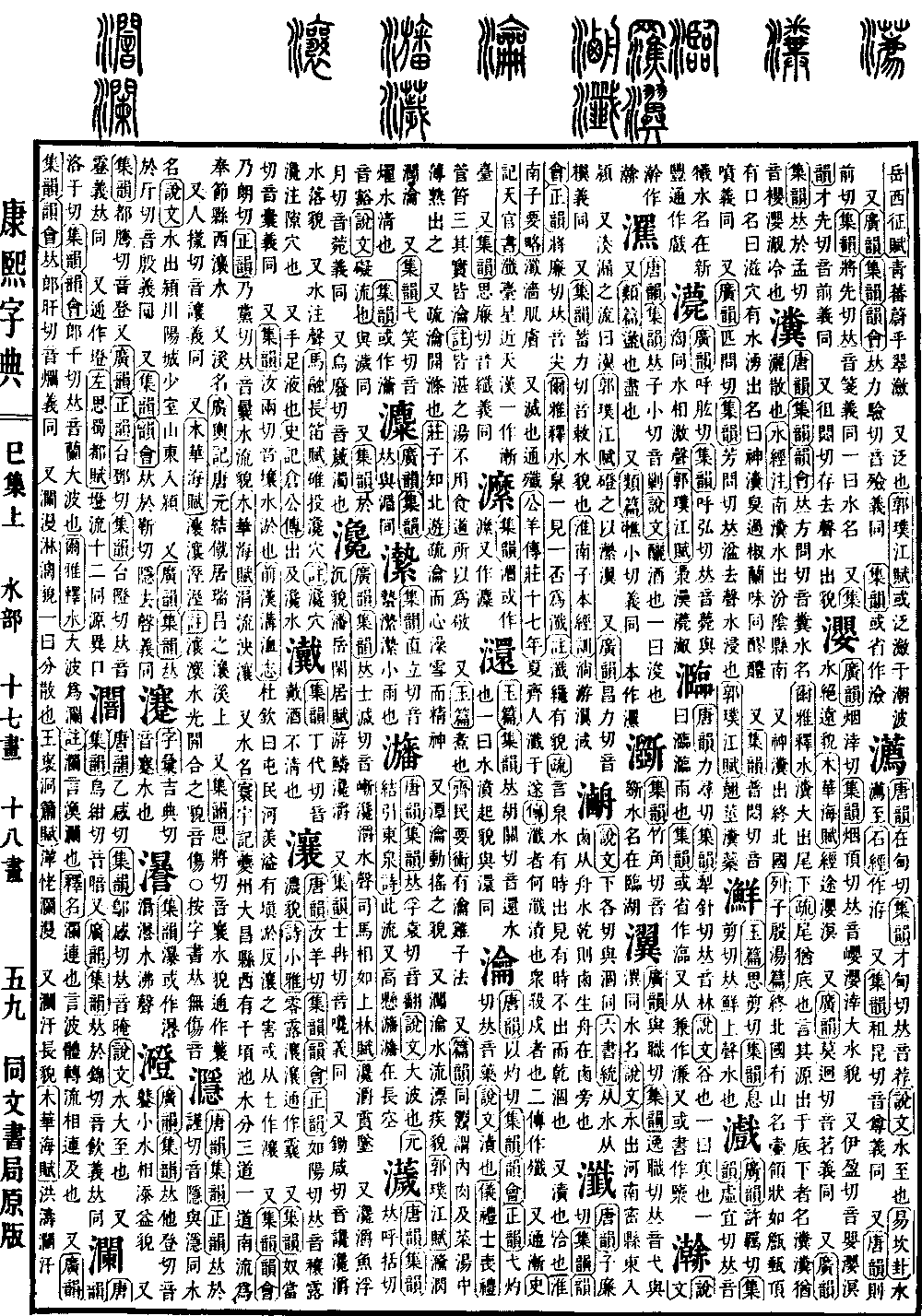
Si Collection, Upper Volume
Radical: Water (shuǐ)
瀼
Kangxi strokes: 21
Page 661, Entry 23
Pronounced rang. Refers to the appearance of heavy dew. Book of Odes (Shijing): The falling dew is heavy. Sometimes also written in a variant form.
Pronounced nang. The meaning is the same.
Pronounced rang. Refers to silt in water. History of the Former Han Dynasty (Qian Hanshu): Du Qin said: Next spring there will surely be overflowing, leading to the danger of silt blockage and backflow. Some editions use the Earth (tǔ) radical and are written as a variant form.
Pronounced nang. Refers to the appearance of flowing water. Mu Hua: Sea Rhapsody (Haifu): Trickling streams are vast.
Also a river name. Universal Geography (Huanyuji): West of Dachang County in Kuizhou, there is a thousand-acre pond; the water divides into three channels, one of which flows south to become the Rang River west of Fengjie County.
Also a stream name. Comprehensive Geography (Guangyuji): Yuan Jie of the Tang Dynasty once rented a residence beside Rang Creek in Ruichang.
Pronounced xiang. Refers to the appearance of water. Also written as a variant form.
Pronounced rang. The meaning is the same.
Mu Hua: Sea Rhapsody (Haifu): Rangrang shishi. Note: Rangrang refers to the appearance of water light opening and closing. Pronounced shang. However, upon investigating dictionaries, there is no such pronunciation as shang.
Textual research: History of the Former Han Dynasty (Qian Hanshu): Du Qin said, the river overflows, causing the danger of silt blockage and backflow. Currently, following the original text with caution, the phrase regarding the river overflowing has been corrected to refer to the inevitable overflowing in the coming spring.