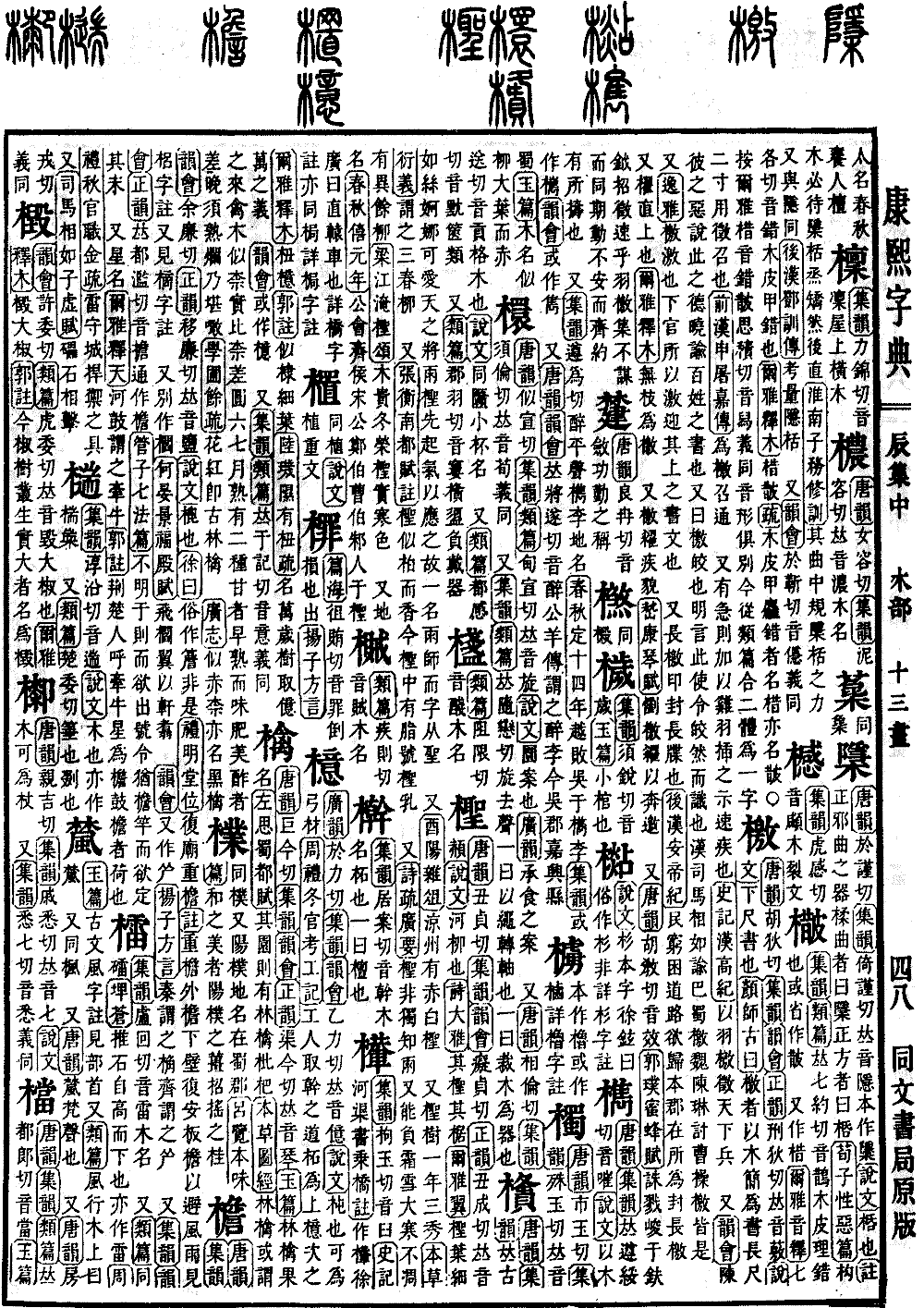
Chen Collection, Middle Volume
Radical: Tree (mù)
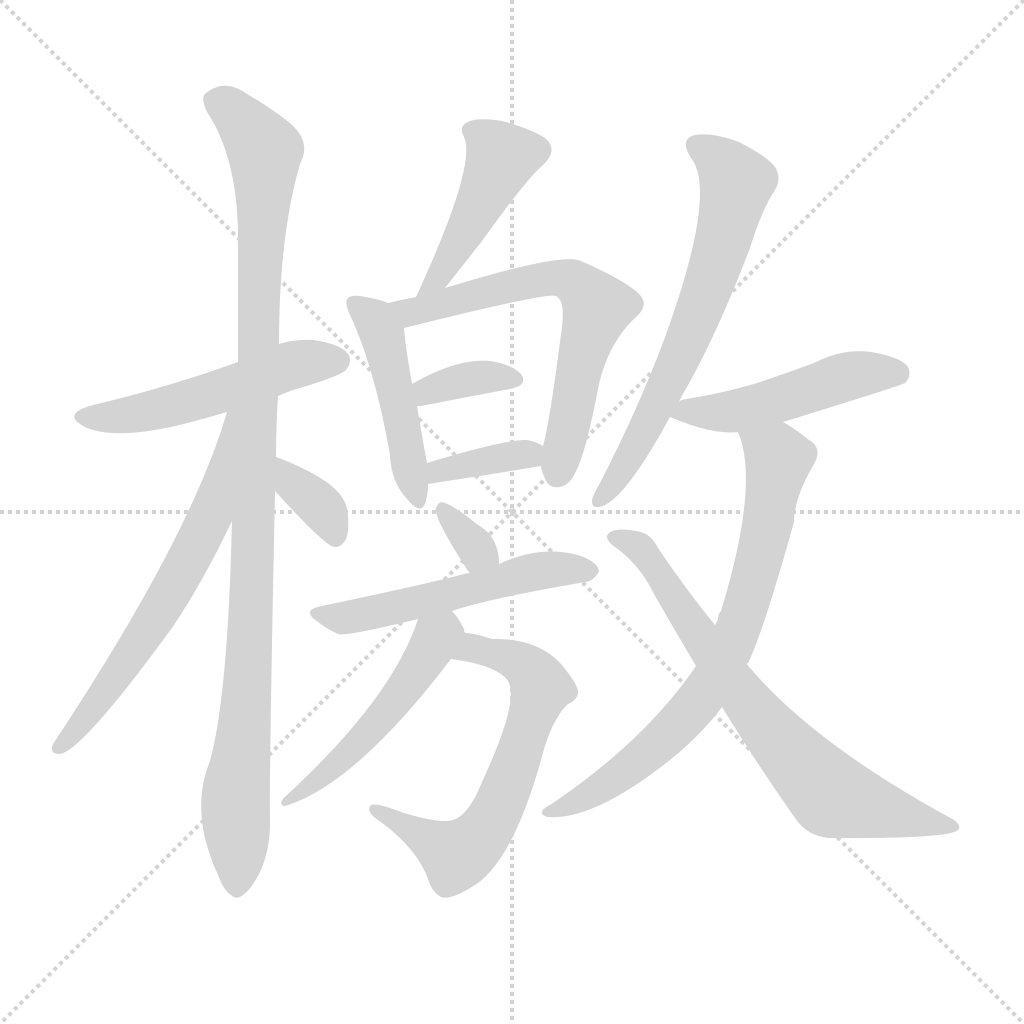
檄
Kangxi strokes: 17
Page 556, Entry 07
Pronounced xiao.
According to the Shuowen Jiezi (Shuowen), it is a document written on a wooden tablet one foot long.
Yan Shigu states: A xi is a document made of wood, twelve inches long, used for summoning people.
In the Biography of Shen Tuji in the History of the Former Han (Qianhan Shu), it is mentioned that he summoned Tong using a xi. If the matter was urgent, chicken feathers were inserted into it to indicate great speed.
In the Annals of Emperor Gao of Han in the Records of the Grand Historian (Shiji), it is recorded that the armies of the world were summoned using a feathered xi.
According to the Yunhui, it is a document that declares the evil of the opponent and the virtue of the self, meant to enlighten the common people. It is also said that xi means clear, indicating that the command is meant to be clearly understood. The Proclamation to Ba and Shu by Sima Xiangru of the Han Dynasty and the Proclamation Denouncing Cao Cao by Chen Lin of the Wei Dynasty are examples of this.
According to the Yi Ya, xi means to stimulate; it is a document used by lower officials to urgently solicit the attention of their superiors.
It also refers to a changxi, which is a long, sealed official document. In the Annals of Emperor An of the Later Han (Houhan Shu), it is noted that when the people were destitute on the roads and wished to return to their home commanderies, the authorities issued them sealed long documents.
It also refers to a long, straight piece of wood. According to the Erya, Explanations of Trees (Erya), a tree without branches is called a xi.
It also means rapid, as in the appearance of someone moving quickly. In the Rhapsody on the Zither (Qin Fu) by Ji Kang, it describes a restless and hurried movement.
Pronounced xiao.
In the Rhapsody on Honeybees (Mifeng Fu) by Guo Pu, it describes punishments as severe as axes and battle-axes, and summons as swift as feathered documents. The assembly gathers without planning, and actions are synchronized without formal agreement.
Textual research: The original text stated that the oar goes straight up. According to the original commentary in the Erya, it has been corrected to say that a xi is a straight piece of wood.