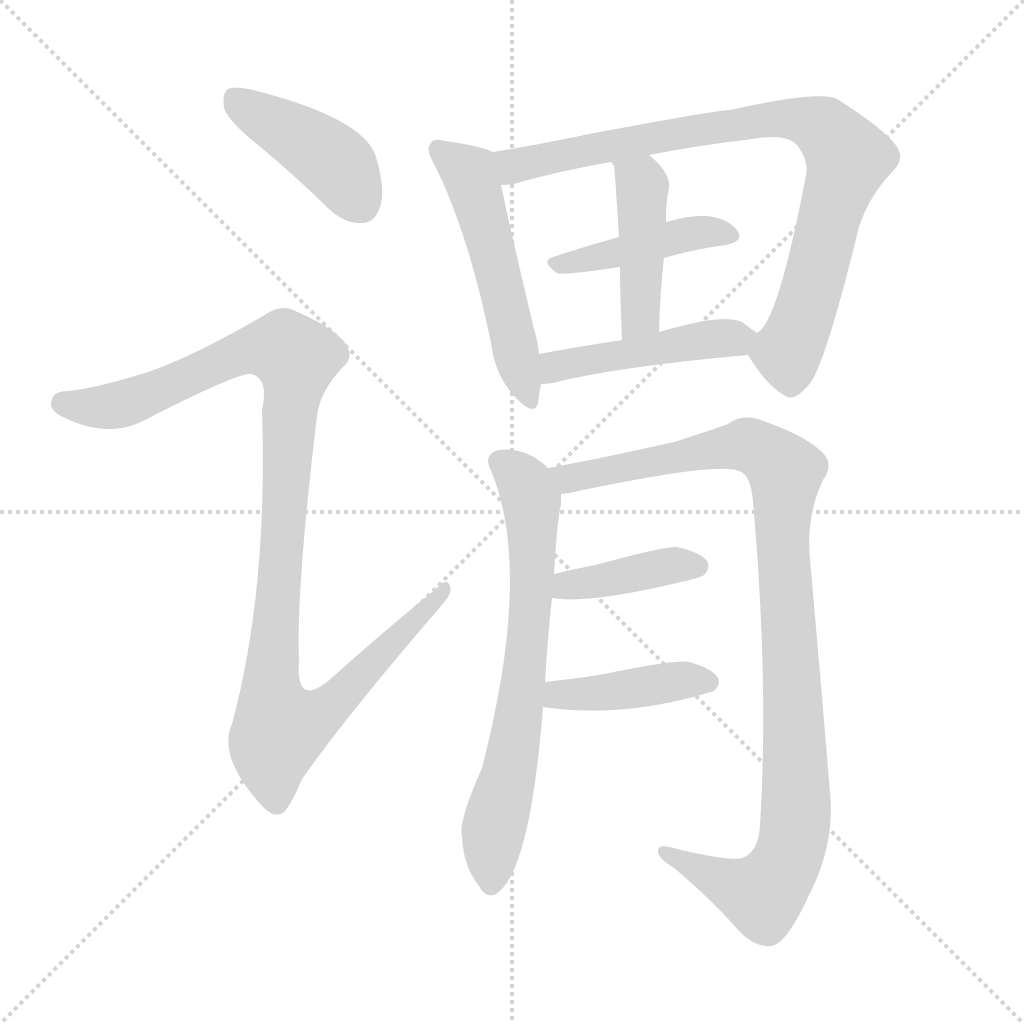
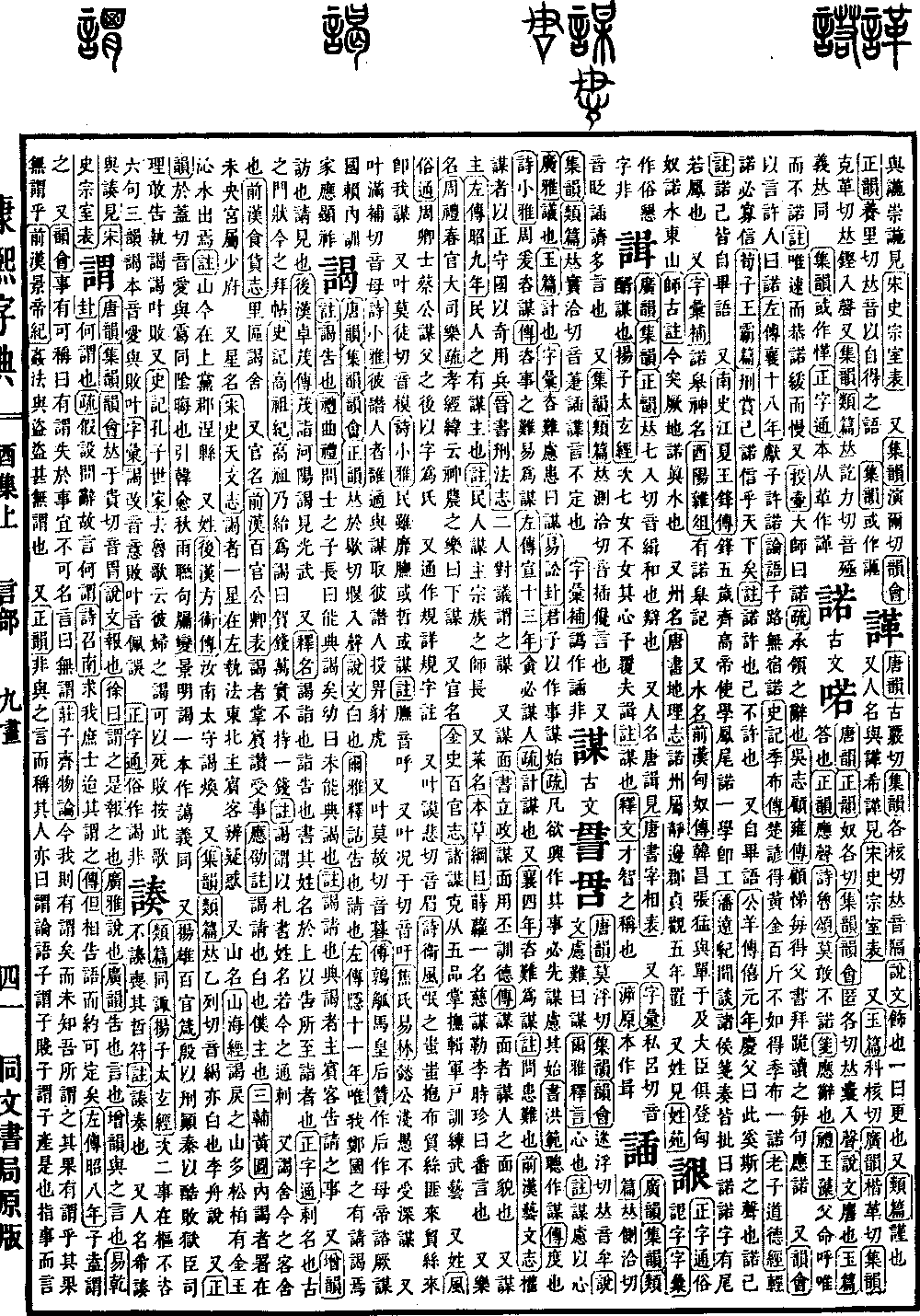
You Collection, Upper Volume
Radical: Speech (yán)
Kangxi Strokes: 16
Page 1173, Entry 02
Pronounced wei (falling tone).
Explaining the Characters (Shuowen): To report.
Xu Shen says: To speak is to report.
Broad Refinement of Characters (Guangya): To explain.
Broad Rhymes (Guangyun): To inform, to speak.
Expanded Rhymes (Zengyun): To speak with someone.
Book of Changes (Yijing), Hexagram Qian: What is meant by this?
Commentary: This is a hypothetical question, hence the phrase what is meant.
Book of Odes (Shijing), Shao Nan: Seeking me are the various gentlemen, wait until I speak to them.
Commentary: Simply by speaking to each other, the agreement can be finalized.
Zuo Tradition (Zuo Zhuan), Year 8 of Duke Zhao: Why do you not speak to him?
Also, Rhyme Collection (Yunhui): When a matter can be described, it is said to have a meaning (you wei); when an act is inappropriate and cannot be described in words, it is said to be meaningless (wu wei).
Zhuangzi, Discussion on Equality of All Things (Qiwulun): Now I have spoken, but I do not know if what I said really has a meaning, or if it really has no meaning.
History of the Former Han (Qian Hanshu), Annals of Emperor Jing: To violate the law and steal is truly senseless.
Also, Correct Rhymes (Zhengyun): Not speaking directly to someone but referring to them is also called wei; in the Analects (Lunyu), Confucius speaks of Zijian and Zichan, this is an example. Referring to a matter is also called wei; in the Book of Odes (Shijing), lines such as saying the road has much dew or that the sky is high are examples. Quoting someone's words is also called wei; in the Analects (Lunyu), such as this is what is meant or is it not what is meant are examples.
Also, Correct Meaning Compilation (Zhengzitong): Citing ancient texts to explain the meaning is also called wei; in the Book of Changes (Yijing), Lin hexagram, the appropriateness of the great ruler is what is meant by carrying out the middle way. In the Book of Rites (Liji), to be sagely and wise is what is meant by transmitting and creating.
Also, Progressive Study of Glosses (Erya): To be diligent.
Book of Odes (Shijing), Xiao Ya: My heart loves him, how can I not be diligent (wei)?
Commentary: Wei means diligent; it refers to the diligent longing for the gentleman.
Also, Broad Refinement of Characters (Guangya): To send.
Jade Chapters (Yupian): To trust, to speak.
Also a surname.
Ten Thousand Surnames Genealogy (Wanxing Tongpu): In the Song dynasty, there was a man named Wei Zhun who passed the imperial examination during the Taiping Xingguo period.
Explaining the Characters (Shuowen): Originally written in a variant form.
Textual Research: In the Book of Rites (Liji), the phrase originally appeared as sagely and wise, corrected to wise and sagely according to the original text.