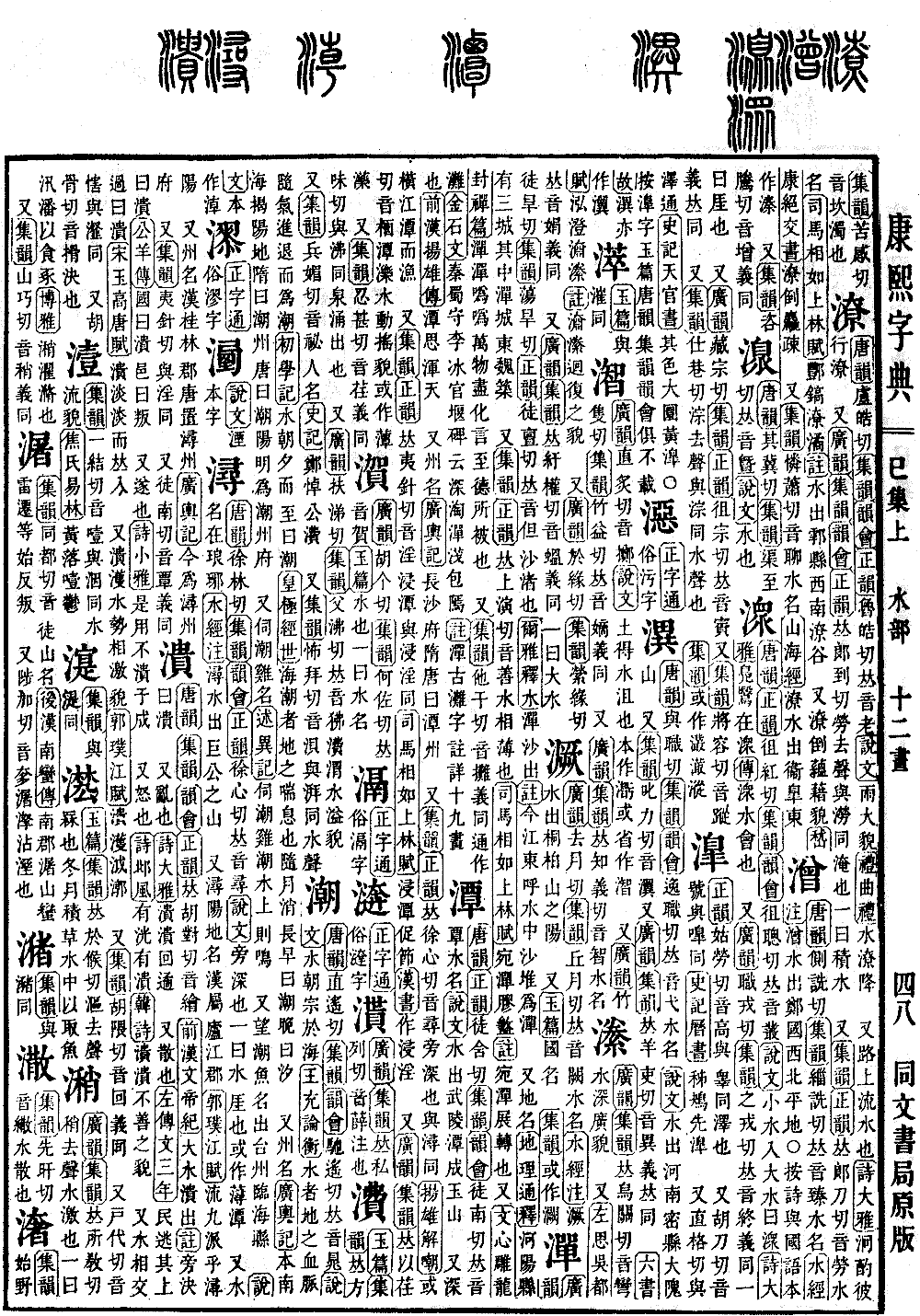
Si Collection, Upper Volume
Radical: Water (shuǐ)
Entry: 溃
Kangxi Strokes: 16
Page 650, Entry 23
Pronounced hui (falling tone).
Book of Han (Qianhan shu), Biography of Emperor Wen: A great flood burst forth. Note: To break through from the side is called kui. It also refers to confusion.
Book of Odes (Shijing), Daya: Confused and twisted.
It also refers to scattering or fleeing. Zuo Commentary (Zuo zhuan), Third Year of Duke Wen: When the common people flee from their ruler, it is called kui. Gongyang Commentary (Gongyang zhuan): When the people of a state flee, it is called kui; when the inhabitants of a city rebel, it is called pan.
It also refers to achieving or realizing. Book of Odes (Shijing), Xiaoya: Therefore, one cannot achieve success.
It also refers to being angry. Book of Odes (Shijing), Beifeng: There is grandeur and there is anger. Han commentary on the Odes (Han shi): Kui kui refers to a state of being unpleasant.
It also refers to water currents crossing or intermingling. Song Yu, Rhapsody on Gaotang (Gaotang fu): Bubbling and swirling, it flows in.
It also refers to kuihuo, which describes the appearance of water forces colliding with one another. Guo Pu, Rhapsody on the Yangtze River (Jiang fu): Swirling and rushing.
Also, according to Jiyun, pronounced hui (level tone), with the same meaning.
Also, pronounced dai (falling tone), same as xie.
Also, pronounced hu (entering tone), meaning to burst through or gush.