You Collection, Lower Volume
Radical: Walk (chuò)
Pronounced tong (level tone)
Kangxi Strokes: 14
Page 1258, Entry 04
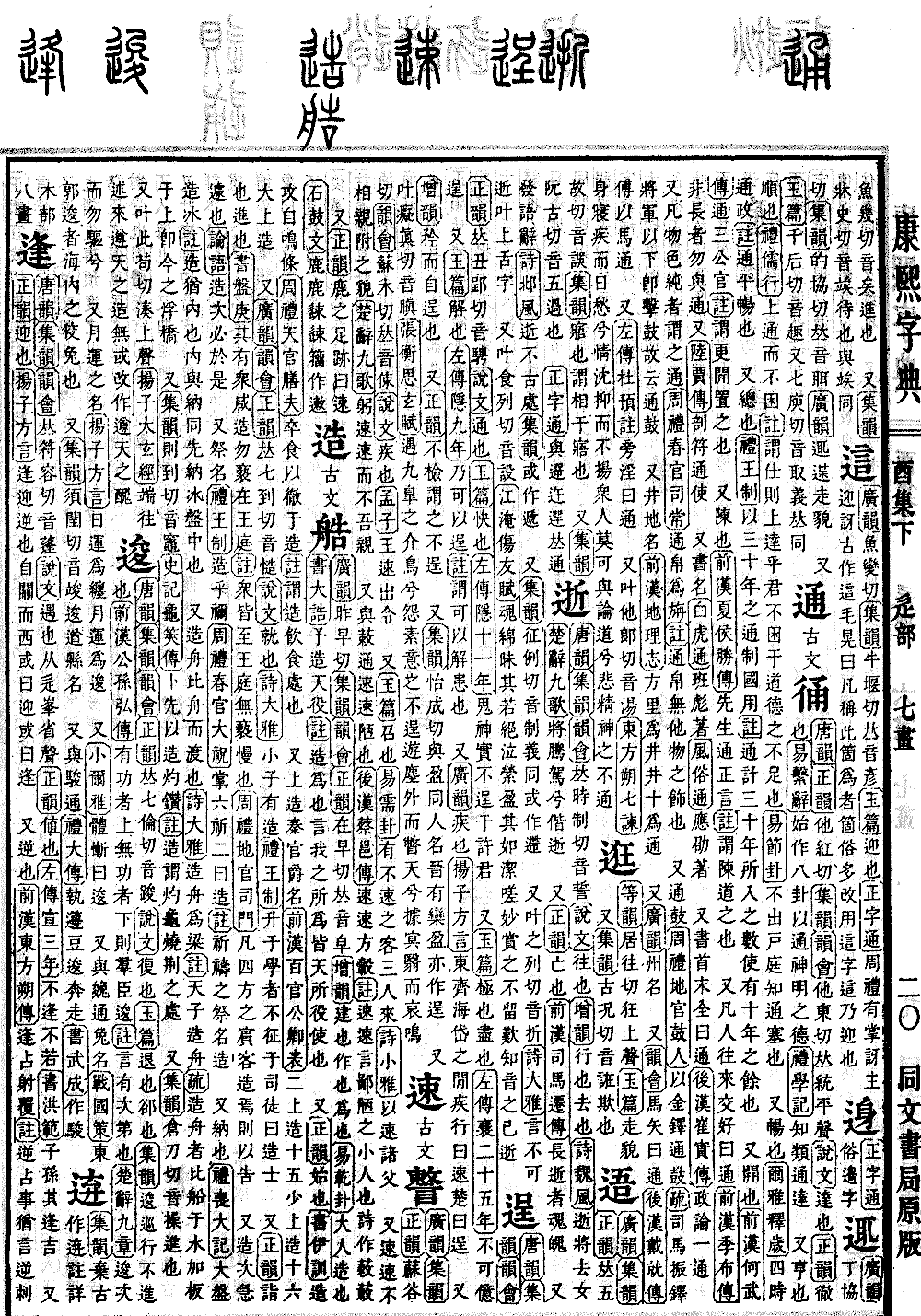
Ancient characters. Pronounced tong (level tone). According to the Shuowen Jiezi, it means to reach. According to the Zheng Yun dictionary, it means to penetrate. In the Book of Changes (Yijing), it is said: Initially, the eight trigrams were created to penetrate the virtues of the divine spirits. In the Book of Rites (Liji), it is said: To know the categories is to be perceptive and comprehensive. It also means prosperous and compliant. In the Book of Rites (Liji), it is said: To be connected to those above without being constrained. The commentary states: This means if one holds office, one reaches the ruler and is not constrained by a lack of moral sufficiency. In the Book of Changes (Yijing), it says: One does not step out of the courtyard gate, knowing the ways of passage and obstruction. It also means unobstructed or smooth. The Erya dictionary states: When the four seasons are in harmony, it is called tong-zheng. The commentary states: Tong means level and unobstructed. It also means to aggregate or total. In the Book of Rites (Liji), it says: Use a thirty-year aggregate to manage national expenditure. The commentary states: This means to calculate the total income over thirty years so as to have a ten-year surplus. It also means to open or establish. In the History of the Former Han (Hanshu), it is said: To open/establish the positions of the Three Excellencies. The commentary states: This refers to newly opening and creating those positions. It also means to guide or lead. In the History of the Former Han (Hanshu), it is said: The master guided with upright words. The commentary states: This means to instruct. Furthermore, when people associate or interact, it is called tong. In the History of the Former Han (Hanshu), it is said: Do not associate with anyone who is not a man of virtue. Also, in the Biography of Lu Jia, it says: To split the tally and send an envoy. It is also the name of books. The Comprehensive Discussions in the White Tiger Hall (Baihu Tong) was written by Ban Gu. The Comprehensive Customs (Fengsu Tong) was written by Ying Shao. A complete text from beginning to end is called a tong. In the History of the Later Han (Houhanshu), it is said: It is appropriate to copy one complete text. Also, any object that is uniform in color is called tong. In the Rites of Zhou (Zhouli), it says: A flag of uniform color is called a zhan. The commentary states: A flag of uniform color has no other decorations. Also, a signal drum. In the Rites of Zhou (Zhouli), it says: Use a metal bell to signal the drums. The commentary states: When the officer of the horses shakes the bell, the generals and those below them strike their drums; hence, it is called signaling the drums. Also, a name for a well-field division. In the History of the Former Han (Hanshu), it is said: A square mile is a well, and ten wells make a tong. Also, in the Guangyun dictionary, it is the name of a prefecture. Also, in the Yunhui dictionary, horse manure is called tong. In the History of the Later Han (Houhanshu), it is said: Fumigate it with horse manure. Also, according to the commentary by Du Yu on the Zuo Commentary (Zuozhuan), illicit sexual relations are called tong. Also, rhyming with tang. In the Seven Admonitions (Qi Jian), it is said: My body is afflicted with illness and daily I am sorrowful; my feelings are suppressed and cannot soar. There is no one among the crowd with whom I can discuss the Way; I am saddened that my spirit cannot find passage.
Textual corrections: In the Erya, it says when the four seasons are in harmony, it is called tong-zheng. The original text said "four seasons are tong-zheng," but the words "in harmony" cannot be omitted. It is now corrected to "In the Erya: When the four seasons are in harmony, it is called tong-zheng." Also, the Erya does not contain the "Explanation of Years" chapter, so it has been omitted. The Comprehensive Discussions in the White Tiger Hall (Baihu Tong) was written by Ban Gu, not Ban Biao. Following the original text, Ban Biao has been corrected to Ban Gu. Regarding "A complete text from beginning to end is called a tong," the History of the Later Han (Houhanshu) says "a political treatise in one copy," which has been corrected to "it is appropriate to copy one complete text." In the History of the Former Han (Hanshu), regarding "A square mile is a well, and ten wells make a tong," this phrase appears in the "Treatise on Food and Money," not the "Treatise on Geography," so it has been corrected to "Treatise on Food and Money." Regarding "Horse manure is called tong," the History of the Later Han (Houhanshu) says "applied with horse manure," which has been corrected to "fumigate it with horse manure."