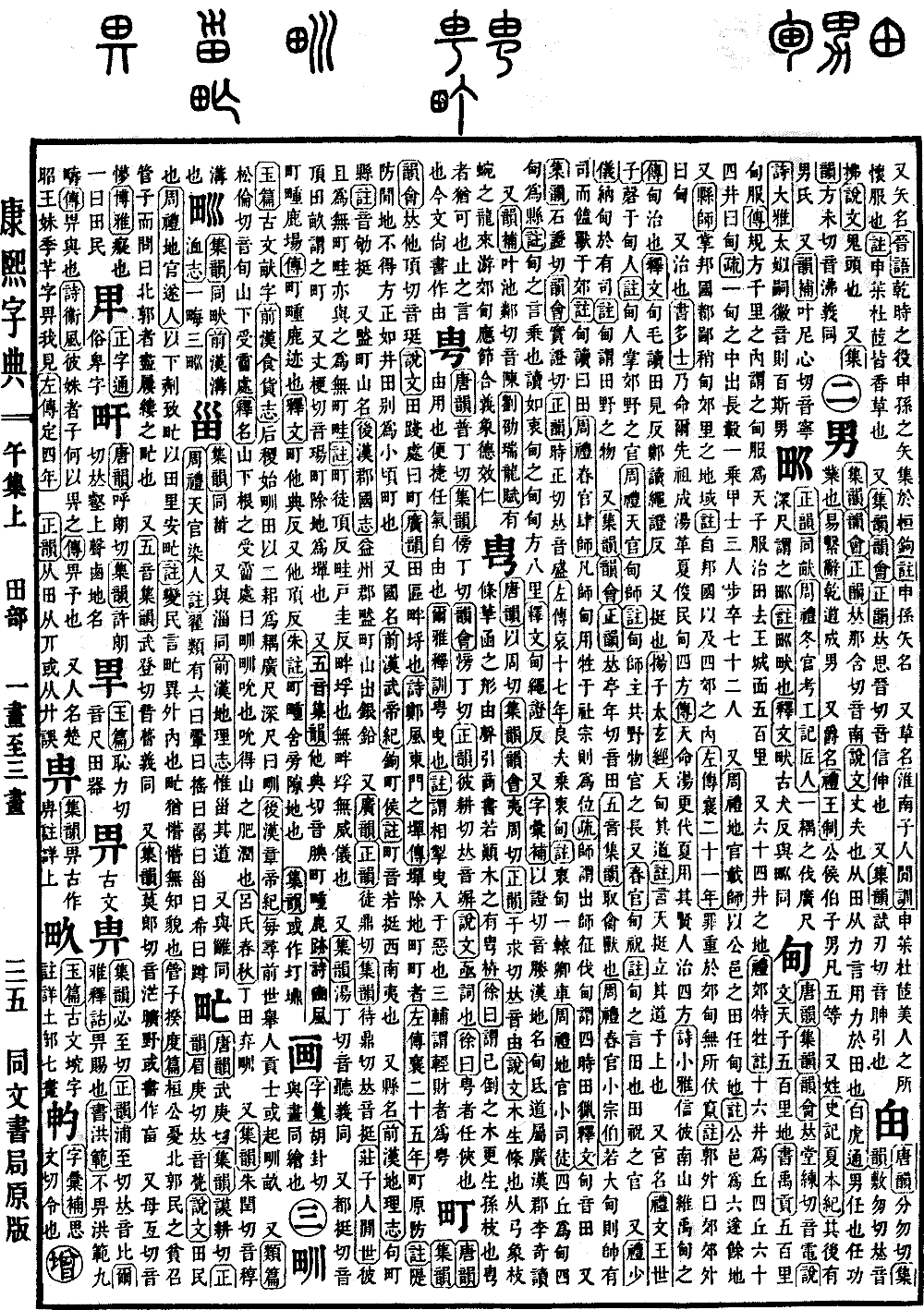
Wu Collection, Upper Volume
Radical: Field (tián)
Town
Kangxi strokes: 7
Page 759, Entry 07
Tang Rhymes (Tangyun), Collection Rhymes (Jiyun), and Dictionary of Rhymes (Yunhui) all state the pronunciation is ting (falling tone).
Shuowen Jiezi states that a place where fields are trodden is called a town.
Guangyun states it refers to the boundaries or ridges of field plots.
In the commentary to the Book of Odes (Shijing), Zheng Feng, "The Plain at the East Gate," the term refers to land cleared and leveled.
In the Zuo Tradition (Zuo Zhuan), twenty-fifth year of Duke Xiang, it refers to the ridges and defenses of the fields. The commentary explains this as land between levees and embankments that cannot be as square and proper as standard well-field land, thus distinguished as small town plots.
Also a name of a state. In the Annals of Emperor Wu in the Book of Han (Qian Han Shu), it mentions the Marquis of Goutown. The commentary states the pronunciation is like ting, referring to an ethnic group in the southwest.
Also a county name. In the Treatise on Geography in the Book of Han (Qian Han Shu), it refers to Goutown County. The commentary states the pronunciation is qu ting.
Also Luting, a mountain name. In the Treatise on Commandaries and States in the Book of the Later Han (Hou Han Shu), it records Luting Mountain in Yizhou Commandery, which produces silver and lead.
Also, according to Guangyun and Zheng Rhymes (Zhengyun), and Collection Rhymes (Jiyun), the pronunciation is ting (rising tone).
In the Zhuangzi, "In the World of Men," it refers to those who are without fixed boundaries or demarcations. The commentary notes the pronunciation is ting, and defines it as boundaries or ridges. To be without boundaries is to be without rigid decorum.
Also, according to Collection Rhymes (Jiyun), the pronunciation is ting (level tone). The meaning is the same.
Also pronounced ding (falling tone). Refers to a plot of land.
Also pronounced chang (falling tone). Refers to land cleared to make a raised earthen platform.
Also, according to Five Sounds Collection of Rhymes (Wuyin Jiyun), the pronunciation is tian (rising tone).
Refers to town-tuan, the tracks of deer. In the Book of Odes (Shijing), Bin Feng, "Town-tuan," the commentary states that town-tuan refers to deer tracks. The Explanatory Text (Shiwen) says the pronunciation is tian, and also ting (falling tone). The Zhu commentary states that town-tuan refers to the vacant land beside a dwelling.
Collection Rhymes (Jiyun) notes that it is sometimes written in the variant form (ting).