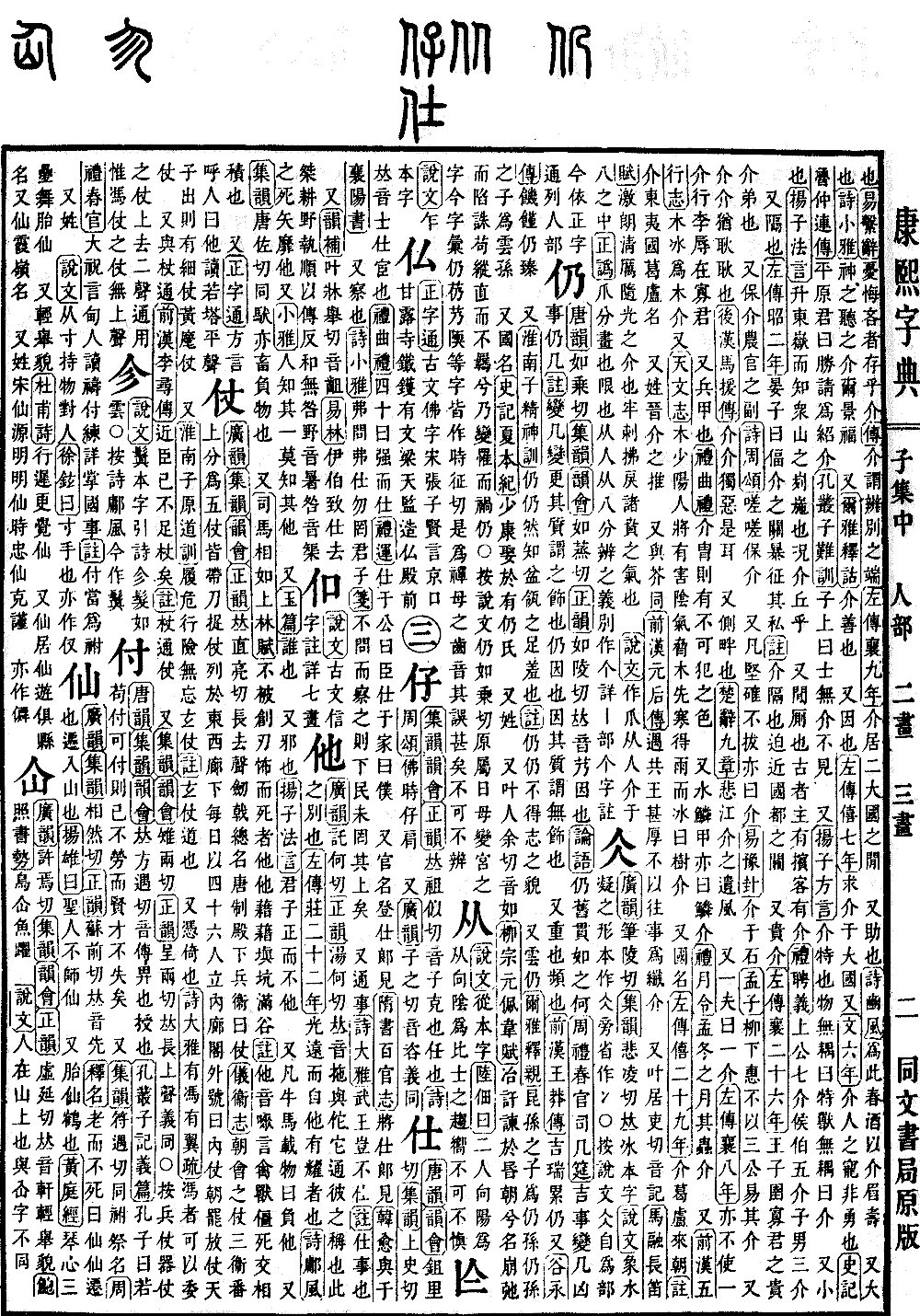
Zi Collection, Middle Volume Radical: Person (rén) Kangxi Stroke Count: 5 Page 92, Entry 09.
According to the Guangyun (Guangyun), pronounced tuo. According to the Zheng Yun (Zheng Yun), pronounced tuo. It is phonetically interchangeable with tuo and ta. It is used to refer to another person, distinguishing them from oneself. According to the Zuo Commentary (Zuo Zhuan), concerning the twenty-second year of Duke Zhuang, the light spreads far and wide, shining from another location. According to the Book of Odes (Shijing), in the Yong Feng section, one swears unto death that there will be no second heart. According to the Xiao Ya section, people only know one aspect of it and are unaware of other sides. According to the Yu Pian (Yu Pian), it refers to who. It also refers to that which is not upright. According to the Model Sayings (Fayan) by Yang Xiong, the superior person is upright and not devious. Furthermore, whenever oxen or horses carry goods, it is called burdening another. According to the Jiyun (Jiyun), pronounced tuo. It also refers to livestock carrying loads. According to the Shanglin Fu (Shanglin Fu) by Sima Xiangru, those who were not wounded by blades or swords but died of terror lay crisscrossed, filling the pits and valleys. Annotation: It is pronounced kou. It refers to the carcasses of birds and beasts piled up in disorder. According to the Zhengzitong (Zhengzitong), in local dialects, it is used to refer to a person. Pronounced ta (level tone).