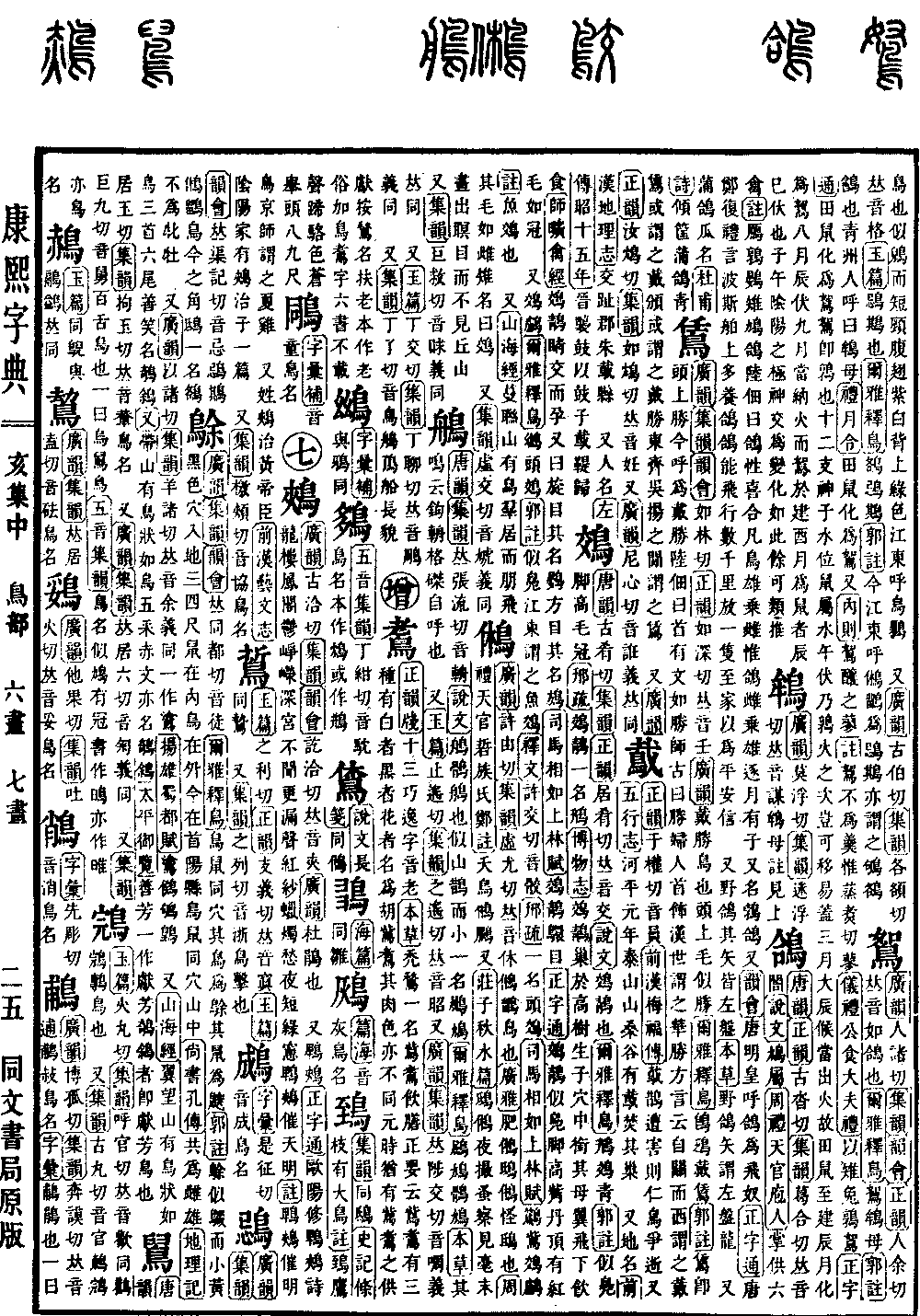
Hai Collection, Middle Volume
Radical: Bird (niǎo)
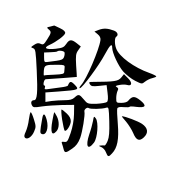
Character: Tu
Kangxi strokes: 18
Page 1489, Entry 21
According to the Extensive Rhymes (Guangyun), Collected Rhymes (Jiyun), and Rhyme Meeting (Yunhui), the pronunciation is tu, similar to the sound of tu.
The Erya, Explanation of Birds (Erya, Shinia) records that there is a bird that dwells in the same burrow as a field mouse; this bird is called the tu, and the mouse is called the shu.
Guo Pu comments that the tu resembles the sandgrouse but is smaller in size, with yellow and black feathers. It digs burrows three or four feet deep into the ground; the mouse lives inside, and the bird lives at the entrance. Today, in Shouyang County, they can still be seen in the mountains where birds and mice share a burrow.
The commentary by Kong Anguo on the Classic of History (Shangshu) states that they live together like a mated pair. The Geographic Record (Diliji) states that they are not, in fact, in a reproductive relationship.
Additionally, the Extensive Rhymes (Guangyun) and Collected Rhymes (Jiyun) provide the pronunciation yu, with the same meaning. Sometimes written in a variant form. In the Rhapsody on the Capital of Shu (Shudu Fu) by Yang Xiong, it is written as qu.
Also, the Classic of Mountains and Seas (Shanhaijing) records that on Yiwang Mountain, there is a bird shaped like a crow with three heads and six tails that enjoys laughing; its name is qi.
The same text also records that on Dai Mountain, there is a bird shaped like a crow with multicolored feathers and red markings, also called qi.
The Imperial Readings of the Taiping Era (Taiping Yulan) records that the shanfang bird is also written as the xianfang bird. The qi bird is the xianfang bird. The character for sandgrouse (duo) was originally written with the bird radical combined with the character (zhuo).