Wu Collection, Lower Volume
Radical: Stand (lì)
Kangxi Strokes: 12
Page 871, Entry 20
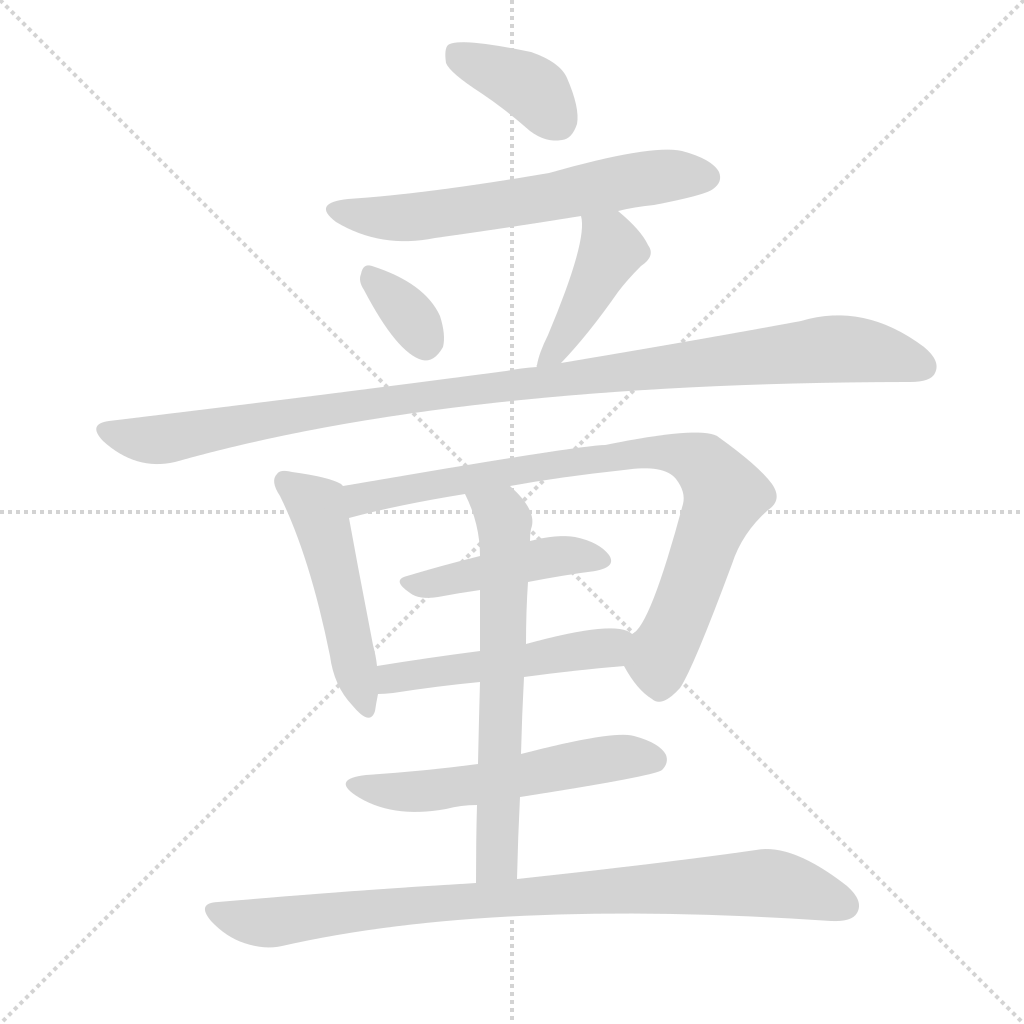
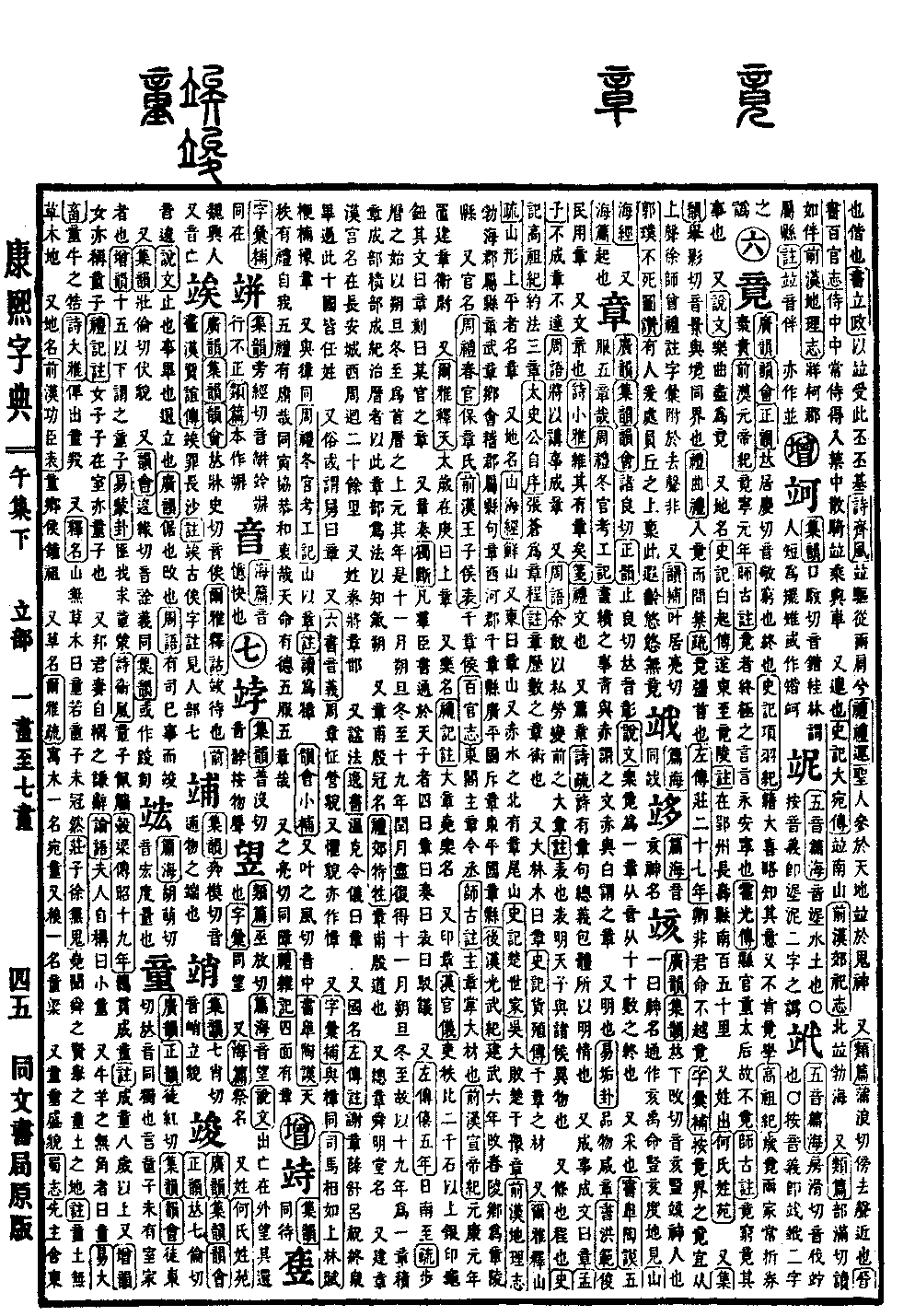
Pronounced tong. Alone. Refers to a child who has not yet formed a family. Expanded Rhymes (Zengyun): Those fifteen years old and younger are called children. Book of Changes (Yijing), Hexagram Meng: It is not that I seek the child for enlightenment. Book of Odes (Shijing), Odes of Wei: The child wears an awl for untying knots. Commentary on the Spring and Autumn Annals (Guliang Zhuan), Nineteenth Year of Duke Zhao: Bound by ties and becoming a child. Commentary: Becoming a child refers to being eight years old or older. Also, Expanded Rhymes (Zengyun): A female may also be called a child. Book of Rites (Liji), Commentary: A female in her maiden home is also a child. Also, a humble term used by the wife of a sovereign to refer to herself. Analects (Lunyu): The wife of a sovereign refers to herself as a small child. Also, an ox or sheep without horns is called tong. Book of Changes (Yijing), Hexagram Da Chu: The horns of a small bull. Book of Odes (Shijing), Greater Odes: Causing the hornless black ram to emerge. Also, Explanation of Names (Shiming): A mountain without grass or trees is called tong, like a child who has not yet worn a crown. Zhuangzi, Xu Wugui: Yao heard of Shun's virtue and recommended him at a place where no grass or trees grow. Commentary: Tong soil, land without grass or trees. Also, a place name. History of the Former Han (Qianhan Shu), Table of Meritorious Officials: Marquis of Tongxiang, Zhong Zu. Also, a plant name. Commentary on the Erya (Erya Shu): The parasitic tree is also called wanton. Also, a type of grass, also called tongliang. Also, tongtong, the appearance of luxuriant growth. Records of the Three Kingdoms (Shuzhi): The mulberry tree at the southeast corner of the First Lord's residence was luxuriant, like a small carriage canopy. Also, Pianhai: A male who has committed a crime and becomes a slave is called a tong servant. Book of Changes (Yijing), Hexagram Lü: Obtaining the loyalty of a child servant. History of the Former Han (Qianhan Shu), Biography of Merchants: Tong fingers numbered in the thousands. Commentary: Tong refers to slaves. Supplement to the Rhyme Meetings (Yunhui Bu): Tong refers to slaves or the young. In current writing, the character for young is written as tong, and the character for servant is written as tong; this follows an error. Also, a surname. Commentary on the Jijiupian: The son of Zhuanxu was named Laotong, and his descendants used it as a surname. Broad Rhymes (Guangyun): In the Han dynasty, there was an Administrator of Langya named Tong Zhongyu. Also, Pronounced zhong. Commentary on the Gongyang Zhuan, Eleventh Year of Duke Huan: The Duke met with the Duke of Song at Futong. Commentary: Tong is pronounced zhong. The Zuo Commentary and Guliang Commentary both write it as zhong. Also used as the word for same. Liezi, Yellow Emperor Chapter: Those whose appearance is the same as mine, I draw close to and love. Those whose appearance is different from mine, I distance myself from and fear. Commentary: Tong means same, an error in sound. Also rhymes with the sound of huang. Han Yu, Poem on this day being worth regret: Startling waves overlap in the dark, constellations flicker against one another. Horses are exhausted and whinny, the attendants and children on the left and right weep.