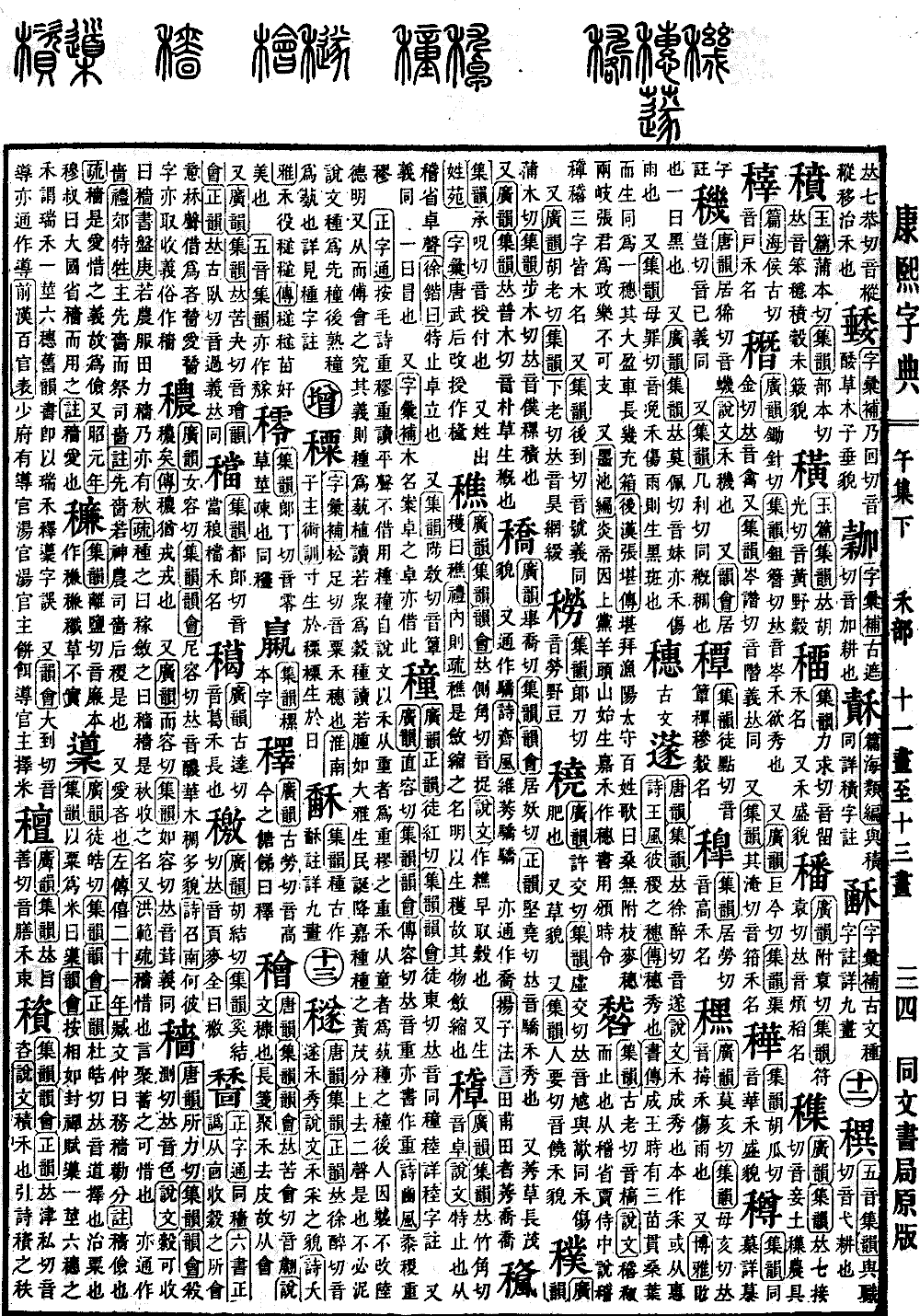
Wu Collection, Lower Volume
Radical: Grain (hé)
Kangxi Strokes: 17
Page 860, Entry 29
Pronounced tong. Refers to early-ripening grain (tonglu). See the entry for lu for detailed commentary.
Also pronounced zhong; sometimes written in a variant form (zhong).
Book of Odes (Shijing), Odes of Bin: The broomcorn and panicled millet are planted early and ripen late.
Correction from Proper Character Dictionary (Zhengzitong): In the Odes of Mao, the term meaning early-planted and late-ripening is pronounced in the level tone, and it should not be borrowed as the characters for planting or the variant for grain. Since the Explanation of Simple and Compound Characters (Shuowen Jiezi) interpreted the character composed of grain and heavy as the early-planted and late-ripening term, and the character composed of grain and child as the planting term, later scholars have followed this without modification, and Lu Deming further supplemented this theory. Upon investigating the original meaning, the character for plant signifies to sow, pronounced like the word for crowd; when referring to grain seeds, it is pronounced like the word for swollen. For example, in the Greater Odes (Daya), Odes of Living People (Shengmin): He sent down excellent seeds, and planted them in the lush fields. The distinction between the rising tone and the departing tone provides evidence for this. There is no need to be constrained by the Explanation of Simple and Compound Characters regarding the interpretation of these terms as first-planted versus late-ripening or as the act of planting. See the entry for plant for detailed commentary.