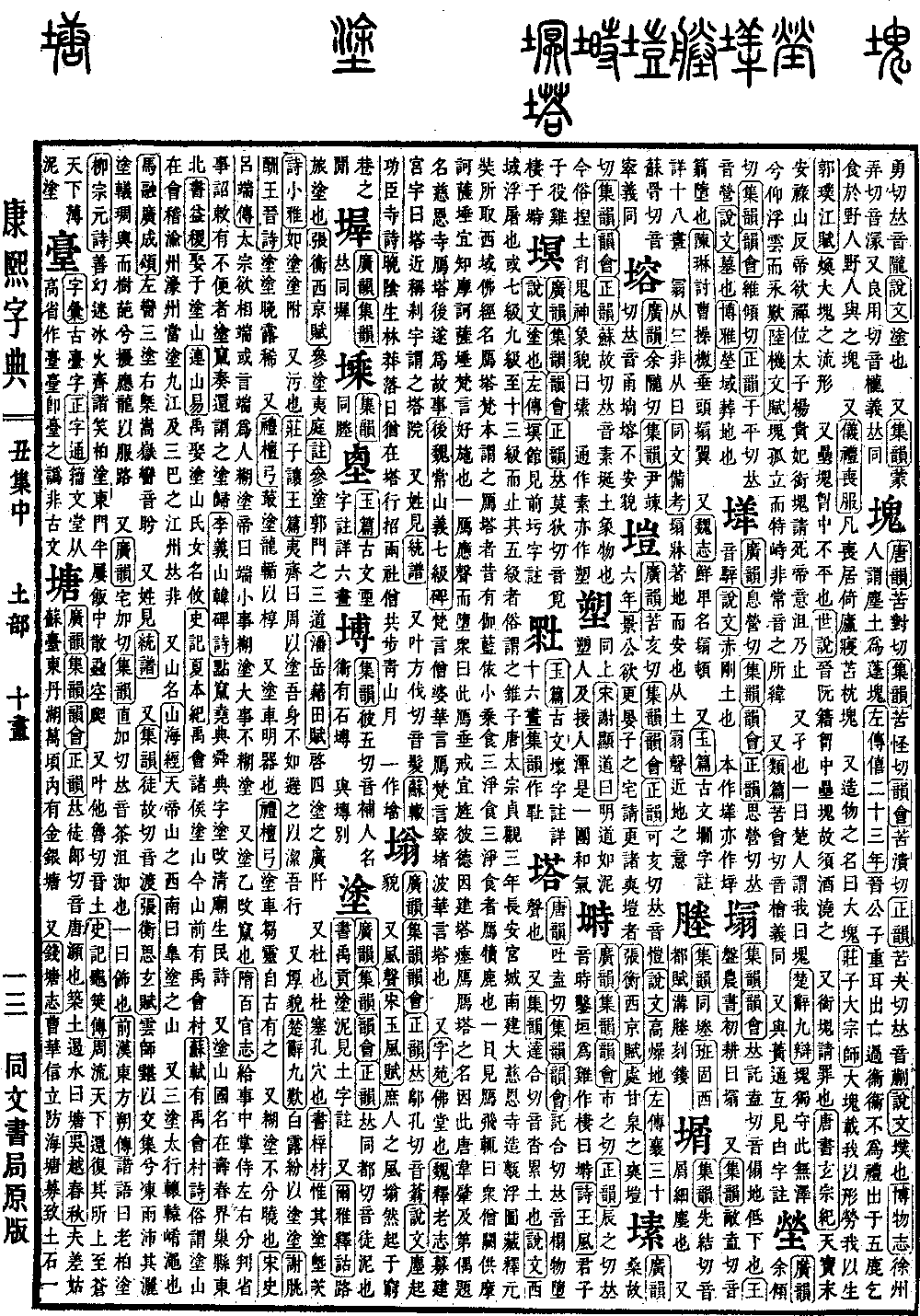
Chou Collection, Middle Volume
Radical: Earth (tǔ)
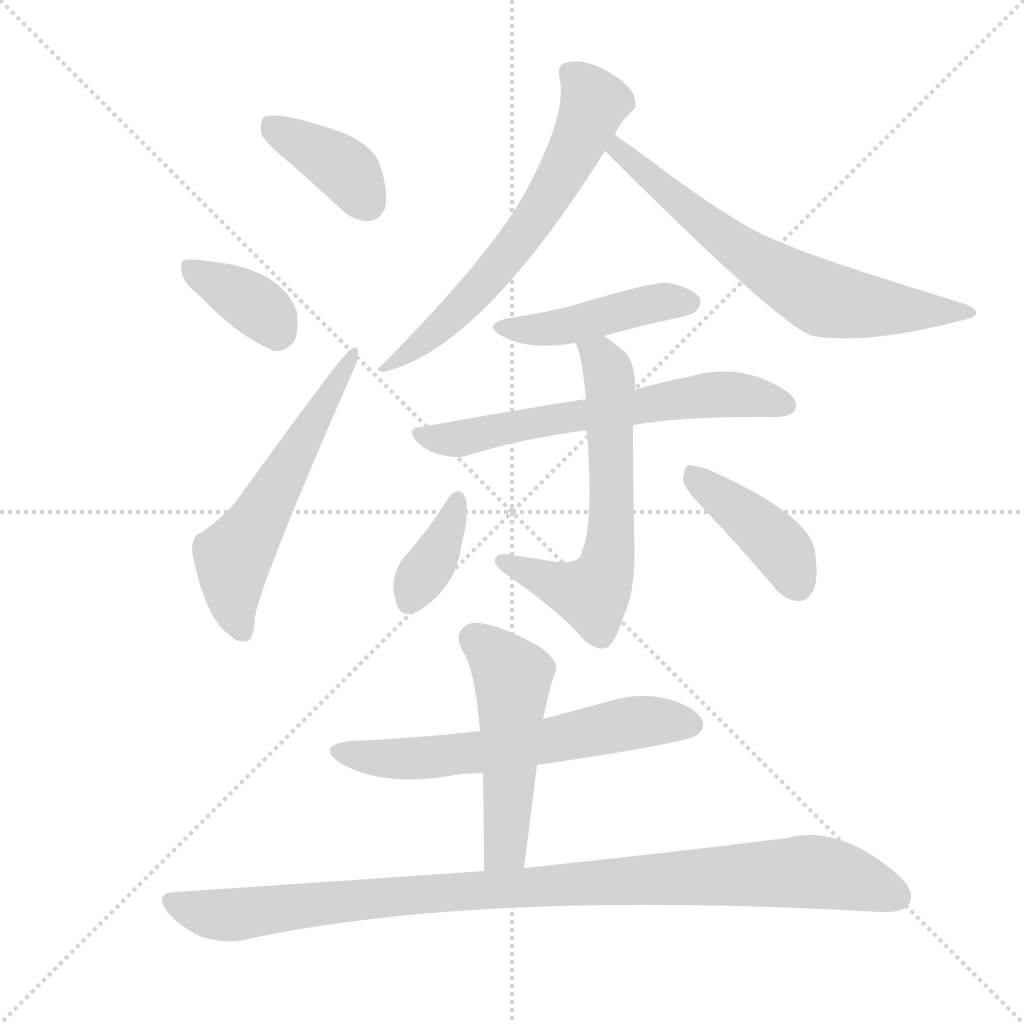
塗; Kangxi stroke count: 13; Page 235, Entry 20
The Broad Rhymes (Guangyun), Compendium of Rhymes (Jiyun), Dictionary of Rhymes (Yunhui), and Orthodox Rhymes (Zhengyun) all note it as pronounced tu (level tone), with the same sound as the character for disciple. Refers to mud. Document of History (Shangshu), section Tribute of Yu (Yugong) contains the phrase, "muddy soil." See the annotations for the character Earth (tǔ) for details.
Also, the Approaches to Etymology (Erya), section Explaining Official Titles (Shizheng) defines the characters for road and journey as meaning road. Zhang Heng’s Rhapsody on the Western Capital (Xijing fu) writes of the three roads at the outer city gate. Annotations state: the three roads refer to the three paths at the outer city gates. Pan Yue’s Rhapsody on Plowing the Field (Jietian fu) mentions opening up four broad paths.
Also refers to blocking, meaning to use mud or similar materials to fill holes. Document of History (Shangshu), section Timber Materials (Zicai) mentions, "only by plastering and coating the roofs." Book of Odes (Shijing), section Lesser Odes (Xiaoya) mentions, "like applying plaster."
Also refers to staining or defiling. In the Zhuangzi, section Yielding the Kingdom, Boyi and Shuqi state: the actions of the Zhou dynasty defiled our hearts and bodies. It is better to avoid it to preserve the purity of our conduct.
Also describes a thick or dense appearance. Songs of Chu (Chu ci), section Nine Sighs (Jiutan) states, "White dew is abundant and thick." Xie Tiao’s Poem Replying to Wang Jin mentions, "The evening dew is sparse and thick."
Also, the Book of Rites (Liji), section Tan Gong mentions, "using mud to plaster the coffin of the dragon hearse." There is also the term mud carriage, referring to a clay carriage used for burial, a type of spirit object. The Book of Rites (Liji), section Tan Gong states, "Mud carriages and grass figures have existed since ancient times."
There is also the term muddled, referring to a lack of understanding or confusion. History of the Song (Song shi), biography of Lu Duan: Emperor Taizong wanted to appoint Lu Duan as prime minister; someone said Lu Duan was muddled. The Emperor said: Lu Duan is muddled in small matters, but not muddled in major ones.
There is also the term smearing, referring to revising text. The Official History of the Sui (Sui baiguan zhi) records: the Attendant Gentleman (Gishizhong) was in charge of managing the imperial entourage and handling affairs of the Secretariat; if imperial edicts were improper, they would smear and revise them before submitting them back, known as smearing and returning. Li Yishan’s Han Poetry mentions, "Editing characters in the Classic of Yao and Classic of Shun, revising the poems of the Qingmiao and Shengmin."
There is also Mount Tu, name of an ancient state. Located northeast of Chao County in the Shouchun region. Document of History (Shangshu), section Counsels of Gao Yao (Yiji) mentions, "Married at Mount Tu." The Linked Mountain Changes (Lianshan yi) records: Yu married the daughter of the Mount Tu clan, named You. The Records of the Grand Historian (Shiji), section Annals of Xia states: Yu met with the feudal lords at Mount Tu; today there is a Yu Hui village in front of the mountain. Su Shi has a poem about Yu Hui village. Popular legends place Mount Tu in Kuaiji, Yuzhou, Haozhou, Dangtu, Jiujiang, as well as Jiangzhou in the Three Ba region; these claims are incorrect.
It is also the name of a mountain. The Classic of Mountains and Seas (Shanhaijing) records: to the southwest of Heavenly Emperor Mountain lies Mount Gaotu.
There is also the term Three Paths, referring to the three strategic locations of Taihang, Huanyuan, and Xiaomian. Ma Rong’s Eulogy on Guangcheng writes, "Looking at the three paths on the right; overlooking Mount Song on the left." The term indicates looking.
It is also a surname. See the General Genealogy (Tongpu).
According to the Compendium of Rhymes (Jiyun), it is also pronounced du (falling tone). Zhang Heng’s Rhapsody on Thinking of the Profound (Sixuan fu) writes, "The cloud masters gather together, freezing rain falls on the mud. Carving the carriage and planting flowers, stirring the response dragon to serve the road."
According to the Broad Rhymes (Guangyun), it is also pronounced cha (level tone). Refers to low, damp places. Another interpretation refers to decoration. In the Former Han History (Qian Han shu), biography of Dongfang Shuo, a humorous remark states: Old cypress is decorated. Liu Zongyuan’s poetry mentions, "Good illusions confuse ice and fire, Qi Xie laughs at the cypress decoration. At the East Gate, the ox eats multiple meals, in Zhongsan, lice crawl in vain."
Also, it rhymes with tu (rising tone). Records of the Grand Historian (Shiji), section Biography of the Turtle Diviner states, "Wandering throughout the world, returning to its origin. Up to the azure heaven, down to the thin muddy path."
Editorial Note: Regarding the term Three Paths, referring to the three strategic locations of Taihang, Huanyuan, and Xiaomian, per the Compendium of Rhymes (Jiyun), the character for Huanyuan has been corrected. In Ma Rong’s Eulogy on Guangcheng, the text has been corrected to read: "Looking at the three paths on the left; overlooking Mount Song on the right." The reading of the term for look has been corrected to mean to see. Liu Zongyuan’s poem has been corrected to read: "At the East Gate, the ox eats multiple meals."