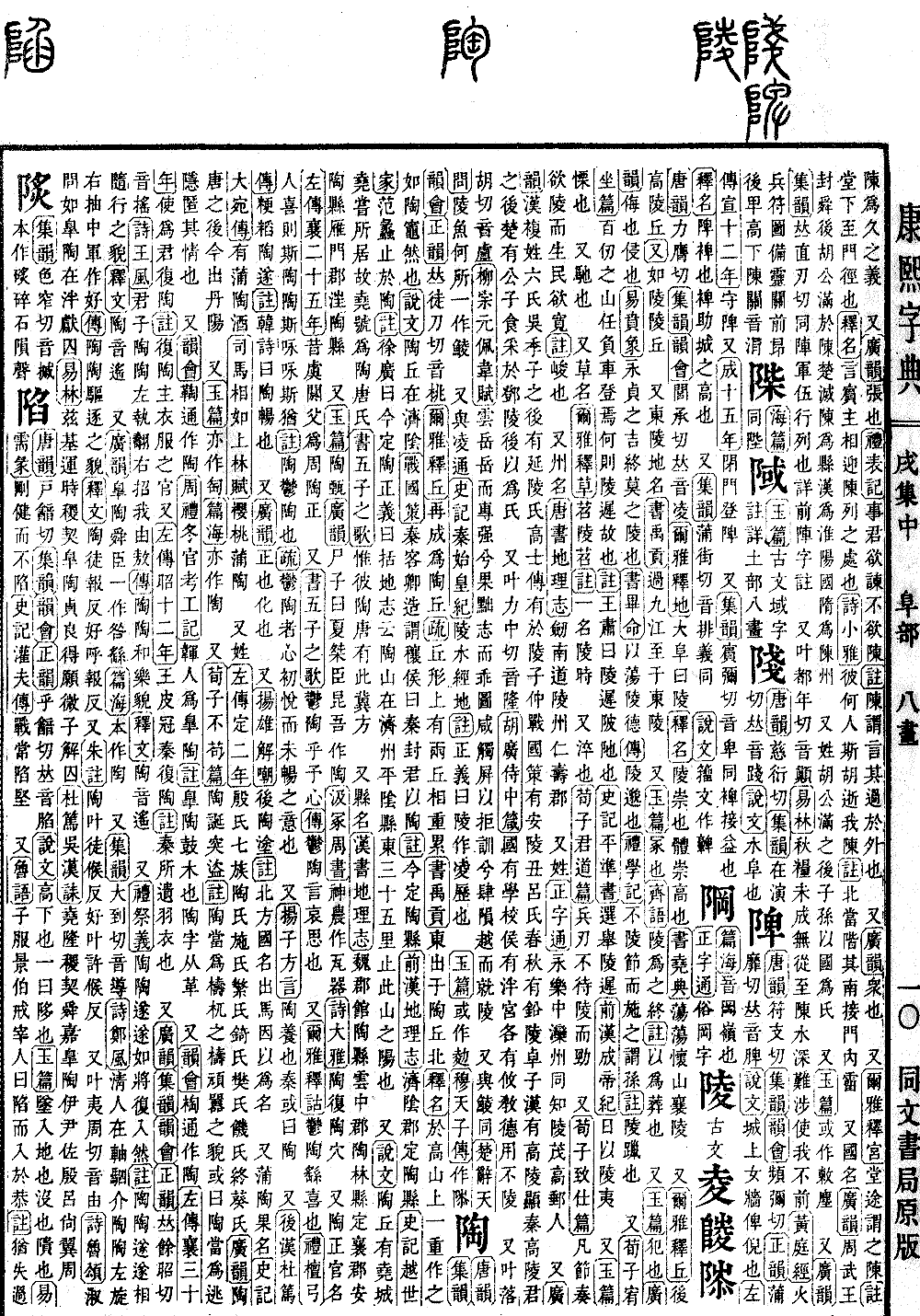
Xu Collection, Middle Volume
Radical: Mound (fù)
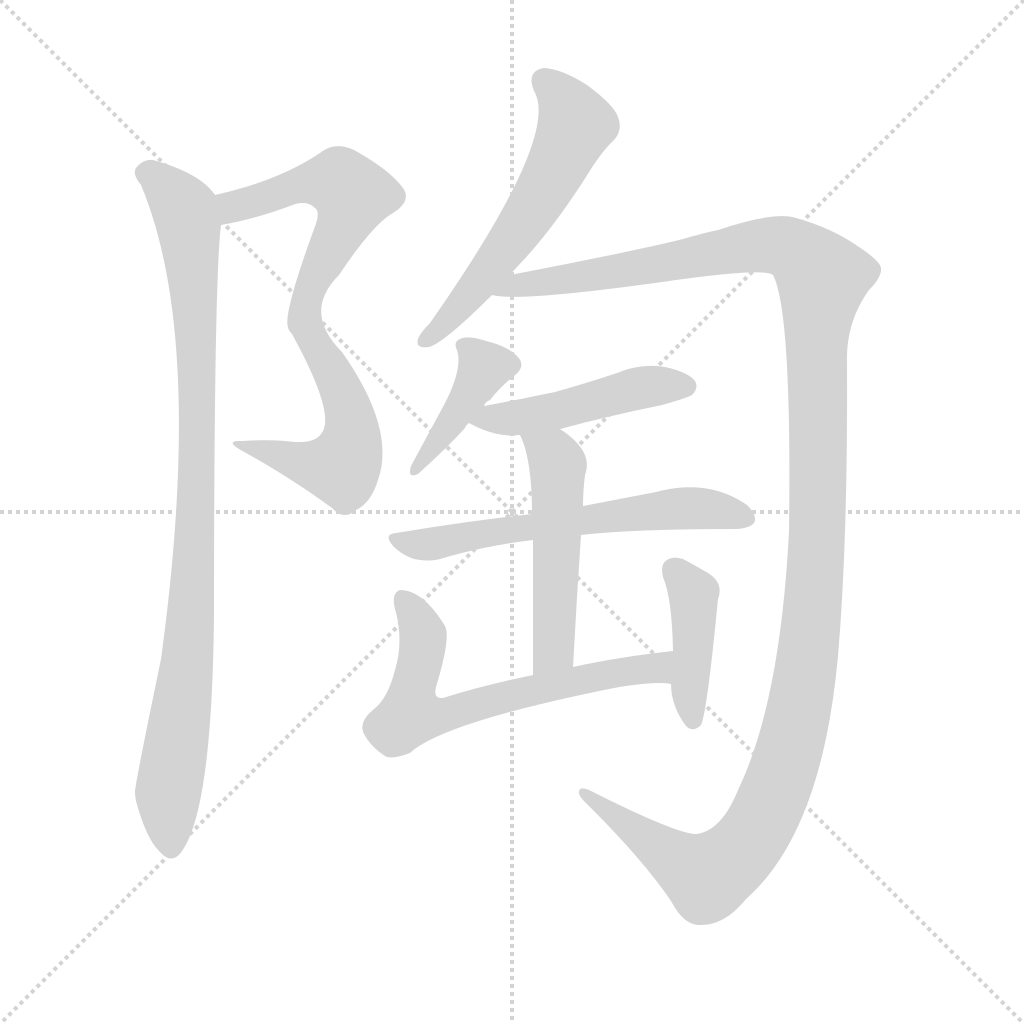
Character: Táo
Kangxi Strokes: 16
Page: 1354, Entry 10
In Tang Rhyme, Ji Rhyme, Yun Hui, and Zheng Rhyme, pronounced like táo.
In Er Ya (Erya), Explanation of Mounds (Shi Qiu): "Two mounds together form a Táo Mound." The commentary explains that the shape of the mound has two mounds piled one upon another. In Book of Documents (Shujing), Tribute of Yu (Yu Gong): "Flowing east, originating north of Táo Mound." In Explanation of Names (Shiming): "Piled up in layers on a high mountain, like a Táo stove." In Explaining and Analyzing Characters (Shuowen Jiezi): "Táo Mound is in Jiyin." In Strategies of the Warring States (Zhanguoce): "Qin's guest minister Zao said to Marquis Rang: Qin will grant you the land of Táo." The note states: "Present-day Dingtao county." In Former Han History (Qian Han Shu), Treatise on Geography (Dili Zhi): "Dingtao county in Jiyin Commandery." In Records of the Grand Historian (Shiji), House of Yue (Yue Shijia): "Fan Li resided in Táo." The note from Xu Guang says: "Present-day Dingtao." Zhengyi states: "The Kuodizhi says: Táo Mountain is thirty-five li east of Pingyin county in Jizhou; he resided south of this mountain."
Also in Explaining and Analyzing Characters (Shuowen Jiezi): "Táo Mound has Yao City; Yao once lived there, hence Yao was called Táo Tang shi." In Book of Documents (Shujing), Song of the Five Sons (Wu Zi Zhi Ge): "Only Táo Tang shi possessed this Jizhou territory."
Also a county name. In Han History (Han Shu), Treatise on Geography (Dili Zhi): "Guantao county in Wei Commandery, Taolin county in Yunzhong Commandery, Antao county in Dingxiang Commandery, Tao county in Yanmen Commandery."
Also in Jade Chapters (Yupian): Táo zhēn (making pottery). In Guang Rhyme (Guangyun): "Shizi said: Kunwu, a minister of Jie of Xia, made pottery." In Jizhong Zhou Shu (Jizhong Zhoushu): "Shennong made earthenware." In Book of Odes (Shijing), Greater Odes (Daya): "Táo fù táo xuè (digging earth rooms and caves)."
Also Táo zheng, an official title. In Zuo Commentary (Zuozhuan), Duke Xiang 25th Year: "Formerly, Yu Efu served as Táo zheng of the Zhou dynasty."
Also in Book of Documents (Shujing), Song of the Five Sons (Wu Zi Zhi Ge): "Yù táo in my heart." The commentary states: "Yù táo means sorrowful longing."
Also in Er Ya (Erya), Explanation of Words (Shi Gu): "Yù táo means joy." In Book of Rites (Liji), Tan Gong (Tan Gong): "When people are joyful, they become yù táo; when yù táo, they sing; when they sing, they dance." The note states: "Táo is yù táo." The commentary explains: "Yù táo means the heart has just begun to feel joy but is not yet completely unburdened."
Also in Yangzi's Dialects (Yangzi Fangyan): "Táo means to nurture." "Some places in Qin refer to it as 'táo'."
Also in Later Han History (Hou Han Shu), Biography of Du Du (Du Du Zhuan): "Jingdao táo suì." The note states: "Han's Book of Odes (Hanshi) says: Táo means lush and flourishing."
Also in Guang Rhyme (Guangyun): "Correct, also transform."
Also in Yang Xiong's Dismissing Ridicule (Yang Xiong Jiechao): "Hòu Táo Tú." The note states: "A northern country's name, known for producing horses, hence its name."
Also pú táo, a fruit name (grape). In Records of the Grand Historian (Shiji), Account of Dayuan (Dayuan Zhuan): "There was pú táo wine." In Sima Xiangru's Rhyme-prose on the Imperial Park (Sima Xiangru Shanglin Fu): "Cherry and pú táo."
Also a surname. In Zuo Commentary (Zuozhuan), Duke Ding 4th Year: "The seven clans of Yin people: Táo clan, Shi clan, Fan clan, Qi clan, Fan clan, Ji clan, Zhongkui clan." In Guang Rhyme (Guangyun): "Descendants of Táo Tang shi, now originating from Danyang."
Also in Jade Chapters (Yupian): Sometimes also written as the variant form táo. In Pianhai: Sometimes also written in a variant form.
Also in Xunzi (Xunzi), On Honor and Disgrace (Rong Ru Pian): "Táo dàn tū dào." The note states: "Táo should be interpreted as táo from 'táo wù'. It describes a stubborn and noisy appearance. Some say 'táo' should be 'táo', meaning to conceal the truth."
Also in Yun Hui (Yunhui): A character meaning 'to hem or trim' is used interchangeably with this character. In Rites of Zhou (Zhouli), Artisans' Records (Dongguan Kaogong Ji): "The drum maker makes gāo táo." The note states: "Gāo táo is the wooden frame of a drum. The character táo is derived from the radical leather (gé)."
Also in Yun Hui (Yunhui): A character meaning 'to hem or trim' is used interchangeably with this character. In Zuo Commentary (Zuozhuan), Duke Xiang 30th Year: "He was made the prince's fù táo." The note states: "Fù táo is an official in charge of clothing."
Also in Zuo Commentary (Zuozhuan), Duke Zhao 12th Year: "The king wore a leather crown and wore Qin's fù táo." The note states: "Fù táo refers to feather clothing gifted by Qin."
In Guang Rhyme, Ji Rhyme, Yun Hui, and Zheng Rhyme, pronounced like yáo.
In Book of Odes (Shijing), Odes of Wang (Wang Feng): "The gentlemen are táo táo, holding a feather fan in the left hand, and beckoning me to ramble on the right." The commentary states: "Táo táo describes a harmonious and joyful appearance." The Explanation of Text (Shu Wen) notes: "Táo is pronounced yáo."
Also in Book of Rites (Liji), Meaning of Sacrifices (Ji Yi): "Táo táo suì suì, as if about to re-enter." The note states: "Táo táo suì suì describes walking together in succession." The Explanation of Text (Shu Wen) notes: "Táo is pronounced yáo."
Also in Guang Rhyme (Guangyun): Gāo Yáo, a minister of Shun. Also written as jiù yáo. In Pianhai: Originally written in a variant form.
In Ji Rhyme, pronounced like dǎo.
In Book of Odes (Shijing), Odes of Zheng (Zheng Feng): "The Qing people are on the axle, four armored horses táo táo. They turn left, pull right, the central army ready for battle." The commentary states: "Táo táo describes a galloping appearance." The Explanation of Text (Shu Wen) notes: "Táo is pronounced tú bào fǎn. The character for 'good' is pronounced hū bào fǎn."
Also in Zhu Xi's Commentary (Zhuzhu): "Táo, rhyming with tú fǎn. The character for 'good', rhyming with xǔ fǎn."
Also a rhyming pronunciation: pronounced like yóu.
In Book of Odes (Shijing), Odes of Lu (Lu Song): "With noble questions like Gāo Yáo, prisoners are offered in the Pan." In Book of Changes Commentary (Yilin): "When this foundation aligns with the times, Hou Ji and Xie and Gāo Yáo. Upright and good achieve their wishes, Weizi releases prisoners." In Du Du's Eulogy for Wu Han (Du Du Wu Han Lei): "Yao honored Jì and Qiè, Shun praised Gāo Yáo. Yi Yin assisted Yin, Lü Shang aided Zhou."
Correction Note:
In Zuo Commentary (Zuozhuan), Duke Ding 2nd Year: "The seven clans of Yin." According to the original text, "2nd Year" should be corrected to "4th Year", and "Yin clans" to "Yin people."
In Xunzi (Xunzi), Undiscriminating Chapter (Bu Gou Pian): "Táo dàn tū dào." Note: "Táo should be the táo from 'táo wù', describing a stubborn and noisy appearance." It is hereby noted that this is from Xunzi (Xunzi), On Honor and Disgrace (Rong Ru Pian), not Undiscriminating Chapter (Bu Gou Pian). Now, according to the original book, Undiscriminating Chapter (Bu Gou Pian) is changed to On Honor and Disgrace (Rong Ru Pian). The note's description of "stubborn and noisy appearance" is changed according to the original text to "stubborn and treacherous appearance."