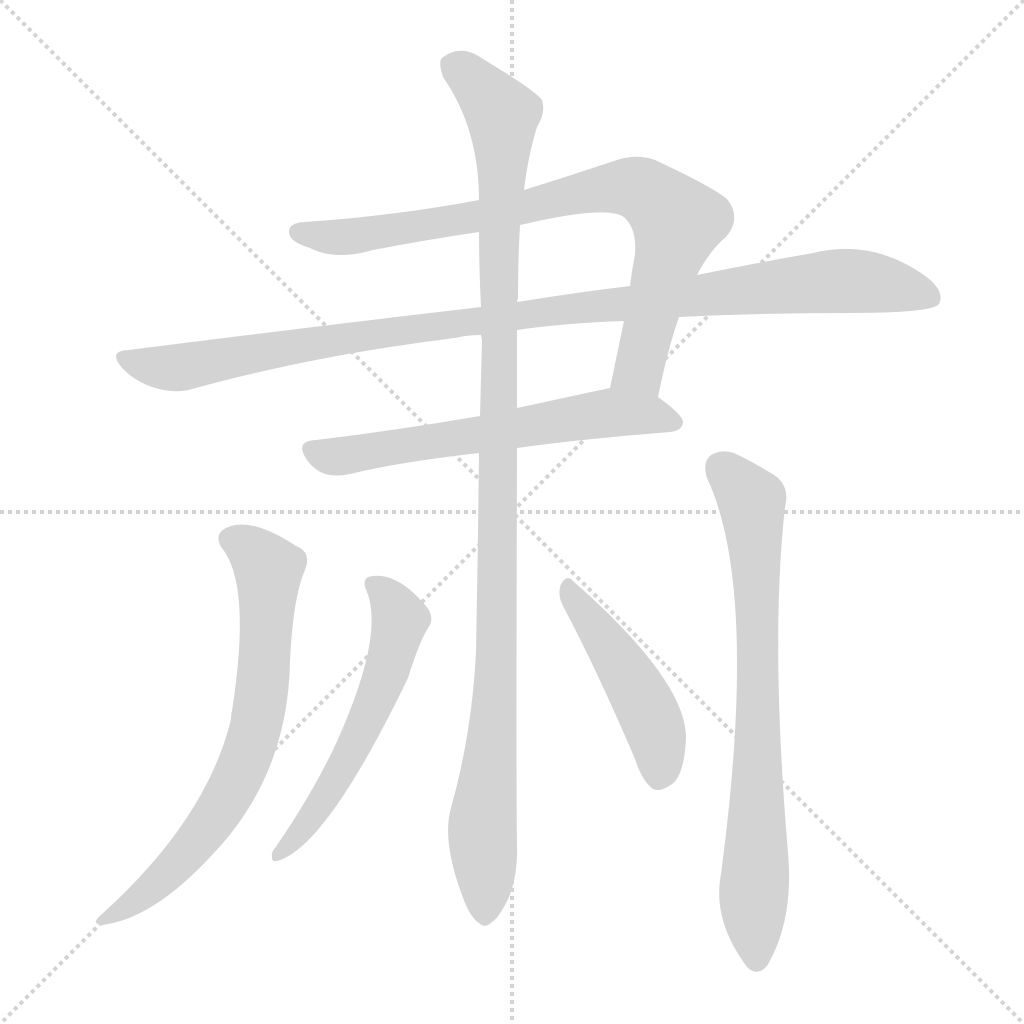
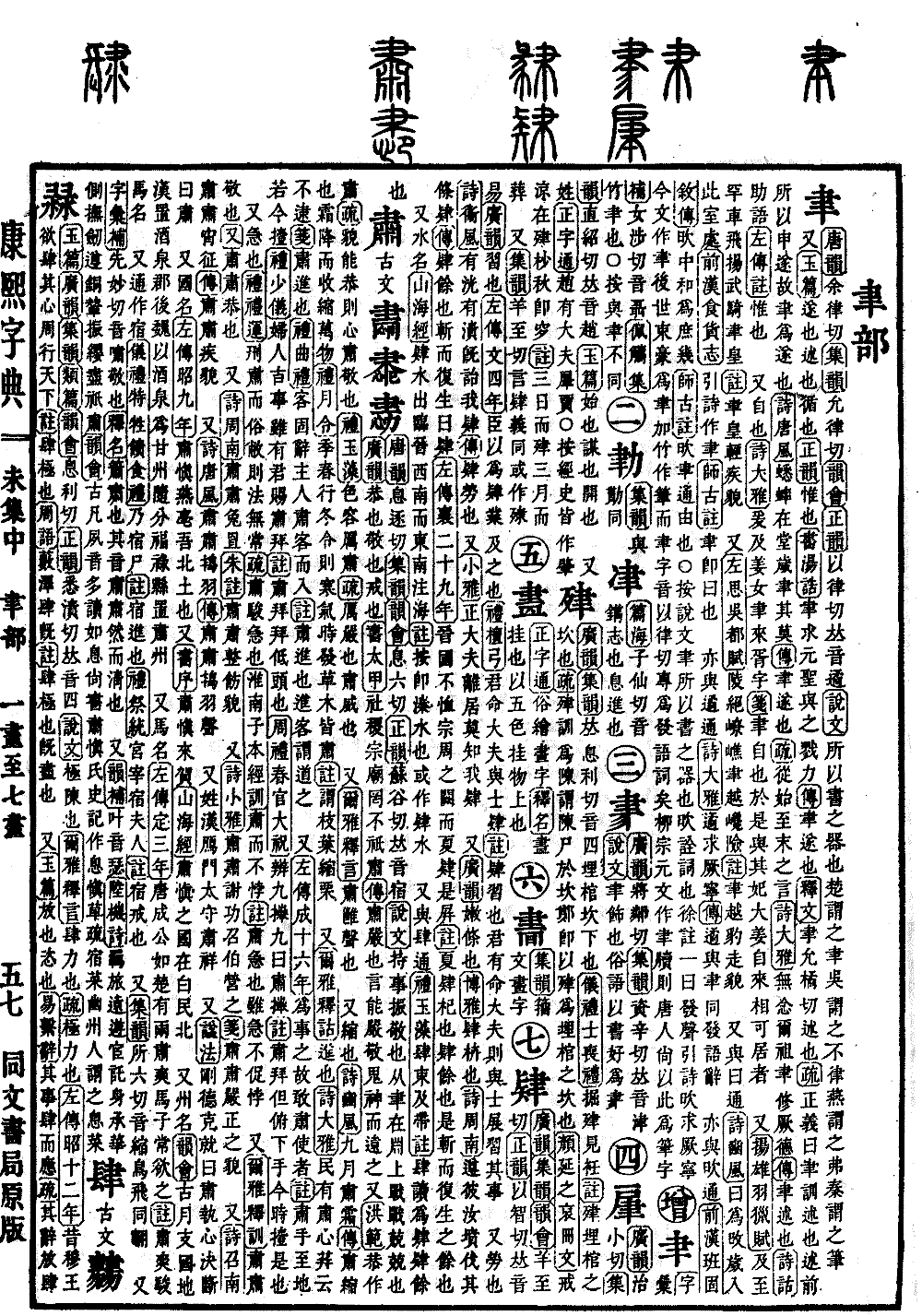
Wei Collection, Lower Volume
Radical: Brush (yù)
Kangxi Strokes: 13
Page 971, Entry 07
Pronounced su. Pronounced su. Pronounced su. Pronounced su.
Explained in Explaining and Analyzing Characters (Shuowen Jiezi) as: to be stimulated and respectful while managing affairs. The character form is composed of brush above, representing a trembling and cautious appearance.
Defined in Extended Rhymes (Guangyun) as: respectful, awe-struck, and cautious.
Book of Documents (Shangshu), Chapter Taijia: When it comes to the altars of the soil and grain and the ancestral temples, there is nothing that is not handled with respectful caution. Commentary: Su means solemn. It refers to the ability to solemnly and respectfully serve spirits while keeping a proper distance from them.
Also Book of Documents (Shangshu), Chapter Hongfan: Respect leads to solemnity. Commentary: If one's demeanor is respectful, one's inner heart will naturally be filled with solemn reverence.
Also Book of Rites (Liji), Chapter Yuzao: One's color and appearance should be stern and solemn. Commentary: Li means stern; su means majestic.
Also Erya, Chapter Explaining Words: Su yong describes the nature of a sound. It also carries the meaning of shrinking or contracting.
Book of Odes (Shijing), Chapter Binfeng: In the ninth month, the frost becomes biting. Commentary: Su means contracting; the falling frost causes all things to contract and wither.
Book of Rites (Liji), Chapter Yueling: If the winter government is implemented during the last month of spring, then cold air will frequently arise, and the branches and leaves of plants will shrink. Commentary: It refers to the leaves and branches curling and shrinking.
Also Erya, Chapter Explaining Words: Means to offer or to introduce.
Book of Odes (Shijing), Chapter Daya: The people have a respectful heart, but their prayers do not reach. Commentary: Su means to strive for or to advance.
Book of Rites (Liji), Chapter Quli: The guest firmly declined, so the host respectfully guided the guest inside. Commentary: Su means to lead. It means to guide the guest in.
Also Zuo Commentary (Zuozhuan), Year 16 of Duke Cheng: Because of the official business, I dare to respectfully greet the envoy. Commentary: Su means to bow with the hands to the ground, similar to the modern obeisance.
Book of Rites (Liji), Chapter Shaoyi: In auspicious matters for women, even if there is a gift from the lord, she performs the respectful bow. Commentary: This respectful bow means to lower the head and bow.
Rites of Zhou (Zhouli), Chapter Spring Officials: Distinguishing the nine types of bows, the ninth is the respectful bow. Commentary: The respectful bow involves only lowering the hands while standing (without kneeling), which is the same as the modern obeisance.
It also means rapid.
Book of Rites (Liji), Chapter Liyun: If one is too rapid and customs decay, then laws lose their stability. Commentary: Su means to be steep and hurried.
Huainanzi, Chapter Essentials of the Classics: Rapid yet not confused. Commentary: Su means hurried. Even though hurried, one is not confused or disorderly.
Also Erya, Chapter Explaining Teachings: Su su is the appearance of being respectful. Also: Su su is the appearance of being cautious.
Also Book of Odes (Shijing), Chapter Zhounan: The respectful and cautious rabbit net. Commentary: Su su means orderly and strictly arranged.
Also Book of Odes (Shijing), Chapter Xiaoya: The strictly executed work, managed by the Duke of Shao. Commentary: Su su means sternly righteous.
Also Book of Odes (Shijing), Chapter Zhaonan: Rapidly traveling in the night. Commentary: Su su means swift and rapid.
Also Book of Odes (Shijing), Chapter Tangfeng: The sound of the bustard's wings flapping. Commentary: Su su refers to the sound of the flapping wings.
It is also a surname. For example, the Han dynasty administrator of Yanmen, Su Xiang.
Also in the Canon of Posthumous Titles: A firm and strong character that can accomplish tasks is called su; a decisive and resolute inner nature is called su.
It is also a country name. Zuo Commentary (Zuozhuan), Year 9 of Duke Zhao: The Sushen and the Yanbo were territories in our north. Also Book of Documents Preface (Shangshu Xu): The Sushen came to offer congratulations. Classic of Mountains and Seas (Shanhaijing): The country of the Sushen is located north of the White People.
It is also a prefecture name. Collected Rhymes (Yunhui): It was the site of the ancient Yuezhi country. The Han dynasty established Jiuquan Prefecture. During the Northern Wei, Jiuquan was changed to Ganzhou. During the Sui dynasty, Su Prefecture was established by dividing off Fulu County.
It is also a horse name. Zuo Commentary (Zuozhuan), Year 3 of Duke Ding: Duke Cheng of Tang went to Chu, possessing two Su-shuang horses, which Zichang desired. Commentary: Su-shuang is the name of a fine horse.
It is also used as a loan character for su. Ceremonial Rites (Yili), Chapter Guest Offering Rites: Then present the guest-offering. Commentary: Su means to offer.
Book of Rites (Liji), Chapter Jitong: The palace steward notifies the wife. Commentary: Su means to warn or inform.
Also in Collected Rhymes, pronounced su, meaning the flight of a bird. Same as the character for soaring.
Also in Dictionary Supplement (Zihuibu), pronounced xiao. It means respectful.
Shiming: The xiao flute derives its name from su, because its sound is solemn and clear.
Also in Rhyme Supplements (Yunbu), rhymed with the sound of se. A poem by Lu Ji: A traveler far from home for official duty, entrusting my body beside the brilliant court. Stroking my sword while following the bronze carriage, shaking my tassels in total respectful caution.
Collected Rhymes: In ancient times, wherever the sound su appeared, it was mostly read as xi. In the Book of Documents, the Sushen tribe is written as Xishen in the Records of the Grand Historian (Shiji). The vegetable known as su-cai is called xi-cai by people in Youzhou.