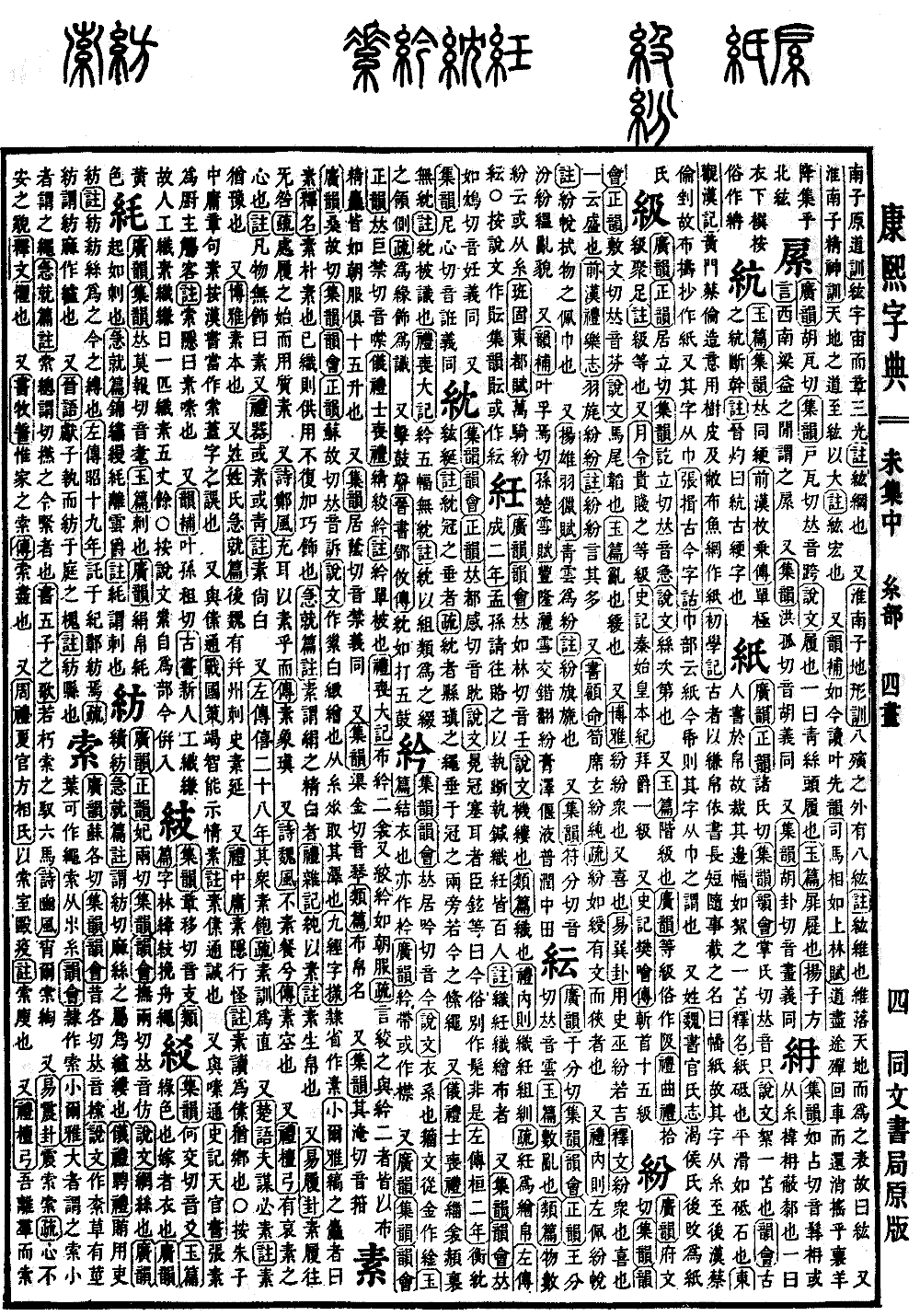
Wei Collection, Middle Volume
Radical: Silk (mì)
Kangxi Strokes: 10
Page 918, Entry 11
Pronounced su.
According to the Etymological Dictionary (Shuowen), it is written as the character variant, referring to white, fine-textured silk. It is composed of the Silk radical, indicating its smooth quality. In the Nine Classics Character Dictionary (Jiujing Ziyi), the abbreviated clerical script form is written as su. In the Small Er-ya (Xiao Er-ya), coarse unbleached silk is called su. According to the Definitions of Names (Shiming), su means simple or unadorned; when woven, it is ready for use without further ornamentation. According to the Commentary on the Quick Reference Chapter (Jijiu Pian Zhu), su refers to the refined white quality of woven silk.
In the Book of Rites (Liji), Miscellaneous Records (Zaji), it states: pure with su. The commentary explains: su is raw silk fabric.
Also, in the Book of Changes (Yijing), Treading Hexagram (Lü Gua): treading the path with su (simplicity) leads to no blame. The commentary notes: this refers to acting with an honest and simple disposition at the beginning of one's endeavors.
Also, in the Book of Odes (Shijing), Odes of Qi (Qi Feng): ear ornaments made of su. The commentary explains: su is an ivory ear ornament.
Also, in the Book of Odes (Shijing), Odes of Wei (Wei Feng): not eating in vain (su). The commentary explains: su means empty or without merit.
Also, in the Book of Rites (Liji), Tan Gong: having a heart of mourning and austerity (su). The commentary explains: all things without ornament are called su.
Also, in the Book of Rites, Record of Ritual Vessels (Liqi): either su or green. The commentary explains: su means honoring white.
Also, in the Zuo Commentary to the Spring and Autumn Annals (Zuo Zhuan), 28th Year of Duke Xi: the masses were fed in advance (su). The commentary explains: su is defined as straightforward.
Also, in the Discourses of Chu (Chu Yu): one’s schemes must be considered in advance (su). The commentary notes: su means hesitation or deliberation.
Also, in the Guangya: su means origin or fundamental.
Also, a surname. According to the Surname Quick Reference (Xingshi Jijiu Pian), there was a Bing Province inspector named Su Yan during the Later Wei dynasty.
Also, in the Book of Rites (Liji), Doctrine of the Mean (Zhongyong): to live in obscurity (su) and act in strange ways. The commentary notes: su is read as su (to move towards), meaning to incline toward. According to the Zhu Xi's Commentary on the Doctrine of the Mean, the character su in the Han History (Hanshu) should be written as suo, suggesting the character is a mistake.
Also, interchangeable with su (to move towards). In the Strategies of the Warring States (Zhan Guo Ce): exhausting intelligence and wisdom to show one's true feelings (su). The commentary notes: su and su are interchangeable, meaning sincerity.
Also, interchangeable with su (crop of a bird). In the Records of the Grand Historian (Shiji), Treatise on the Celestial Offices (Tianguan Shu): Zhang su (the bird's crop) acts as the host for the banquet guests. The commentary notes: the Search for Mysteries (Suoyin) says that su is the same as the crop of a bird.
Also, in the Rhyme Supplement (Yunbu), it rhymes with the pronunciation zu. In the Ancient Poems (Gushi): The new wife weaves fine silk (jian), the old wife weaves su. Weaving fine silk one bolt a day, weaving su more than five zhang. Note that in the Etymological Dictionary (Shuowen), this was originally its own radical, but it is now merged into this section. This character is identical to the other variant.