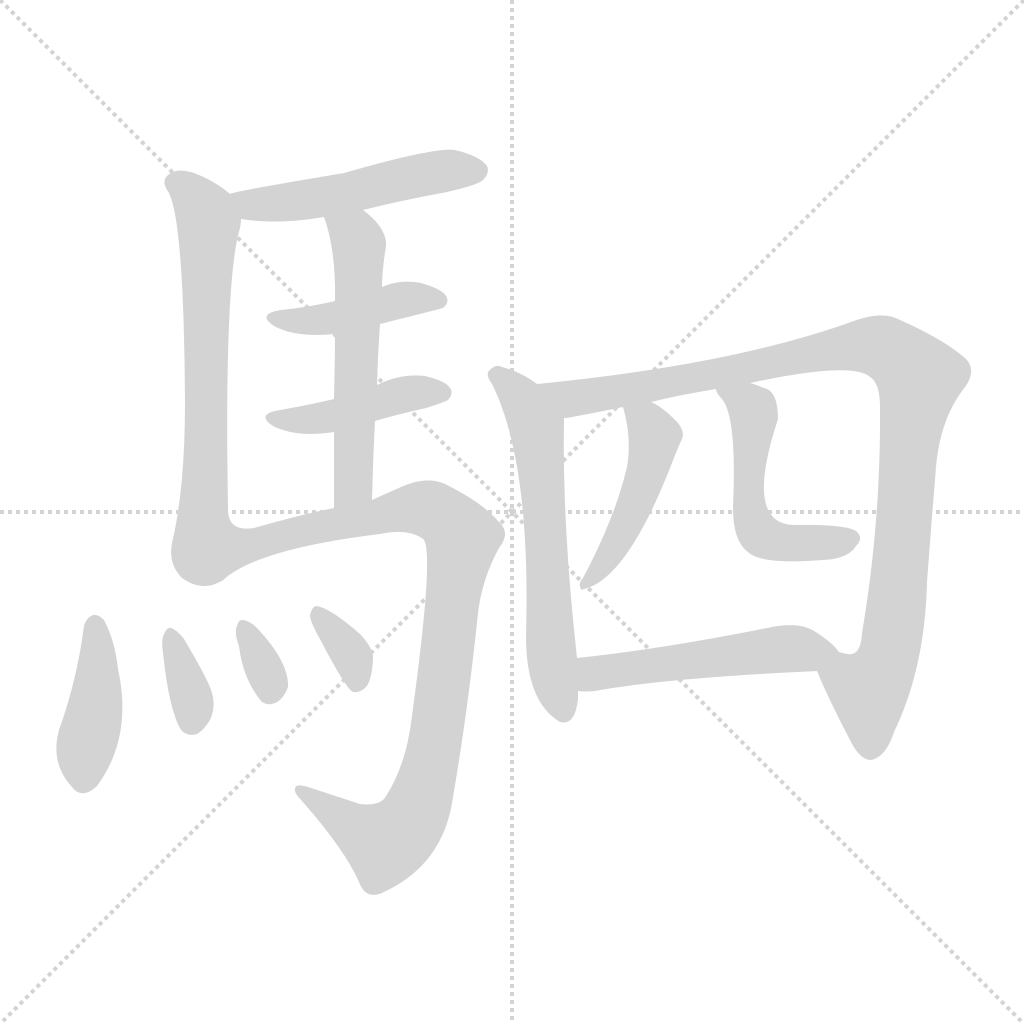
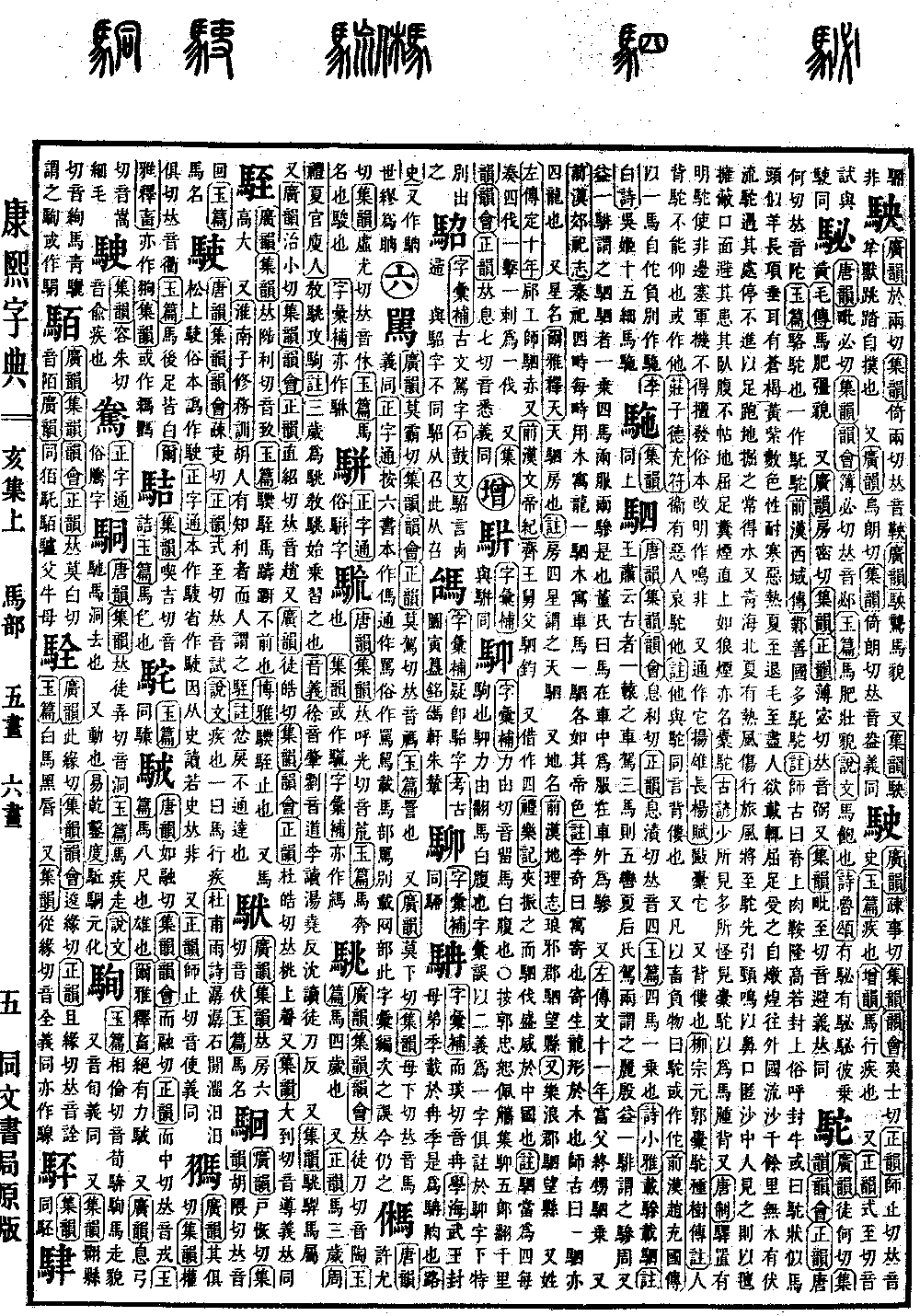
Hai Collection, Upper Volume
Radical: Horse (mǎ)
Kangxi brush strokes: 15
Page 1437, Entry 06
Pronounced si (falling tone).
Yu Pian (Jade Chapters) defines this as: Four horses pulling a single carriage.
Book of Odes (Shijing), in the commentary for the section Yongfeng, Wang Su states: Ancient single-shaft carriages were drawn by three horses and had five reins; the Xia dynasty used two horses, called li; the Shang dynasty added one outer horse, called can; the Zhou dynasty added another outer horse, called si. The so-called si means one carriage drawn by four horses, with the two horses in the middle called fu, and the two on the sides called can. Dong states: The horses in the middle of the carriage shaft are called fu, and those on the sides of the shaft are called can.
Also appears in Zuo Zhuan (Tradition of Zuo), Duke Wen, 11th year, which records "Fufu Zhongsheng si cheng."
Also appears in Book of Han (Hanshu), Treatise on Suburban Sacrifices, which records: In the Qin dynasty, sacrifices were made to the four shrines (zhi), each using four wooden dragons and one set of wooden carriage horses (four in total), with colors corresponding to the colors of the respective supreme deities. Commentary: Li Qi states: "Yu" means to entrust, implying that the form of the dragon is entrusted to the wood. Shi Gu states: One si also refers to four dragons.
Also a name for a constellation. Erya (Approaching Elegance), Interpretation of Heaven, states: "Tian Si" (Celestial Four) refers to the Fang constellation. Commentary: The Fang constellation has four stars, hence it is called Tian Si.
Also a place name. Book of Han (Hanshu), Treatise on Geography, records: Langya Commandery had a Siwang County. Also recorded: Lelang Commandery also had a Siwang County.
Also a surname. Zuo Zhuan (Tradition of Zuo), Duke Ding, 10th year, records a craftsman from the Hou territory named Si Chi.
Also appears in Book of Han (Hanshu), Annals of Emperor Wen, which records: The maternal uncle of the Prince of Qi was named Si Jun.
Also used as a loan character for the number four. Book of Rites (Liji), Record of Music, records: "With the chime and drum together, they strike and stab four times, displaying great majesty in the Central Kingdom." Commentary: Here si should be read as four. Each time a passage is played, four strikes and stabs are performed; one strike and one stab is called one fa.
Also pronounced xi. The meaning is the same.
Textual research: The citation from the commentary on the Small Odes (Xiaoya) section "zai can zai si" by Wang Su is noted. I have verified that the cited opinion of Wang Su appears in the sub-commentary to the commentary on the Yongfeng section, Gan Mao, and is not a commentary on the Small Odes. Based on the original text, the seven characters "Small Odes zai can zai si commentary" have been changed to "Yongfeng Liang Ma Wu Zhi sub-commentary."