Si Collection, Upper Volume
Radical: Water (shuǐ)
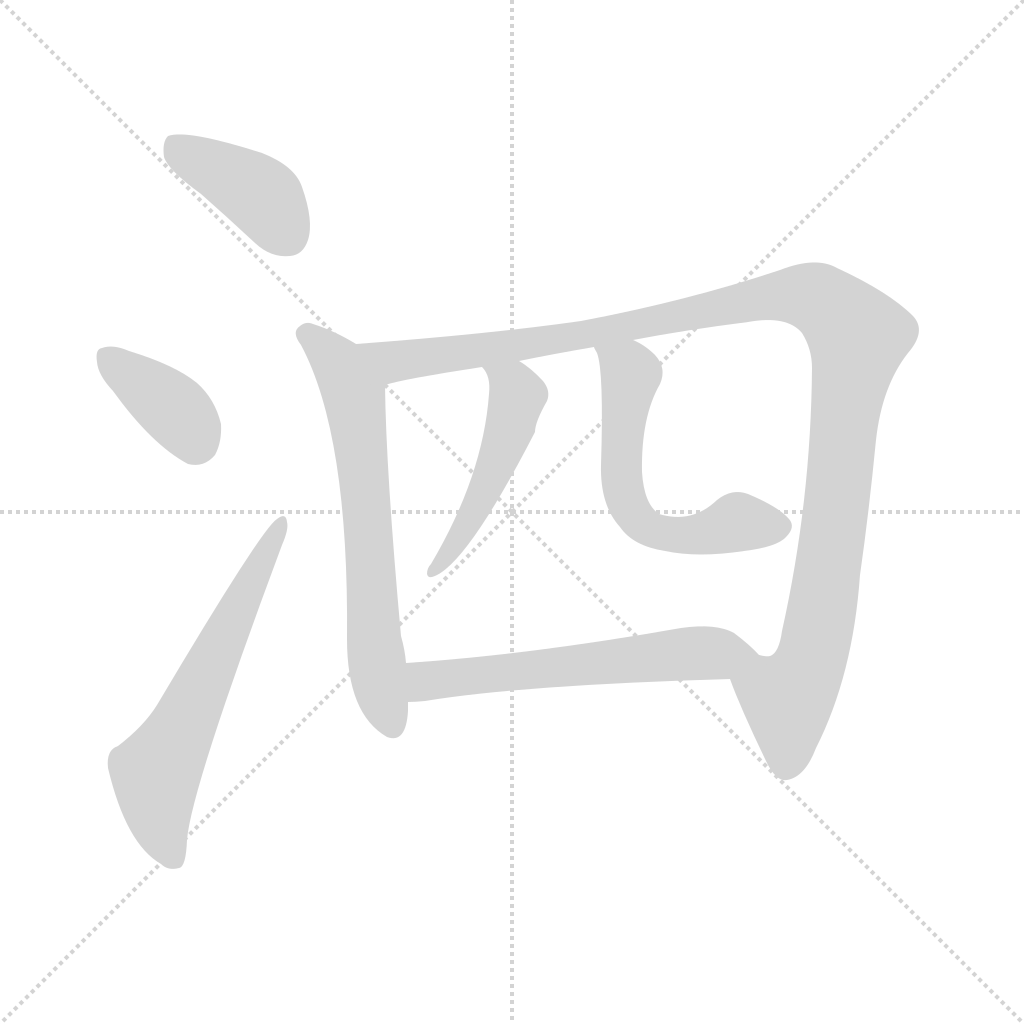
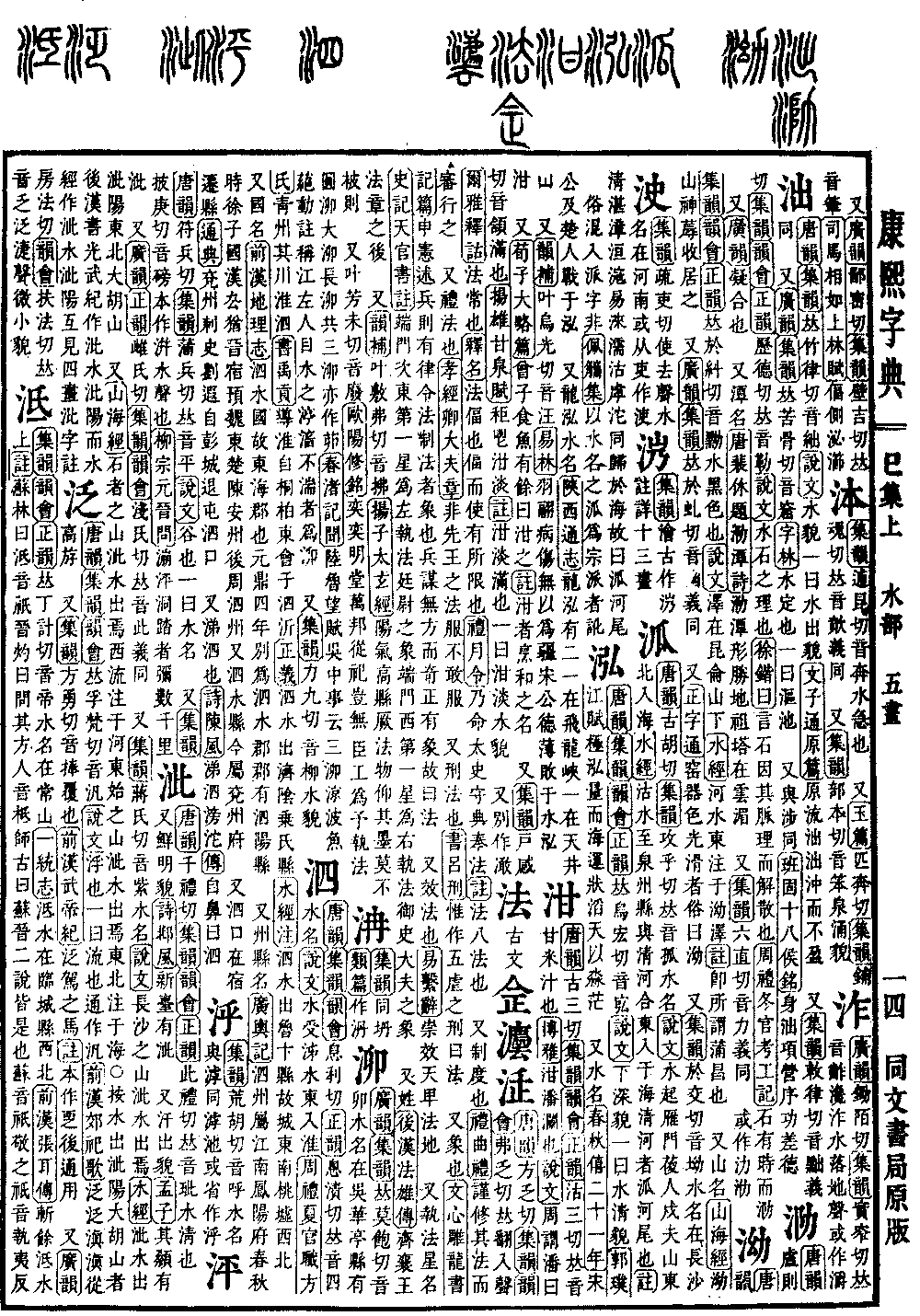
Si
Kangxi stroke count: 9
Page 616, Entry 17
Pronounced si (falling tone)
Name of a river.
According to the Explaining Graphs and Analyzing Characters (Shuowen), it is a water source that receives the Ji River and flows east into the Huai River.
In the Rites of Zhou (Zhouli), Summer Offices, Officials of Provinces, it is stated that in Qingzhou, the rivers are the Huai and the Si.
In the Book of Documents (Shujing), Tribute of Yu, it is stated that the Huai River is led from Mount Tongbai and flows east to meet the Si and Yi rivers.
In the Correct Meaning (Zhengyi), it is stated that the Si River emerges from Chengshi County in Jiyin.
In the Commentary on the Classic of Water (Shuijingzhu), it is stated that the Si River emerges from the southeast of the ancient city of Bian County in Lu, and from the northwest of Taoxu.
Also the name of a state.
In the History of the Former Han (Qianhan), Treatise on Geography, it is noted that the State of Sishui was part of the former Donghai Commandery. In the fourth year of the Yuanding era, it was separated to become Sishui Commandery, which contained Siyang County.
Also the name of a prefecture and a county.
In the Extensive Records of the Universe (Guangyuji), it is noted that Si Prefecture belonged to Fengyang Prefecture in Jiangnan. During the Spring and Autumn period, it was the State of Xu; during the Han dynasty, it was Qiuyou; during the Jin dynasty, it was Suyu; during the Wei dynasty, it was Dongchu; during the Chen dynasty, it was An Prefecture; and during the Northern Zhou dynasty, it was Si Prefecture. There is also Sishui County, which currently belongs to Yanzhou Prefecture.
Also Sikou, located in Suqian County.
In the Comprehensive Statutes (Tongdian), it is noted that Liu Xia, the Inspector of Yanzhou, retreated from Pengcheng to station his troops at Sikou.
Also refers to nasal mucus and tears.
In the Book of Odes (Shijing), Odes of Chen, it is written: Tears and nasal mucus flowed down in torrents.
The Commentary (Zhuan) states: That which comes from the nose is called si.