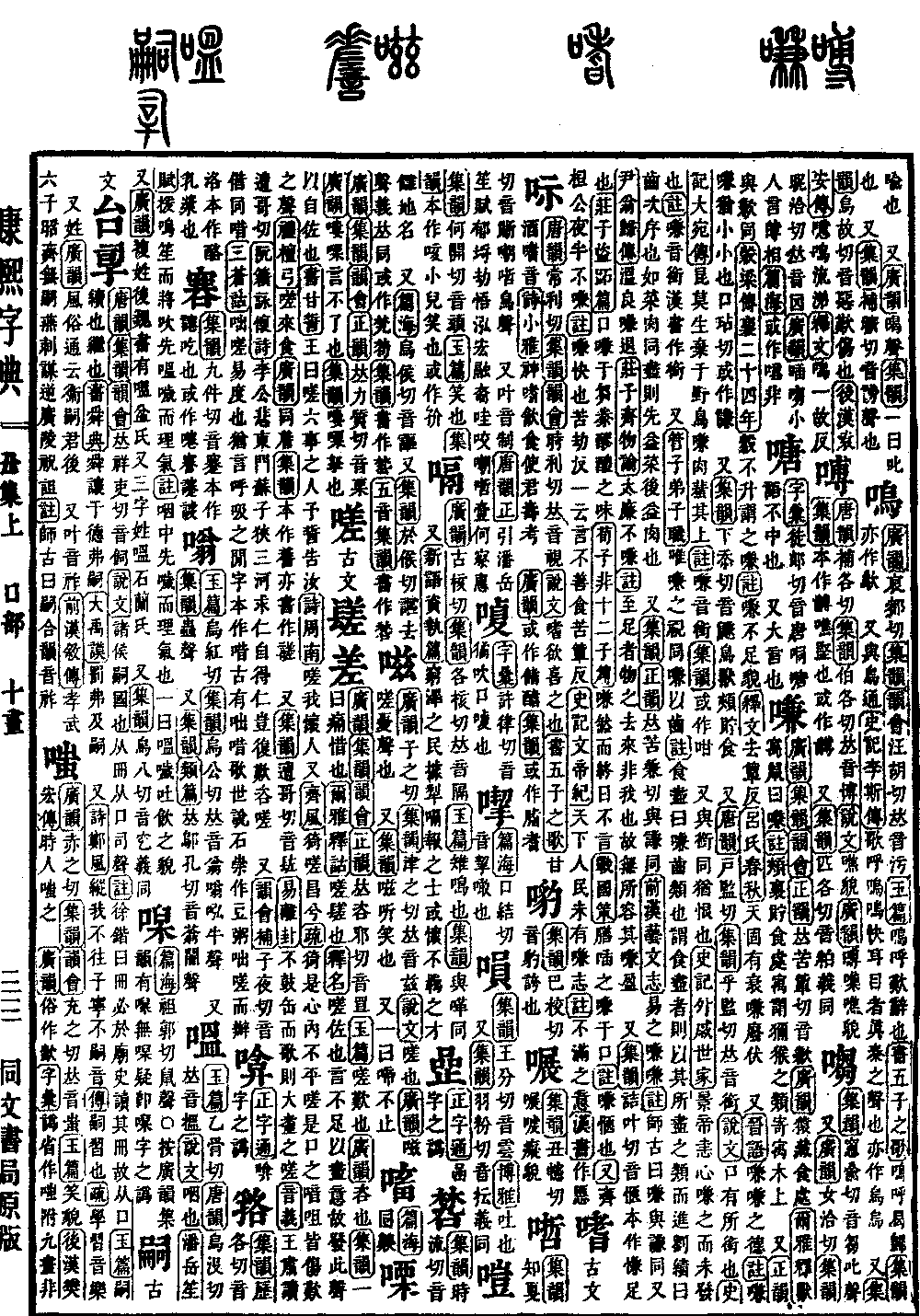
Chou Collection, Upper Volume
Radical: Mouth (kǒu)
Si
Kangxi stroke count: 13
Page 203, Entry 30
Ancient form: Tai (tái), Si (sì)
Pronounced si (falling tone).
Shuowen Jiezi explains this as feudal lords inheriting their fiefs. The character structure is composed of "register" and "mouth," with "si" providing the phonetic.
Note: Xu Kai says that because investitures must be read aloud by the court historian at the ancestral temple, the character includes the component for "mouth."
Yupian states: Si means to continue or to inherit.
Book of Documents (Shangshu), Canon of Shun: Shun was humble and deferred to a virtuous person, unwilling to inherit the throne.
Book of Documents (Shangshu), Counsels of the Great Yu: Punishments should not implicate descendants.
Also, Book of Odes (Shijing), Odes of Zheng: Even if I do not go to you, would you not continue to send me news?
Commentary: Si means to review or to continue.
Sub-commentary: Refers to the study of music.
Also used as a surname.
Guangyun: According to the Customs and Traditions (Fengsu Tong), it is the lineage of the ruler Si of the state of Wei.
Also occurs with the rhyming sound zuo.
Book of Han (Qian Hanshu), Biographical Sketches: Emperor Wu had six sons; Emperor Zhao and the Prince of Qi had no heirs, the Prince of Yan plotted rebellion, and the Prince of Guangling cursed the imperial court.
Note: Shigu says that here, si rhymes and is pronounced as zuo.