Xu Collection, Middle Volume
Radical: Mound (fù)
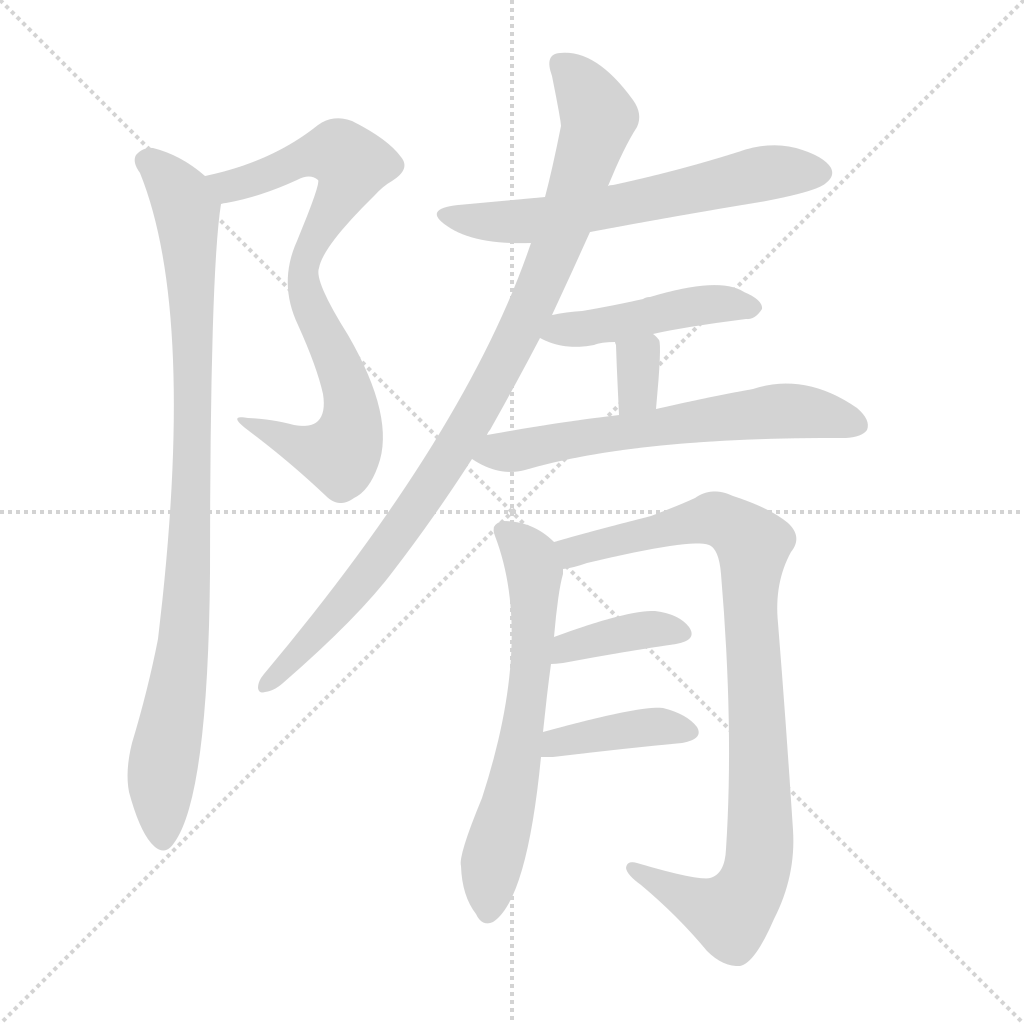
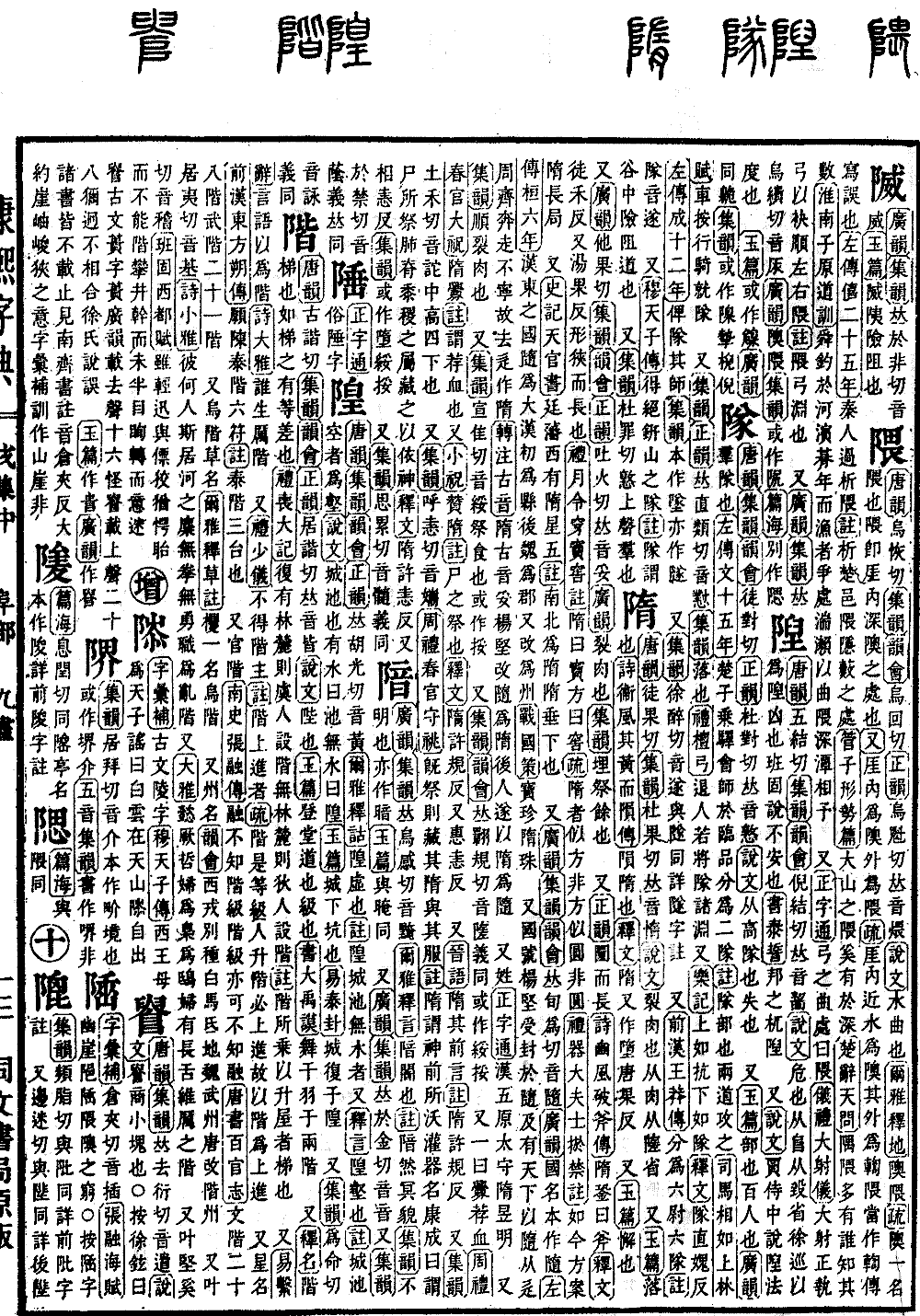
The character suí Kangxi Strokes: 17 Page: 1357, Entry 05
From Tangyun (Tángyùn) and Jiyun (Jíyùn), pronounced similarly to duò. Shuowen Jiezi (Shuōwén Jiězì) defines it as torn flesh. The character is formed from the radical "meat" (ròu) and an abbreviated form of the character "隓" (huī).
Also, Yupian (Yùpiān) defines it as to fall. In the commentary to "Its Yellow and Falling" from the Book of Odes (Shijing), "yǔn" means suí. The Shijing commentary notes that suí is also written as "墮" (duò), with an ancient phonetic annotation corresponding to táng guǒ.
Also, Yupian defines it as lax or negligent.
Also, from Guangyun (Guǎngyùn), Jiyun, Yunhui (Yùnhuì), and Zhengyun (Zhèngyùn), pronounced similarly to tuǒ. Guangyun defines it as torn flesh. Jiyun defines it as burying leftover sacrificial offerings.
Also, Zhengyun defines it as round and long. The commentary to "Broken Axe" from the Book of Odes states that an axe head with an oval hole is called "fǔ". The Shijing commentary provides ancient phonetic annotations corresponding to tú hé and tāng guǒ. It describes a long and narrow shape. The commentary to "Digging Ditches and Cellars" in the Book of Rites (Liji) notes that an oval shape is called "dòu", and a square shape is called "jiào". The sub-commentary states that suí is neither quite square nor quite round. The commentary to "Regulations for Officials and Scholars" in the Book of Rites notes it resembles modern rectangular tables.
Also, in the "Book of Celestial Officials" from the Records of the Grand Historian (Shiji), it mentions five suí stars on the western side of the court's protective screen. The commentary notes that suí refers to a north-south alignment. Suí means hanging down.
Also, from Guangyun, Jiyun, and Yunhui, pronounced similarly to suí. Guangyun defines it as a state name, originally written as "隨" (suí). In "Duke Huan, Year 6" of the Zuo Commentary (Zuo Zhuan), it is stated that among the states east of the Han River (Hànshuǐ), the state of Suí was the largest. In the early Han dynasty, it was established as a county, later a commandery during the Later Wei dynasty, and then a prefecture. The "Strategies of the Warring States" (Zhan Guo Ce) mentions the precious pearl of Marquis Suí.
It also refers to a dynastic title. Yang Jian (Yáng Jiān) was enfeoffed in the territory of Suí. After gaining control of the empire, because the character "隨" (suí) contains the "walk" (chuò) radical, symbolizing restless movement in places like Zhou (Zhōu) and Qi (Qí), he removed the radical and changed it to "隋". Zhuan Zhu Gu Yin (Zhuǎnzhu Gǔyīn) notes that anciently, "隋" was pronounced tuǒ. Yang Jian changed "隨" to "隋", and later generations thus used "隋" for "隨".
Also, it is a surname. Zhengzitong (Zhèngzìtōng) cites Sui Yuming (Suí Yùmíng), the Grand Administrator of Wuyuan (Wǔyuán) in the Han dynasty, as an example.
Also, Jiyun defines it as following the grain of torn flesh.
Also, from Jiyun, pronounced similarly to suí (referring to the character "綏" (suí)). It refers to sacrificial food. Sometimes written as "挼" (ruó).
Also, from Jiyun and Yunhui, pronounced similarly to huī. The meaning is the same as the character "隓" (huī). Sometimes written as "綏" (suí) or "挼" (ruó). Another explanation is to anoint newly made artifacts with blood. In "Spring Officials, Grand Supplicator" from the Rites of Zhou (Zhouli), it mentions "suí xìn". The commentary notes this refers to offering sacrificial blood. The "Minor Supplicator" mentions "zàn suí". The commentary notes this refers to offerings for the 'shi' (shī), personator of the deceased. The Zhouli commentary provides ancient phonetic annotations corresponding to xǔ guī and huì huì.
Also, in the "Discourses of Jin" (Jinyu), "suí qí qiányán". The commentary notes "suí" is pronounced with an ancient phonetic annotation corresponding to xǔ guī.
Also, from Jiyun, pronounced similarly to tuó (referring to the character "詑" (tuó)). Refers to a shape that is high in the middle and low on four sides.
Also, from Jiyun, pronounced similarly to huì (referring to the character "孈" (huì)). In "Spring Officials, Guardian of the Ancestral Temple" from the Rites of Zhou, after the sacrifices, "suí" and ritual garments are collected. The commentary notes that "suí" refers to a vessel used for libations before the spirit. Zheng Xuan (Zhèng Xuán) says it refers to the lungs, spine, millet (shǔ), and other grains (jì) offered to the 'shi' (shī), personator of the deceased, which are collected to invoke divine presence. The Zhouli commentary provides ancient phonetic annotations corresponding to xǔ huì and xiāng huì. Jiyun notes it is sometimes written as "墮" (duò), "綏" (suí), or "挼" (ruó).
Also, from Jiyun, pronounced similarly to suǐ (referring to the character "髓" (suǐ)). The meaning is the same.