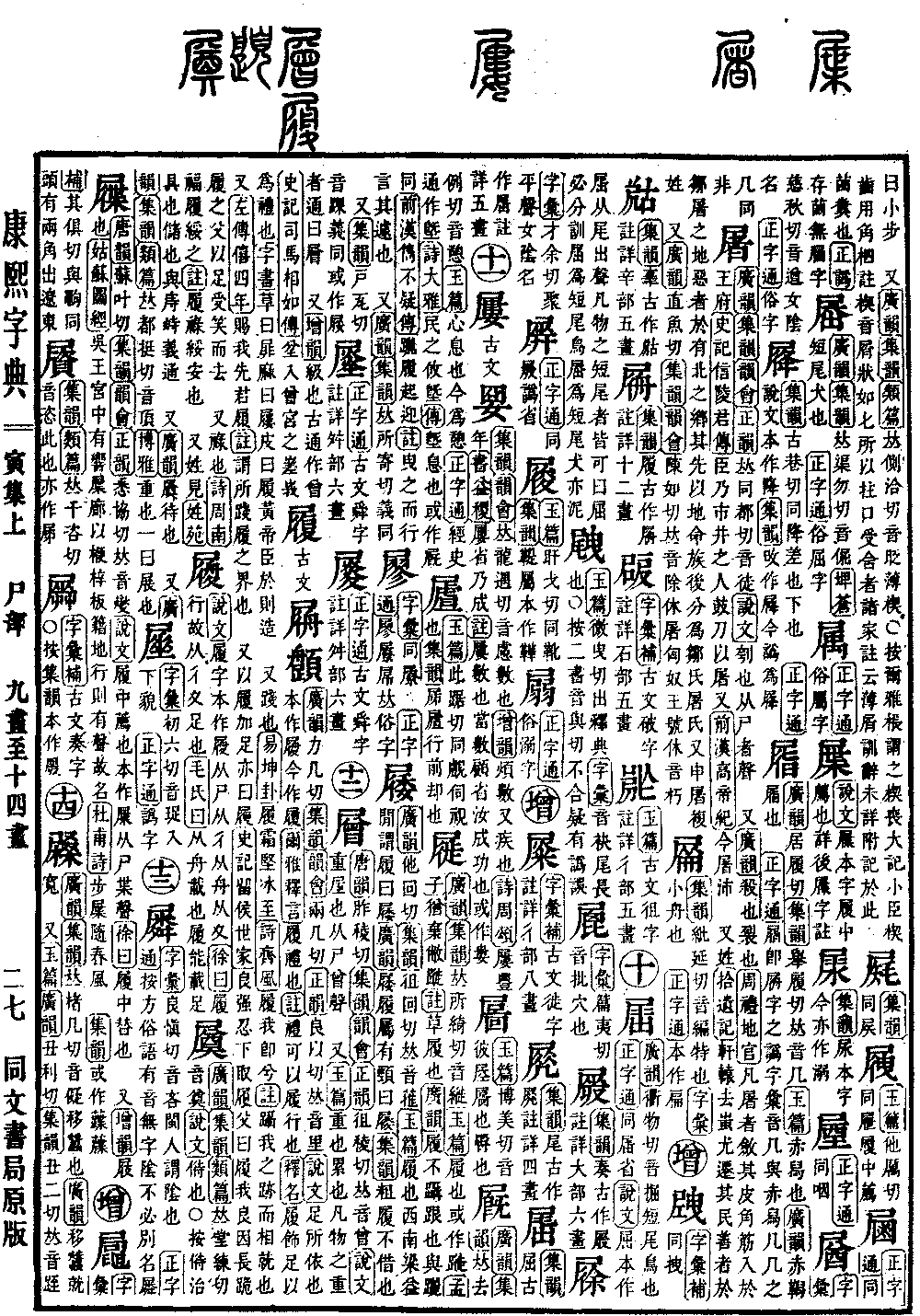
Yin Collection, Upper Volume
Radical: Corpse (shī)
Page 303, Entry 05
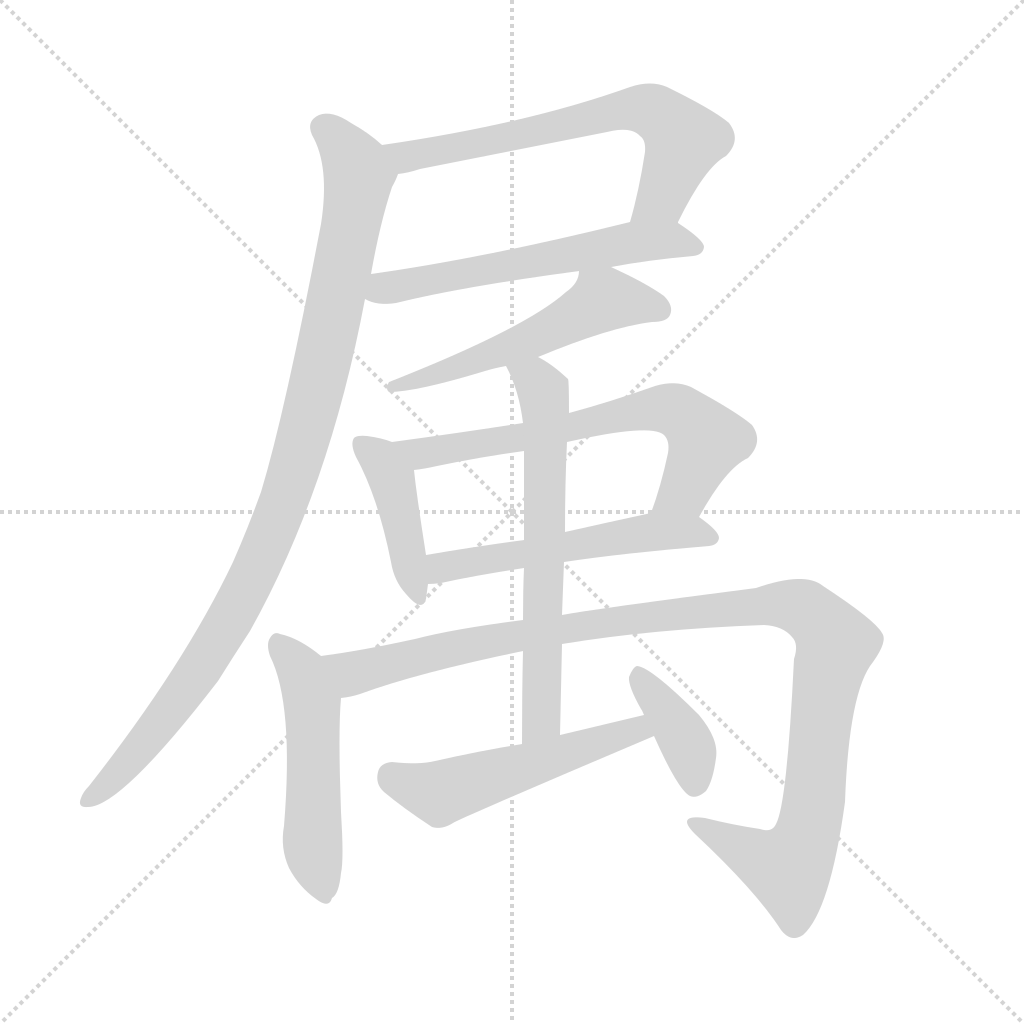
Zhengzitong (Correct Meaning Through Investigation) states that this is a vulgar form of the character for belonging or attached.
According to Guangyun (Broad Rhymes) and Jiyun (Collected Rhymes), the pronunciation is zhu. According to Yunhui (Collection of Rhymes), the pronunciation is zhu. The pronunciation is the same as that for the word for candle.
Shuowen Jiezi (Explaining Simple and Analyzing Compound Characters) defines it as connecting. The character is composed of the radical for tail and the phonetic element for shu. Xu states: The character signifies continuous connection, just as a tail is attached to a body, hence it is derived from the radical for tail.
Guangyun defines it as to gather or to assemble. The Book of Rites (Zhouli), Section on District Chiefs (Zhouzhang), records: In the first month of the year, on a lucky day, he gathers the people of his district and reads the laws. The commentary explains that this means to gather together.
The Book of Mencius (Mengzi) records: Then he gathered his elders and informed them.
It also means to entrust. The Zuo Commentary (Zuozhuan), Third Year of Duke Yin, records: When Duke Mu of Song was ill, he summoned the Great Minister Kongfu and entrusted his son, Duke Shang, to him. The Records of the Grand Historian (Shiji), Biography of the Marquis of Liu, records: Among the generals of the King of Han, only Han Xin is capable of being entrusted with important matters and assuming command over a region.
It also means respectful. The Book of Rites (Liji), Section on Rites and Ceremonies (Liqi), records: Respected and respectful is his loyalty. The commentary notes that this describes a respectful appearance.
It also means to follow in succession. The Records of the Grand Historian (Shiji), Biography of Lord Xinling, records: The envoys of Lord Pingyuan had their caps and carriages following one after another toward Wei.
The Discourses of the States (Guoyu), Discourses of Jin, records: Must harbor deep resentment. The commentary explains that it means to harbor or form resentment.
It also means to be satisfied. The Zuo Commentary (Zuozhuan), Twenty-eighth Year of Duke Zhao, records: Wishing to measure the mind of a superior man with the heart of a base person, one is merely satisfied. The commentary notes that this means to be satisfied, implying that base people know when they have had enough, and superior men should do the same.
The Zuo Commentary (Zuozhuan), Twenty-third Year of Duke Xi, records: Holding the whip and bow-case in his left hand, and having the quiver and case attached on the right, he attended to the ruler. The commentary notes that this means to wear or be attached.
The Book of Rites (Zhouli), Record of Trades (Kaogongji), records: When examining the way of carriages, one desires them to be simple and firmly attached. The commentary notes that this indicates a solid attachment.
It also means to show concern. The Book of History (Shangshu), Section on Zicai, records: Concerning the respect for the widowed and the concern for the wives. The commentary explains that this means to visit and show concern. The term wives refers to concubines.
It also refers to the layers of scales in armor. The History of the Former Han (Qianhanshu), Treatise on Penal Law, records: The brave warriors of the Wei state wore armor of three layers. Ruzhun comments: The upper body is one layer, the thighs and pants form one layer, and the lower legs form one layer, totaling three layers that are all connected.
According to Guangyun, Jiyun, and Yunhui, the pronunciation is shu. According to Zhengyun (Correct Rhymes), the pronunciation is shu. The pronunciation is the same as that for the word for scorpion.
The Book of Odes (Shijing), Minor Odes (Xiaoya), Section on Constant Plum (Changdi), where Zheng Xuan notes: It refers to the order of Zhaomu, the ancestral placement in a temple.
It also refers to affiliation, control, or subordinate officials. The Book of Rites (Liji), Royal Regulations (Wangzhi), records: Beyond a thousand li, district chiefs are established; five states are grouped as one, and this group has a leader.
The Book of History (Shangshu), Section on Zhouguan, records: Each leads their own subordinates to initiate the nine provinces.
It also refers to the nine clans or relatives. The Records of the Grand Historian (Shiji), Biography of Tian Dan, records: Tian Dan was a distant relative of the Tian family of Qi.
It also refers to the same group or generation. The Records of the Grand Historian (Shiji), Biography of the Marquis of Liu, records: Today, Your Majesty rose from the status of a commoner, and with these people you took the empire, yet those you enfeoffed are all old friends like Xiao He and Cao Can.
It also means to follow. The Records of the Grand Historian (Shiji), Biography of Xiang Yu, records: When Yu crossed the Huai river, only about a hundred of his cavalrymen were able to follow him.
The History of the Former Han (Qianhanshu), Biography of Jia Yi, records: Skilled at writing. Shigut notes that this means to connect words or compose an essay.
The Zuo Commentary (Zuozhuan), Second Year of Duke Cheng, records: Han Jue said: Your humble servant is unfortunate, as my turn happens to be in the line of battle. The commentary explains that this means to happen to be or to coincide with.
The Book of History (Shangshu), Section on Tribute of Yu (Yugong), records: The Jing river flows into the bend of the Wei river. The commentary explains that this means to reach or arrive at. Ma Rong says it means to enter.
According to Wuyin Jiyun (Collected Rhymes of Five Sounds), the pronunciation is zhu. It means to pour in. The Book of Ceremonial (Yili), Section on Marriage Rites, records: Pour three measures of water into the vessel. The commentary notes that this means to pour.
The Discourses of the States (Guoyu), Discourses of Jin, records: If we act first, I fear the people of the state will focus their eyes and ears on me. The commentary explains that this means to focus attention.
The works of Qu Yuan, Li Sao (Encountering Sorrow), records: I have the Wangshu star go as a guide, and Fei Lian follows behind.
It also has the rhyming pronunciation of shu. The Book of Odes (Shijing), Minor Odes (Xiaoya), records: If the superior man has plans, the base man will join in. This rhymes with the word for attach in the previous line.
It also has the rhyming pronunciation of zhu. Ban Gu, Western Capital Rhapsody (Xidu Fu), records: Passing over the ramparts and exceeding the western wall, blending with the Jianzhang palace and connecting to the outer structures. This rhymes with the words for pavilion and the爵擢 phrase.
Zhengzitong states that writing the character as the variant forms for belonging or entrusting is incorrect.